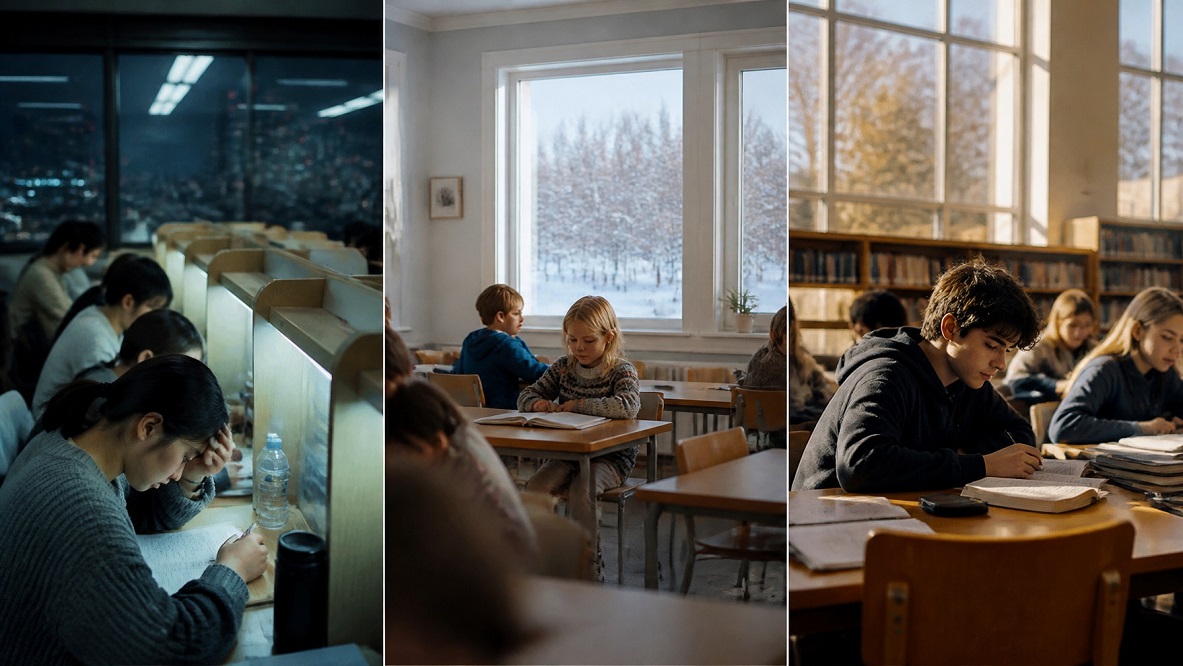
Study culture differs sharply across these three countries. South Korea centers on exam preparation and private academies, Finland on light homework, play, and trust in teachers, and the United States on moderate homework with mixed pressures. Each has strengths and costs, and students everywhere can borrow ideas from all three.
South Korea: A Whole Country Built Around One Exam
In South Korea, the Suneung, or College Scholastic Ability Test, is a national event. A World Economic Forum report describes it being held on the third Thursday of November at 1,190 test sites, with 595,924 applicants in the year covered. Students typically spend 12 years preparing, and fewer than 2 percent of applicants enter the most prestigious universities.
The country nearly stops on exam day. Construction noise halts, planes do not take off, and banks close. Police help students reach their test sites on time, and parents pray at temples and churches while their children sit the exam.
South Korea’s Private Academy Culture
Much study happens outside school in private academies called hagwons. The same report valued the industry at about 17.8 trillion won, roughly 15.8 billion dollars, and said 83.6 percent of five-year-olds attended private academies in 2016. By age 15, students had completed an average of 6.4 years of extra courses.

The pressure carries a cost. The report noted that over 20 percent of 15-year-olds reported being dissatisfied with their lives in 2015, and that the government had begun capping work hours and funding mental health programs. These figures date from the report’s 2018 publication, so check current data for the latest picture.
Finland: Light Homework, Play, and Trust
Finland looks very different. An overview of Finnish schools says homework is small, about 10 to 20 minutes for grades 1 to 4 and roughly 30 to 60 minutes a night in upper secondary. It reinforces class lessons instead of introducing new material, and teachers decide what to assign.
There are no national standardized tests until the end of upper secondary school. Children are encouraged to play outdoors in all seasons and to join music, sports, or arts clubs. Family time and downtime are treated as part of healthy learning. Most teachers also hold master’s degrees in education, which helps explain why schools trust them to make these choices.

The United States: Moderate Homework and Mixed Pressures
The United States sits in the middle on homework. In a WGBH report on homework research, a 2012 national survey found that 79 percent of 9-year-olds and 65 percent of 13-year-olds reported an hour or less the previous day, as did 53 percent of 17-year-olds, while about 13 percent of 17-year-olds reported more than two hours.
The same report cited a 2012 OECD finding that U.S. 15-year-olds averaged about six hours of homework a week, compared with about three in Korea. Comparisons like this are imperfect, and Korean students also spend time in private academies, so homework hours alone do not show how much students study. The picture is a reminder that a number rarely tells the whole story of a study culture.
What Students Can Borrow From Each Culture
- South Korea: a strong commitment to goals and steady, disciplined routines.
- Finland: trust, short homework, and time to play, rest, and follow interests.
- United States: flexibility, with room for sports, clubs, and part-time work.
The healthiest approach likely blends them: work hard with clear goals, protect rest and play, and measure success by understanding more than by exam scores alone.
Common Questions About Study Culture Around the World
What is the Suneung?
The Suneung, or College Scholastic Ability Test, is South Korea’s national college entrance exam. It is held in November, and the whole country adjusts for the day.
What are hagwons?
Hagwons are private academies in South Korea where students take extra classes after school. The industry is large, and many children begin attending at a young age.
Do Finnish students really have little homework?
Finnish students do get homework, but the amount is small and teachers decide what to assign. It generally reinforces what was taught in class.