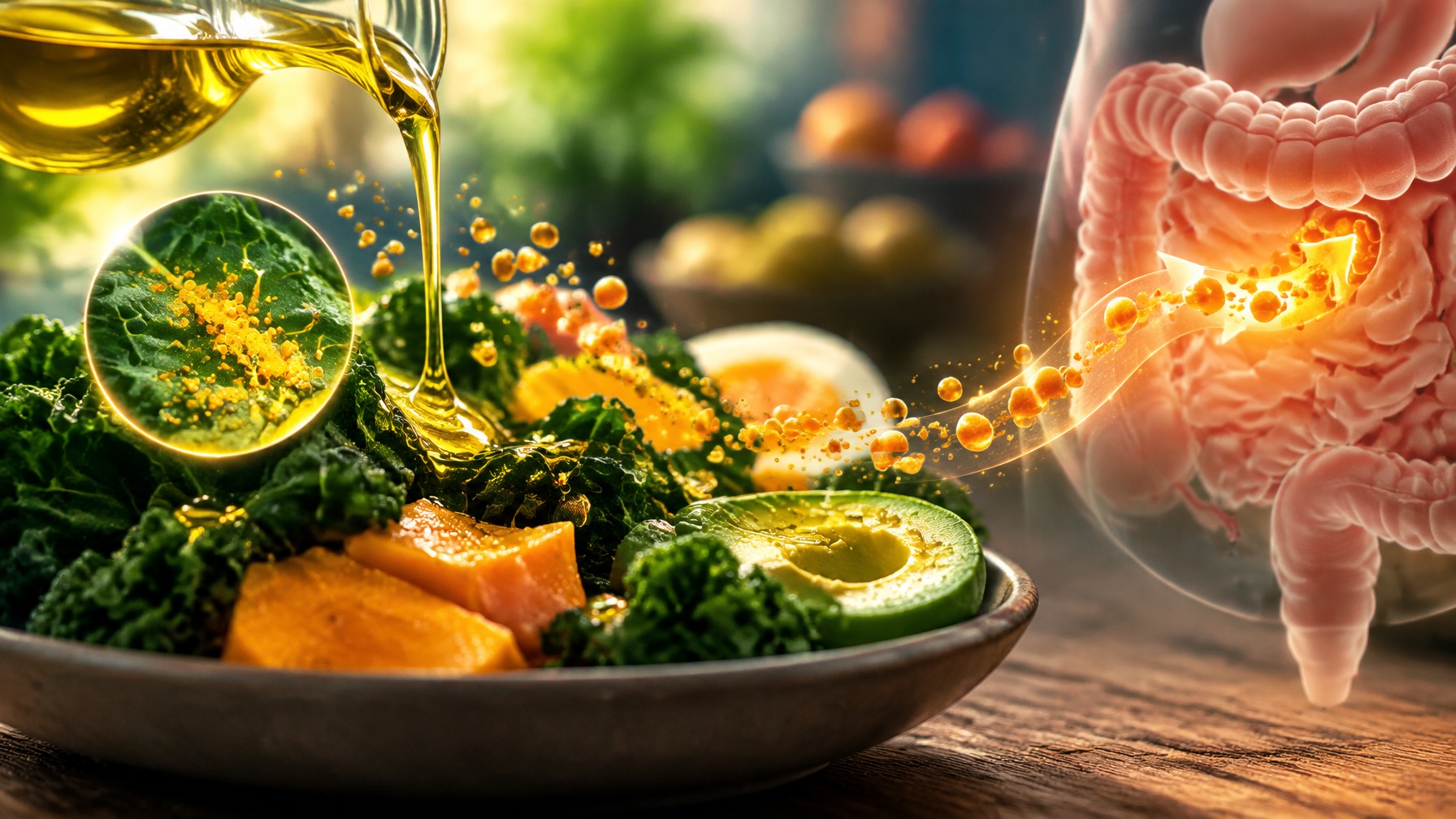
Dietary fat helps you absorb lutein from food because lutein is a fat-soluble carotenoid that dissolves in lipids rather than water. When you eat lutein-rich vegetables like spinach or kale alongside healthy fats such as olive oil, avocado, or eggs, your digestive system packages lutein into tiny transport droplets called micelles that carry it across your intestinal wall into your bloodstream. Without fat present in the meal, most of that valuable eye pigment passes straight through your digestive tract unused.
The Chemistry Behind Fat-Soluble Carotenoids
Many essential vitamins, like vitamin C and the B vitamins, dissolve effortlessly in water and enter your circulation with very little assistance. Carotenoids belong to a completely different chemical family. Lutein and its close partner zeaxanthin are lipophilic molecules, meaning they are attracted to fats and repel water.
Inside raw leafy greens, lutein sits locked inside tough plant cell walls and protein complexes. Chewing and cooking help release lutein from those plant structures, yet once it enters your watery digestive tract, lutein molecules tend to clump together instead of dispersing. Because the lining of your small intestine is covered by a thin watery layer, free-floating lutein struggles to reach the cells responsible for nutrient uptake on its own.
How Dietary Fat Unlocks Lutein in Digestion
Adding even a modest amount of healthy fat to your plate triggers a remarkably coordinated digestive sequence that solves this absorption bottleneck.
First, fat stimulates your gallbladder to release bile salts and prompts your pancreas to secrete fat-digesting enzymes called lipases. Together, bile salts and broken-down dietary fats form microscopic spheres known as mixed micelles. These tiny carriers feature a water-friendly outer shell and a fat-friendly inner core – creating the exact taxi service lutein needs.
Lutein tucks safely inside the oily center of each micelle, glides smoothly across the watery barrier of your small intestine, and absorbs into intestinal cells. From there, your body packages lutein into chylomicrons that travel through your lymphatic system and bloodstream straight toward your eyes, where it accumulates in the macula to filter high-energy blue light and support crisp contrast sensitivity.
Human nutrition research indexed on PubMed demonstrates that adding full-fat dressing or avocado to carotenoid-rich salads dramatically increases carotenoid uptake compared to fat-free meals, proving that what you pair with your greens matters almost as much as the greens themselves.
Smart Food Pairings That Maximize Lutein Absorption
You do not need heavy, greasy meals to unlock lutein. A small spoonful of healthy monounsaturated or polyunsaturated fat is plenty to activate bile flow and micelle formation.
- Sauteed Greens With Olive Oil: Lightly wilting spinach, kale, or Swiss chard in extra-virgin olive oil both softens rigid plant fibers and supplies oleic acid, a monounsaturated fat that pairs wonderfully with carotenoids.
- Spinach Salads With Avocado or Nuts: Tossing fresh greens with sliced avocado, walnuts, pumpkin seeds, or an olive oil vinaigrette turns a low-fat bowl of leaves into a highly bioavailable eye-health meal.
- Whole Eggs With Veggies: Egg yolks are one of nature’s smartest lutein delivery systems. Although yolks hold fewer milligrams of lutein than a big pile of kale, their natural phospholipid fat matrix makes that lutein exceptionally easy for your body to absorb.
- Corn and Bell Peppers With Healthy Fats: Roasting sweet corn or orange bell peppers with avocado oil or serving them alongside wild salmon boosts total carotenoid absorption while adding complementary omega-3s.
Getting Consistent Daily Lutein Beyond Meal Prep
Cooking colorful vegetables with healthy oils is a fantastic foundation, yet busy schedules make it tough to hit optimal daily lutein targets through food alone every single day. Even when you eat well, natural variations in soil, storage, and cooking methods affect how much lutein actually reaches your plate.
Taking a targeted eye supplement alongside a meal that contains healthy fats – such as breakfast with eggs or lunch with olive oil – gives your body reliable, concentrated carotenoid support every day. Formulas like Performance Lab Vision pair marigold-derived lutein and zeaxanthin with microalgae astaxanthin, saffron, European blackcurrant, and bilberry in one clean vegan capsule, designed to be taken with food so your eyes receive steady, well-absorbed nutritional support for macular pigment density, glare recovery, and daily visual focus.