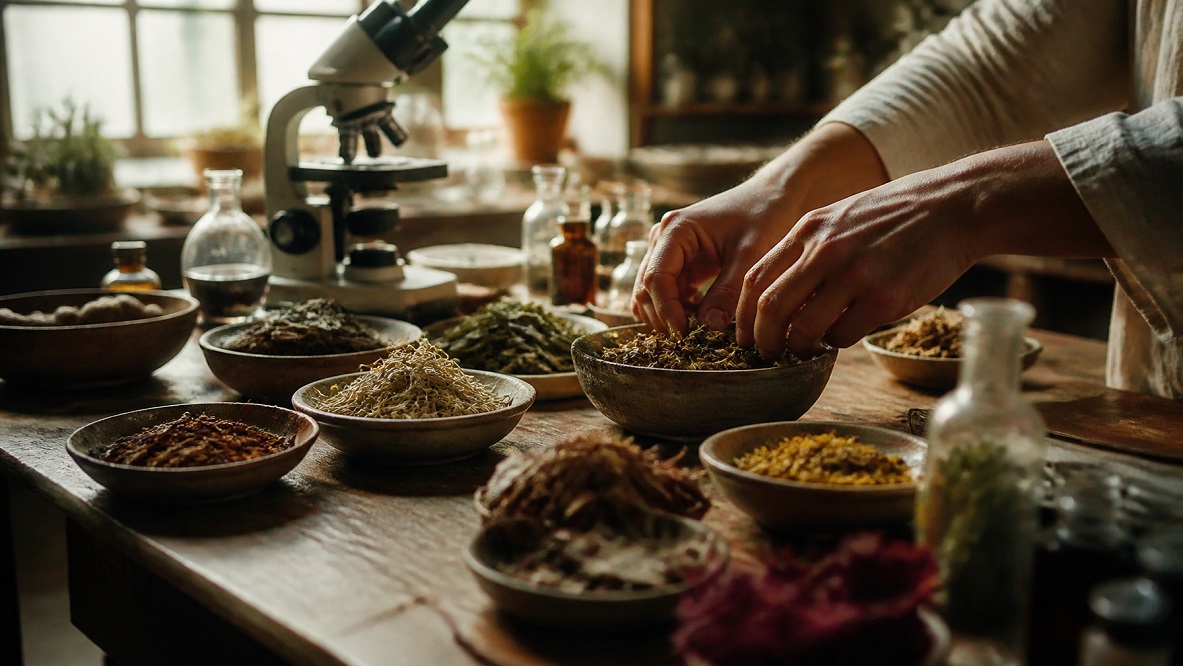
Many herbs now being studied in laboratories have centuries of traditional use behind them, and science has treated them in very different ways. Sweet wormwood from Chinese medicine led to a Nobel Prize-winning malaria drug, while ginkgo failed a major dementia prevention trial. Revisiting tradition means testing it, and the results can go either way.
Sweet Wormwood and a Nobel Prize for Revisiting Tradition
The best-known success story belongs to Tu Youyou, a Chinese scientist who searched ancient medical texts for a malaria remedy. According to a Nobel Prize profile, one text described sweet wormwood being used around 400 AD to treat intermittent fevers.
Her team’s first attempts, which involved boiling the plant, seemed to destroy the active ingredient. A hint in the old text led her to switch to a solvent with a lower boiling point, which preserved the compound and led to artemisinin. She received the 2015 Nobel Prize in Physiology or Medicine. The lesson is that tradition can hold practical clues, sometimes right down to how a plant should be prepared.
Ginkgo and the Limits of Folk Reputation
Ginkgo biloba comes from a tree native to China, and it has long been sold as a memory herb. The National Center for Complementary and Integrative Health describes the Ginkgo Evaluation of Memory study as the largest clinical trial of ginkgo’s effect on dementia. Over eight years, 240 milligrams a day of ginkgo did not reduce the development of dementia or Alzheimer’s disease in older people.

That result does not make traditions worthless. It shows why a long reputation needs testing, and it is a good reason to be wary of any product that leans only on history.
Bacopa and Rhodiola Under the Microscope
Two herbs from very different parts of the world are in the middle of this process. A National Library of Medicine overview of Bacopa notes that some human studies have examined verbal learning and delayed word recall, and the research is still developing.
Rhodiola, a root used in Russia and Scandinavia, is in a similar place. The National Center for Complementary and Integrative Health says there is not enough reliable evidence to know whether it helps with any health purpose, and most human studies are of low to moderate quality.
Both herbs appear among the ingredients in Mind Lab Pro, along with other ingredients that have traditional backgrounds. Interest in them is likely to continue as the research grows, and new studies deserve the same curious but careful reading.

Why Some Herbs Pass Tests and Others Do Not
Several things can separate a traditional use from a trial result. A herb may have been used for a different purpose than the one researchers test. The traditional preparation, such as a tea, a paste, or a simple extract, may differ from a modern capsule. And the ages of the participants, the dose, and the length of the study can all change the outcome.
Tu Youyou’s story shows the other side of the coin: paying attention to preparation details in the old text mattered as much as the plant itself.
How to Read Herbal Headlines Wisely
- Look for the plant’s botanical name, such as Bacopa monnieri or Rhodiola rosea.
- Check whether a claim comes from people, animals, or cells in a lab dish.
- Pay attention to cautious words like “may” and “preliminary,” and take them seriously.
- Ask a pharmacist or physician about any herb if you take medication.
Common Questions About Herbal Traditions and Science
Does traditional use prove an herb works?
No. Traditional use is a useful starting point for research, but only well-designed studies can show whether an herb does what people hope.
Why did ginkgo fail its big dementia trial?
In the Ginkgo Evaluation of Memory study, a daily 240 milligram dose did not reduce the development of dementia or Alzheimer’s disease in older people. It is a good example of why traditional claims need testing.
Which traditional herbs are being studied for memory?
Bacopa, rhodiola, and ginkgo are among the best known, and research on each is at a different stage.