
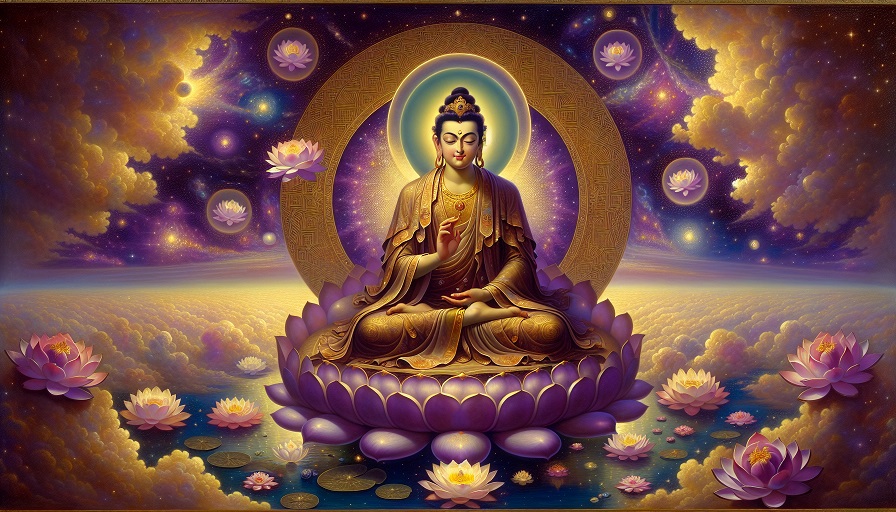
Buddhism has a reputation, not entirely undeserved, for being suspicious of things. The teaching on non-attachment, the recognition that clinging to objects, experiences, and even ideas is a root cause of suffering, can give the impression that the ideal Buddhist practitioner moves through the world lightly, owning little, attached to nothing, requiring no more equipment than a cushion and a reasonably quiet mind. And there is real truth in that picture. The Buddha himself taught with nothing more than words, and the most advanced meditation instruction in many traditions requires no objects at all.
And yet. Walk into any Tibetan Buddhist monastery, any Zen temple, any Theravada shrine room, and what you encounter is not austerity but an extraordinary abundance of carefully made, deliberately chosen, profoundly meaningful objects. Statues, paintings, bells, bowls, prayer wheels, incense burners, offering vessels, stupas, banners, and relics are arranged with precision and cared for with reverence. The material world has not been rejected. It has been recruited, put to work in the service of awakening, transformed from obstacle into instrument. Understanding how and why this happens reveals something important about how Buddhist practice actually works in daily life, as opposed to how it is sometimes theorized to work in the abstract.
The Tension That Isn’t
The apparent contradiction between non-attachment and the use of sacred objects dissolves once you understand what non-attachment actually means in Buddhist teaching. It does not mean indifference to the world or the absence of appreciation for beautiful and meaningful things. It means not clinging, not requiring things to be other than they are, not building a sense of self around possession. A practitioner can appreciate a magnificent Buddha statue deeply, care for it with devotion, and find in it a constant source of inspiration and reminder, without any of that constituting the kind of grasping that Buddhist teaching identifies as problematic. The statue is not owned in the ego-defending sense. It is held, lightly, in service of something larger than the holder.
Matter as Vehicle for Mind
The Tibetan Buddhist tradition in particular is built on a sophisticated understanding of the relationship between the material and the mental. Rather than treating the physical world as a distraction from spiritual development, Vajrayana practice treats it as a vehicle for spiritual development, a field of symbolic meaning in which every object, every sense perception, every experience can be recognized as an expression of the same awakened nature that meditation is cultivating inwardly. A sacred object, in this framework, is simply a physical form in which that awakened nature has been made particularly visible, concentrated, and accessible. It is the dharma wearing a body.
The Buddha Statue: Presence on the Altar
Of all the sacred objects in Buddhist practice, the statue is probably the most universally present and the most commonly misunderstood. Visitors to Buddhist temples sometimes assume that the figures on the altar are gods being worshipped, and practitioners sometimes feel the need to defensively clarify that Buddhism is not about praying to statues. Both positions miss something important about what a statue is actually doing in a practice context.
A Mirror of Possibility
A well-crafted Buddha statue, seated in its characteristic posture of meditative stability, is functioning primarily as a mirror. It shows the meditator what a human mind looks like when it has fully arrived at what practice is moving toward: complete, settled, open, undefended, radiating a quality of warm clarity that needs nothing and excludes nothing. When a practitioner bows to a Buddha statue, they are not submitting to an external authority. They are acknowledging, with a physical gesture that involves the whole body, the reality of what that figure represents and their own aspiration to realize it. The bow is directed outward and simultaneously inward. It is one of the most economical spiritual gestures ever devised.
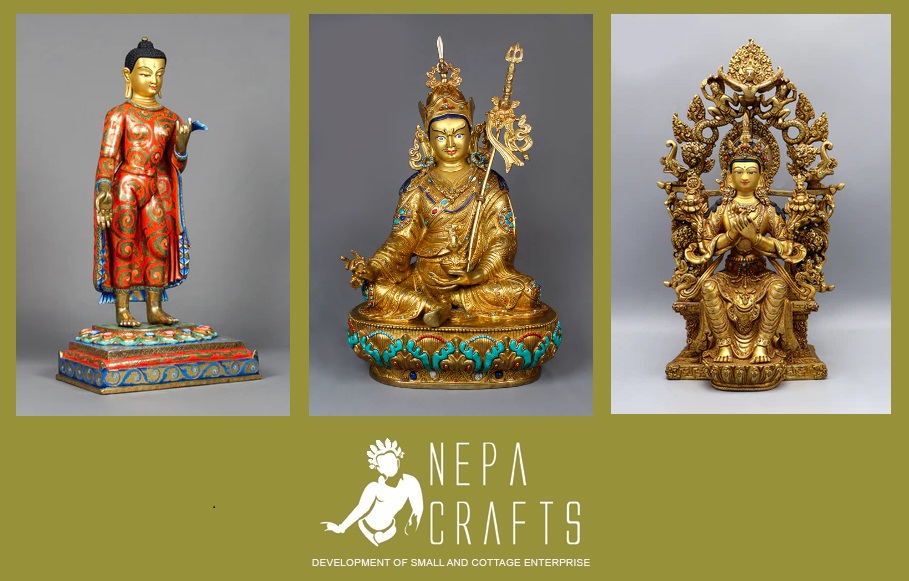
The finest Buddha statues, made by the master craftspeople of Patan in Nepal using techniques passed down through generations of devoted artisans, carry this quality of mirror-like presence with unusual power. The skill of the maker, applied with devotion and sometimes with active spiritual practice during the making, is understood to be embedded in the object itself. This is why practitioners with some experience can often feel the difference between a statue made with genuine craft and spiritual understanding and one produced purely for commercial purposes, even before they know anything about its provenance. Presence is not a mystical property that defies description. It is the accumulated effect of attention, intention, and skill.
Thangka Paintings: The Dharma on the Wall
A Thangka hanging above an altar or in a meditation space is doing several things simultaneously, all of them useful. As we explored in the earlier Thangka articles in this series, it is a visual encoding of Buddhist teaching, a text in the language of image rather than word. In a daily practice context, this means that simply sitting in front of a Thangka and allowing the gaze to rest on it, without any formal visualization technique or doctrinal knowledge, begins a process of absorption. The qualities encoded in the image, the serenity, the compassion, the precision of the symbolic program, communicate themselves to the meditating mind through a channel that bypasses the conceptual filtering of the thinking mind.
The Long Education of the Eye
There is a dimension to living with a Thangka that becomes apparent only over time, and it has to do with the way sustained familiarity with a sacred image deepens rather than dulls the encounter with it. A painting that you have sat in front of daily for two years is not the same painting it was on the day you hung it, even though not a pigment has changed. What has changed is the quality of your looking. The eye has learned the image’s grammar. The mind has absorbed its symbolism. The figure has become, in the most practical sense, an inner resource as well as an outer one. When a practitioner closes their eyes to meditate in front of a Thangka they know well, the image is available internally with a vividness and stability that a new painting could not provide. The sacred object has migrated, through patient daily contact, from the wall into the mind. That is exactly what it was always trying to do.
Singing Bowls: Sound as Sacred Threshold
The role of a singing bowl in daily practice is different from that of a visual object but equally specific and equally important. Where a statue or Thangka addresses the meditating mind primarily through vision and the symbolic imagination, a singing bowl addresses it through sound and through the direct physical experience of vibration in the body.
Marking Sacred Time
The most fundamental function of a singing bowl in everyday practice is temporal: it marks the beginning and end of formal sitting. This seemingly simple function carries more weight than it might initially appear to. One of the persistent challenges of home meditation practice is the porousness of ordinary domestic time, the way a twenty-minute sit can slide into eighteen minutes and then fifteen and then a habitual checking of the phone to see whether enough time has passed. The singing bowl eliminates this problem elegantly. You strike the bowl at the beginning and sit until it is struck again at the end. The sound creates a container. The container creates a commitment. The commitment creates the conditions in which genuine practice can develop.
Beyond this temporal function, the quality of the bowl’s sound does something to the nervous system that the act of sitting down and intending to meditate does not always accomplish on its own. As we explored in the sound healing articles in this series, the sustained resonance of a well-made singing bowl actively shifts the brain toward alpha and theta frequency states associated with relaxed alertness and meditative calm. The bowl is not just announcing that practice has begun. It is helping to create the neurological conditions in which practice can succeed.
Prayer Flags: Offering on the Wind
Among the sacred objects of the Tibetan Buddhist tradition, prayer flags occupy a unique position because they function outdoors, in public, in continuous motion, and without any human attention being directed at them most of the time. Strings of rectangular fabric panels printed with prayers, mantras, and sacred images, traditionally in the five colors of white, blue, red, green, and yellow corresponding to the five elements and the five Dhyani Buddhas, are hung where the wind will catch them. Each movement of the flag in the breeze is understood to send the prayers and mantras printed on it out into the world, blessing all beings in the surrounding environment.
Practice That Continues Without You
What is particularly interesting about prayer flags as a category of sacred object is that they embody a form of practice that continues independently of the practitioner’s active participation. Once hung, the flags are practicing on your behalf whenever the wind blows, which is most of the time. This speaks to a dimension of Tibetan Buddhist understanding that goes beyond what happens on the cushion: the aspiration to benefit all beings is not limited to formal meditation sessions. It can be embedded in objects, in the physical environment, in structures and arrangements that continue radiating their intention long after the practitioner has gone off to make breakfast. The sacred object, in this understanding, extends the reach of practice beyond the boundaries of any individual session or any individual practitioner.
The Daily Rhythm of Objects and Practice
For a practitioner with a functioning home altar and a regular sitting practice, the sacred objects become woven into the texture of daily life in ways that gradually become inseparable from the practice itself. The morning routine of lighting the candle, refreshing the water offering, lighting a stick of incense, and striking the singing bowl to begin the session is not a preamble to practice. It is practice, the initial turning of attention toward what matters, accomplished through physical gesture and sensory engagement before a single moment of formal meditation has occurred.
The objects are doing their work throughout the day, not just during formal sitting. Catching a glimpse of the Buddha statue on the altar while making coffee can produce a momentary remembering, a brief but genuine return to the quality of awareness that practice is cultivating. Hearing a gust of wind move through the prayer flags in the garden can do the same. These small interruptions of ordinary consciousness, scattered through the day by objects chosen and placed specifically to produce them, constitute a form of practice that is less dramatic than a formal session on the cushion but perhaps more pervasive in its long-term effects.
Choosing Objects With Intention
Given the role that sacred objects play in practice, the question of which objects to choose and where to source them is not a trivial one. An object made with genuine craft skill and spiritual understanding, by an artisan who brings both technical mastery and devotional awareness to the work, carries something that a mass-produced replica does not. The Nepalese craftspeople of Patan and the Kathmandu Valley, whose families have been producing sacred Buddhist and Hindu objects for generations using traditional techniques, represent one of the last living continuities of that ancient combination of craft and devotion. Bringing one of their objects into your practice space is not merely a purchase. It is a participation in a tradition of sacred making that stretches back further than most of us can comfortably imagine.
In the end, the role of sacred objects in everyday Buddhist practice is to do what the best teachers do: to be present in a way that consistently reminds you of what is most important, to offer that reminder without judgment or insistence, and to remain available whenever you are ready to receive it. The statue does not care how long it has been since you sat. The Thangka does not track your attendance. The singing bowl is ready whenever you pick up the mallet. That unconditional availability, built into the nature of objects rather than dependent on the moods and schedules of another person, is one of the most quietly radical things about a well-appointed practice space. It is always open. The question is only whether you come in.