
There is a particular kind of frustration that many people encounter when they decide to start meditating. They sit down, close their eyes, follow the breath for about forty-five seconds, and then spend the next nineteen minutes and fifteen minutes thinking about what to make for dinner, replaying a conversation from three days ago, making a mental shopping list, and occasionally remembering that they are supposed to be meditating. The instruction to “just sit and be present” turns out to be considerably more demanding than it sounded. What nobody warned them about is that the thinking mind, left to its own devices, is essentially a golden retriever at a squirrel convention: enthusiastic, energetic, and completely unable to stay in one place.
This is where a singing bowl changes the game. Not by silencing the mind through some mysterious acoustic magic, but by giving it something specific and genuinely compelling to attend to. The sustained, complex, evolving tone of a well-made Himalayan singing bowl is exactly the right kind of sensory experience for a mind that needs an anchor: interesting enough to hold attention, simple enough not to trigger the analytical thinking that keeps people out of meditative depth, and physical enough, in the sense of being felt in the body as well as heard through the ears, to bypass the purely conceptual level where most mental noise lives. What follows is a practical guide to using one of these remarkable instruments, from choosing your first bowl through building a daily practice that actually holds.
Contents
Choosing Your First Singing Bowl
The question of which singing bowl to buy is one that generates considerable anxiety in people new to the practice, largely because of the range of options available and the variety of claims made about different types, sizes, and materials. A few simple principles cut through most of that confusion.
Size and Tone
Larger bowls produce lower, deeper tones. Smaller bowls produce higher, brighter tones. For meditation and stress relief purposes, most practitioners find that a medium to large bowl, roughly seven to ten inches in diameter, produces the kind of deep, resonant tone that is most effective for settling the nervous system. Very small bowls, while beautiful and useful in their own right, tend to produce tones that decay quickly and whose higher frequency is less effective as a sustained meditative anchor. If you have the opportunity to hear a bowl before purchasing, always do so. The relationship between a practitioner and their bowl is partly acoustic chemistry, and a tone that settles one person’s nervous system might not have the same effect on another’s. Trust your body’s response over any technical specification.
Hand-Hammered Versus Machine-Made
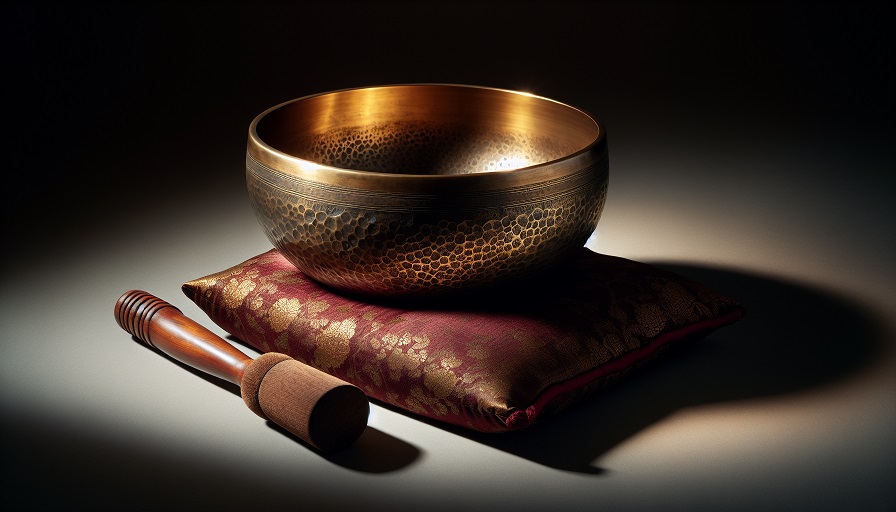
Traditional Himalayan singing bowls are hand-hammered, meaning a skilled artisan shapes the metal by striking it repeatedly with a hammer over a forming surface, a process that creates the characteristic irregular surface texture visible on quality bowls and that also affects the acoustic profile in ways that machine production does not replicate. Hand-hammered bowls tend to produce richer, more complex tones with more pronounced overtones than their machine-made counterparts, because the slight irregularities in the metal’s thickness created by hand-hammering generate a more varied vibrational profile. For meditation purposes, that complexity is a virtue: it gives the listening mind more to attend to and creates the evolving, living quality of sound that holds attention without demanding active thought.
The Cushion and Mallet
A bowl without a cushion and a suitable mallet is a bowl waiting for permission to sing properly. The cushion, typically a hand-stitched round pad in silk or brocade fabric, serves both a practical function, holding the bowl stable and slightly elevated for comfortable playing, and a protective one, preventing the bowl’s base from making contact with a hard surface that would dampen its resonance. The mallet, which can be wooden, leather-wrapped, or felt-tipped, affects the tone the bowl produces. A wooden mallet produces a brighter, more percussive initial strike. A leather-wrapped mallet produces a warmer, more rounded tone. A felt-tipped mallet is the softest and most suited to very gentle playing and the rimming technique. Having both a wooden and a leather-wrapped mallet allows you to find the tone that suits each moment of your practice.
The Two Basic Techniques
There are two fundamental ways to play a singing bowl, and both are worth learning. They produce distinctly different sonic effects and serve different purposes in a meditation session.
The Strike Technique
The strike technique is exactly what it sounds like. The mallet is held lightly, like a pencil rather than a hammer, and brought into contact with the bowl’s outer surface at the midpoint between the base and the rim, using a gentle, glancing stroke rather than a direct impact. The key word is glancing: you are brushing the bowl’s surface with the mallet rather than driving into it, which allows the vibration to develop fully rather than being dampened by the mallet remaining in contact. A correctly struck bowl will ring with a clear, full tone that sustains for many seconds before gradually fading. An incorrectly struck bowl, hit too hard or with the mallet held too tightly, will produce a shorter, flatter, thudding sound that lacks the resonant tail. Practice the strike until the ringing is consistently clean and full, which usually takes no more than a few minutes of adjustment.
The strike technique is most useful for beginning a meditation session, for marking transitions within a session, and for gently drawing the attention back from distraction during sitting practice. One clear strike, attended to from the moment of impact through the full arc of the tone’s decay into silence, is itself a complete mini-meditation, requiring approximately thirty to sixty seconds of genuine present-moment attention. Beginning meditators who struggle to sit for twenty minutes often find that tracking the full arc of a bowl’s tone gives them a reliable, achievable unit of presence to build from.
The Rimming Technique
The rimming technique produces the continuously sustained tone that most people associate with singing bowls at their most iconic. The mallet, held at a slight outward angle, is pressed against the outside of the bowl’s upper rim with moderate, consistent pressure and moved in a slow, steady circular path, maintaining contact throughout. The friction between the mallet and the rim creates a continuous vibration that the bowl sustains and amplifies, producing the singing tone that gives these instruments their name.
Learning the rimming technique well takes patience and a willingness to be initially terrible at it, which is the honest truth about any worthwhile skill. The most common beginner errors are pressing too hard, which produces a harsh scraping sound, pressing too lightly, which produces silence, moving too quickly, which tends to cause the bowl to skip, and moving too slowly, which does not sustain the vibration. The sweet spot, where the bowl sings freely and fully, is a physical sensation more than a visual one: you can feel it in your hand when the technique is right, a subtle increase in resistance as the bowl’s vibration begins to pull at the mallet. Once you have found that sensation even briefly, it is much easier to return to.
A useful starting approach is to strike the bowl first to initiate the tone, then place the mallet against the rim and begin the circular motion while the strike tone is still present. Having the tone already established makes it easier to feel when the rimming technique is sustaining it versus interrupting it.
A Simple Meditation Practice With a Singing Bowl
Once basic technique is established, even at a beginner level, a singing bowl can support a complete and effective meditation practice. The following structure works well for sessions of fifteen to thirty minutes and is suitable for practitioners at any level.
Beginning the Session
Sit comfortably on your cushion or chair, spine reasonably upright, hands resting in the lap, bowl on its cushion within easy reach. Take two or three natural breaths, allowing the body to settle from whatever it was doing before. Then hold the bowl in the left palm or leave it on its cushion, and strike it once with the right hand. Give your complete attention to the tone as it arises, develops, and gradually dissolves into silence. When the last trace of sound is gone, the formal session has begun. From this moment, the thinking mind has been given its instructions: this is not the time for the shopping list.
During the Session
Use the breath as your primary meditation object, following the natural rhythm of inhalation and exhalation with gentle, non-controlling attention. When the mind wanders, as it reliably will, notice the wandering without judgment and return attention to the breath. At any point when the wandering feels particularly persistent or the mind particularly agitated, strike the bowl again and follow its tone all the way to silence before returning to the breath. The bowl becomes an emergency anchor for moments when the breath alone is not enough to hold the mind’s attention, and a friendly, non-judgmental one at that. It does not criticize you for needing it. It simply rings.
For practitioners who want a more structured approach, the rimming technique can be used to create a sustained sound environment during the session, particularly during the early minutes when settling is most challenging. Five minutes of gentle rimming at the session’s beginning, with the attention resting on the sound and the physical sensation of the vibration in the body, is one of the most effective rapid inductions into meditative calm that non-pharmaceutical means provide.
Closing the Session
At the end of the sitting period, strike the bowl three times in succession, with a brief pause between each strike. In Tibetan tradition, three strikes represent the Buddha, the Dharma, and the Sangha, the three jewels of Buddhist practice. For those without a Buddhist orientation, they can simply represent body, speech, and mind, the three dimensions of human experience being invited back into ordinary awareness. After the third strike, sit with the fading tone and allow a moment of gratitude for whatever the session offered, even if what it mostly offered was a clear view of how busy the mind is. That view is itself useful information. After a moment of this quiet, the session is complete.
Using Your Singing Bowl for Stress Relief Outside Formal Practice
The meditation practice described above is the most systematic and ultimately the most rewarding way to work with a singing bowl, but the instrument is also available for less formal use whenever the day takes a difficult turn.
The Two-Minute Reset
Keep the bowl somewhere accessible in your home or workspace. When stress arrives, rather than immediately reaching for a screen or a snack, pick up the mallet instead. Strike the bowl once and give it your full attention until the tone has completely dissolved into silence. Then do it again. Three strikes, attended to fully from beginning to end, take approximately ninety seconds and produce a measurable shift in the nervous system’s activation state. This is not a substitute for a full meditation practice, but it is a genuinely effective interrupt for the escalating loop of anxious thought that stress tends to produce. The bowl is saying: stop. Listen. Feel the vibration. Notice that you are still here, that the moment is still available, and that whatever seemed so urgent thirty seconds ago has not actually moved any closer while you were listening.
The Evening Settling Practice
One of the most consistently valuable uses of a singing bowl is a brief evening practice aimed at completing the day and creating a clear transition between the active engagement of the waking hours and the receptive quality needed for good sleep. Five to ten minutes of gentle rimming, with the lights low and the day’s demands set aside, is a practice that many people find transforms the quality of their sleep as noticeably as anything else they have tried. The bowl is not inducing sleep directly. It is completing the day: giving the nervous system permission to release its residual activation, signaling that the threats and demands of the previous sixteen hours have been heard and can now be set down.
There are more sophisticated things you can do with a singing bowl as your practice develops. You can learn to work with multiple bowls simultaneously, explore the Five Dhyani Buddha bowl system discussed earlier in this series, or incorporate bowl practice into a broader sound healing context. But the most important thing, always, is the simplest: the bowl in your hand, the mallet making contact, the sound arising, and your attention meeting it fully as it travels from that initial ring all the way to the last vibration threading itself out into the silence. That journey, repeated daily, is where the real practice lives.