
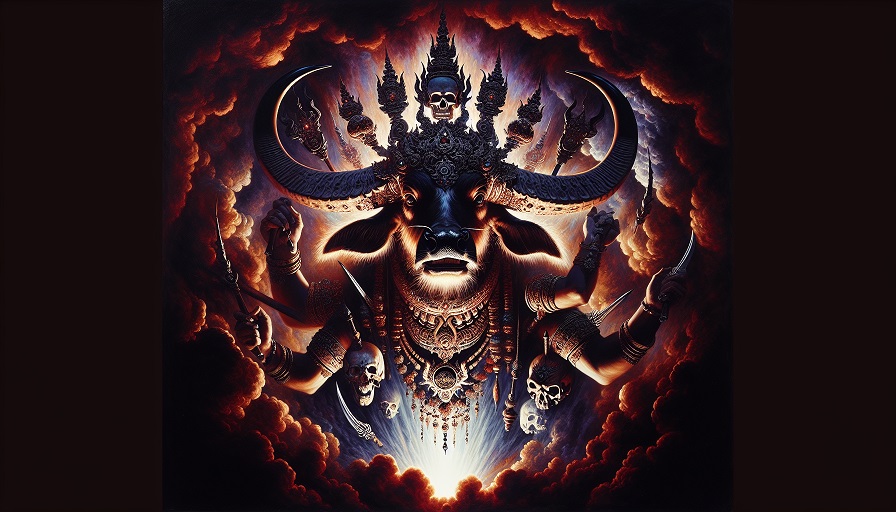
There are Buddhist figures that invite you in with a gentle gesture and a serene expression, and then there is Yamantaka. With his buffalo head, his multiple arms bristling with weapons, his necklace of human skulls, his crown of five dried skulls, his body the color of deep midnight blue, and his expression suggesting that whatever is standing between you and liberation had better move out of the way immediately, Yamantaka does not invite you in so much as demand that you reckon with something. First-time encounters with his image tend to produce either a step backward or a very long stare. Sometimes both.
And yet Yamantaka is not an adversary. He is not a demon, not a figure of evil, and not a relic of some darker, less enlightened moment in Buddhist history that more sophisticated practitioners have quietly moved past. He is, in the Gelug school of Tibetan Buddhism, one of the most important and revered meditation deities in the entire tradition, a figure whose terrifying appearance is inseparable from his function, and whose function is nothing less than the liberation of all beings from the most fundamental fear any living creature carries: the fear of death. Once you understand that, the buffalo head starts to make a different kind of sense.
Contents
The Name and Its Meaning
Yamantaka is a compound Sanskrit name that breaks down with useful clarity. Yama is the lord of death in both Hindu and Buddhist cosmology, the sovereign of the underworld who judges the actions of the dead and determines the conditions of their rebirth. Antaka means terminator, ender, or destroyer. Yamantaka is therefore the Terminator of Yama, the one who ends the lord of death himself. He is, to put it plainly, the death of death.
Vajrabhairava: The Diamond Terror
Yamantaka is also widely known by the name Vajrabhairava, which translates as the Diamond Terrifier or the Indestructible Terror. The vajra prefix, meaning diamond or indestructible, is the same one found in Vajrayana, the diamond vehicle of Tibetan Buddhist practice. It indicates that his terror is not ordinary fear-inducing anger or violence but the indestructible clarity of enlightened awareness wearing a fierce face. Bhairava, borrowed from Hindu Shaivite tradition where it refers to a terrifying form of Shiva, adds the dimension of awe-inspiring power that cannot be ignored or accommodated. Put them together and you have a figure of enlightened ferocity so complete and uncompromising that even death itself cannot withstand it.
The Story Behind the Form
The origin narrative of Yamantaka is one of the most dramatic in all of Tibetan Buddhist mythology, and it does considerable work in explaining why such an extreme form was considered necessary.
When Manjushri Became Fierce
The traditional account begins with Yama, the lord of death, terrorizing all beings in the realm he controlled with such overwhelming power that no force seemed capable of stopping him. The bodhisattvas and protector deities were unable to subdue him because Yama himself, as lord of death, was beyond the reach of any being whose existence remained bounded by death. The logic was inescapable: only something more terrifying than death, only something that stood completely outside death’s jurisdiction, could overcome it.
Manjushri, the bodhisattva of wisdom whom we met in our previous article, took on the task. He transformed himself into a form so wrathful, so beyond the ordinary, and so completely outside the boundaries of what Yama’s power governed, that the lord of death was subdued. That wrathful form of Manjushri is Yamantaka. This is a detail worth sitting with for a moment. The bodhisattva of wisdom, the figure of gentle, flaming-sword clarity, is the inner identity of the most terrifying figure in the Tibetan Buddhist pantheon. Ferocity and wisdom are not opposites in this tradition. Ferocity is what wisdom looks like when it confronts something that gentler approaches cannot reach.
Reading the Iconography
Yamantaka’s appearance is extraordinarily complex, and every element of his multi-headed, multi-armed form has been precisely designed to communicate specific meanings. What looks at first glance like an explosion of terrifying imagery is, on closer examination, a remarkably coherent symbolic program.
The Buffalo Head and the Nine Faces
In his full form, Yamantaka has nine faces, of which the most prominent is the buffalo head. The buffalo, in Tibetan Buddhist iconography, is the animal vehicle of Yama, the lord of death. By wearing Yama’s own animal as his central face, Yamantaka is making a statement that is simultaneously theological and viscerally direct: he has conquered death so completely that he wears its face as his own. The buffalo head is not a trophy. It is an incorporation. The remaining eight faces in his full iconographic program represent the eight manifestations of consciousness in Tibetan Buddhist psychology, now purified and directed toward liberation rather than confusion.
Thirty-Four Arms
In his most elaborate form, Yamantaka has thirty-four arms, each holding a specific implement. The right arms carry weapons and implements of power: a curved knife, a skull cup, a damaru drum made from human skulls, a lasso, a trident, a staff. The left arms carry vessels, implements of offering, and symbolic objects including a skull cup filled with blood, representing the destruction of ego-clinging, and the severed head of Brahma, the creator deity, representing the transcendence of the illusion of a creator separate from the created. Sixteen of his feet stand upon eight Hindu deities and eight animals, a symbolic program indicating his complete transcendence of the cosmos as ordinarily conceived.
The Sixteen Legs and What They Stand On
The imagery of Yamantaka’s feet standing upon a series of figures and animals requires the same reframing that the entire wrathful deity tradition requires. These are not depictions of conquest in any political or military sense. Each figure beneath his feet represents a mental state, a cosmic principle, or a form of attachment that has been overcome and integrated rather than destroyed. The human figures represent the eight worldly concerns that ordinary minds orbit around endlessly: pleasure and pain, gain and loss, praise and blame, fame and disgrace. By standing on these rather than being driven by them, Yamantaka embodies the complete freedom of mind that Buddhist practice aims for.
Wrathful Deities in the Tibetan Tradition: The Bigger Picture
Yamantaka belongs to a category of Tibetan Buddhist figures known as wrathful deities or dharmapalas, protector deities, and understanding why this category exists at all goes a long way toward making the tradition’s aesthetic choices coherent.
Compassion That Does Not Negotiate
The fundamental principle behind wrathful deity iconography is this: genuine compassion does not always look gentle. A doctor performing emergency surgery is not being unkind by making an incision. A parent who physically pulls a child out of the path of a moving vehicle is not being rough. There are situations in which the most compassionate response available is swift, forceful, and does not pause to seek consensus. Wrathful deities represent that quality of compassion. Their ferocity is not anger in the ordinary sense, not the reactive, self-protective, ego-driven anger that Buddhism identifies as one of the three poisons. It is something closer to the focused intensity of a surgeon’s hand or the absolute commitment of a rescue. It is fierce because the situation is serious and because anything less fierce would not be adequate to the task.
Working With Fear
There is also a specifically psychological dimension to wrathful deity practice that is worth understanding. Tibetan Buddhist practice does not treat fear as an obstacle to be avoided. It treats fear as a doorway. The practice of meditating on a figure as fearsome as Yamantaka is understood to work, in part, precisely because of the fear it evokes. To sit with that image, to hold it in visualization, to work with the extreme emotional charge it carries, and to gradually discover that you are not destroyed by it, that the awareness that can hold even this is itself unshakeable, is a practice in confronting the root of fear directly. You do not dissolve fear by avoiding frightening things. You dissolve it by discovering that whatever you are, at the deepest level, is not threatened by what frightens the smaller parts of you.
Yamantaka in the Gelug Tradition
Within Tibetan Buddhism’s four major schools, Yamantaka holds a particularly central position in the Gelug tradition, the school founded by Je Tsongkhapa in the fourteenth century and the school with which the Dalai Lamas are associated. Yamantaka practice is considered one of the three principal tantric practices of the Gelug school, alongside Guhyasamaja and Chakrasamvara, and is among the highest of the highest yoga tantras. Access to Yamantaka practice is traditionally restricted to practitioners who have received the appropriate empowerment from a qualified teacher, a transmission that marks formal entry into the practice and provides the ceremonial permission and instruction needed to work with such a powerful and concentrated form.
Tsongkhapa and Yamantaka
Je Tsongkhapa, the founder of the Gelug school and one of the most revered figures in Tibetan Buddhist history, maintained Yamantaka as his personal meditational deity and is said to have achieved particularly profound realizations through this practice. His example established Yamantaka’s centrality in the Gelug tradition in a way that has persisted for over six centuries. The great monasteries of the Gelug school, from Sera and Drepung in Lhasa to Ganden Jangtse, maintain elaborate Yamantaka practice traditions, and the deity’s image occupies prominent positions in their temple halls alongside the more immediately approachable figures of Tsongkhapa himself and Shakyamuni Buddha.
The Statue as Teacher
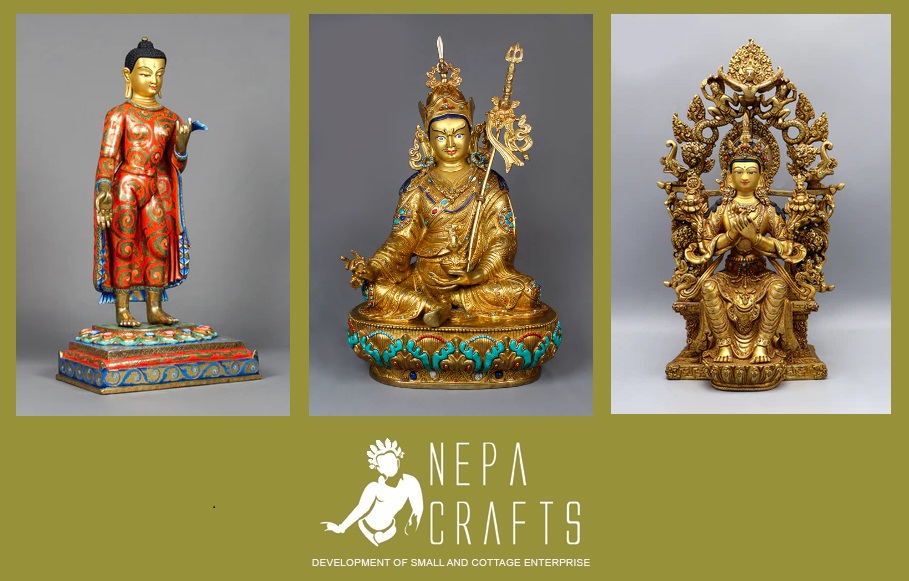
A Yamantaka statue produced by the master craftspeople of Patan presents a different kind of challenge than almost any other Buddhist figure. The sheer complexity of the iconography demands extraordinary technical skill: multiple heads rendered with individuality and precision, dozens of arms in correct position with correct implements, the elaborate decorative program of ornaments, skulls, and symbolic details all executed with the accuracy that the tradition demands. A commission for a Yamantaka statue is, in the studio culture of Patan, a mark of the master craftsperson’s highest level of accomplishment.
What such a statue does when it is placed in a room is immediately evident. It does not let you be comfortable in a passive way. It demands something from your attention. It insists that you engage with it rather than simply acknowledging it and looking away. That quality, that refusal to be ignored or accommodated into the background of ordinary life, is itself a teaching. Death, after all, has the same quality. It does not wait for a convenient moment. It does not let you defer the question indefinitely. Yamantaka, wearing death’s own face and having subdued the lord of death himself, is simply the Buddhist tradition’s most unflinching way of saying: the thing you are most afraid of is precisely what your practice needs to face. And facing it, as practitioners across six centuries of Gelug tradition have discovered, turns out to be survivable. More than survivable. Liberating.