
Sustainability is one of those words that gets used so frequently in contemporary marketing that it risks losing its meaning entirely. Brands that have been operating industrially for decades repackage themselves as green with minimal actual change. Products are labeled eco-friendly because they come in slightly thinner packaging. Against this backdrop of manufactured environmental virtue, the craft traditions of Nepal represent something genuinely different: sustainable making that predates the concept by centuries, rooted not in marketing strategy but in the practical wisdom of communities that learned long ago how to take from the natural world only what it can afford to give.
This is not a recently acquired virtue. Nepalese artisans were practicing what we now call sustainability when the word itself did not exist, because in a mountain culture with limited resources and deep spiritual respect for the natural world, there was simply no other sensible way to work.
Contents
Working With What the Land Provides
The materials at the heart of Nepal’s great craft traditions are almost entirely locally sourced and naturally renewable. Lokta paper is made from the bark of a shrub that regenerates after harvesting. Felt products are made from the wool of sheep and yaks that have been herded in the Himalayan highlands for thousands of years. Hemp fiber, used for bags, textiles, and rope, is grown without pesticides in the foothills of Nepal, where the climate suits it perfectly. Copper and bronze, the metals of Nepal’s extraordinary statue-making tradition, are worked in quantities calibrated to what skilled hands can shape rather than what industrial machinery can churn out.
Even the dyes traditionally used in Nepali textiles and felt products were plant and mineral based until synthetic dyes became available. A growing number of artisan cooperatives and producers have returned to natural dyeing processes, or have adopted what the industry calls low-impact dyes, specifically in response to consumer demand for products that carry no harmful chemical residue from their production. NepaCrafts is among those who have committed to eco-friendly dyeing processes, using Swiss-developed CLARIANT dyes that meet rigorous environmental standards for their wool and textile products.
The Small Workshop Model
Much of Nepal’s craft production happens in small family workshops or village cooperatives rather than factories. This is not a romanticized anachronism. It is an economically and ecologically rational structure. Small workshops produce no industrial waste streams. They consume no factory-scale energy. Each piece is made by a human being working at human scale, which means production is inherently calibrated to actual demand rather than optimized for volume regardless of need.
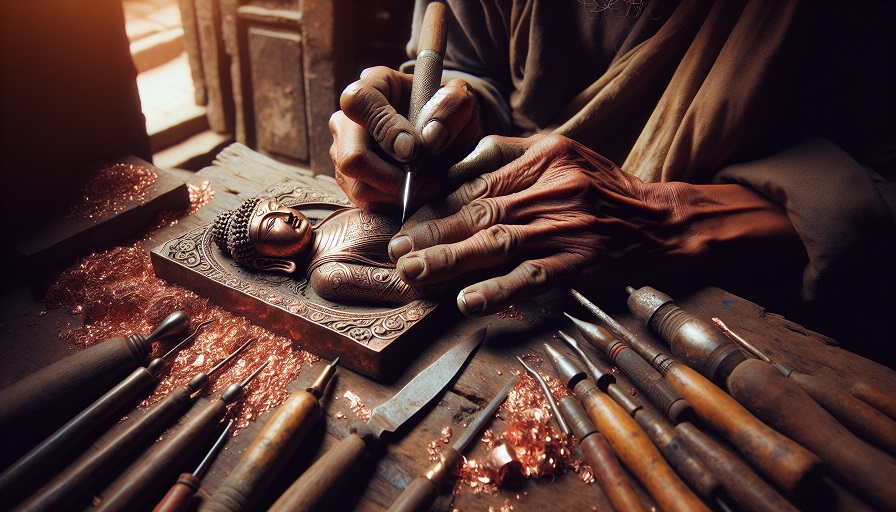
The contrast with industrial production is stark. A factory producing decorative bronze objects generates effluent, consumes significant energy, and produces at a rate that requires aggressive marketing to justify. A family workshop in Patan producing handmade copper statues generates almost no waste beyond metal filings that are collected and recycled, consumes the energy of skilled human hands and a small furnace, and produces pieces whose quality ensures they will be owned and cared for across generations rather than discarded when the next trend arrives.
Craft as Carbon Sense
There is a dimension of ecological intelligence embedded in high-quality handmade objects that rarely gets discussed in sustainability conversations: longevity. A finely made singing bowl or a well-crafted Thangka painting is not a product with a planned obsolescence. It is an object made to last, potentially for centuries, by someone who understood that the measure of good craft is how long it endures rather than how cheaply it can be produced. Every such object that remains in use for fifty years represents fifty years of not buying a replacement, which is an environmental calculation that rarely appears in standard lifecycle analyses but matters enormously in the aggregate.
Women, Cooperatives, and Community Sustainability
A significant dimension of Nepal’s sustainable craft ecosystem is the role of women’s cooperatives in organizing and sustaining traditional production. From the Lokta paper cooperatives of the mountain regions to the felt-making and wool-knitting cooperatives of the Kathmandu Valley, women’s collectives have been the organizational backbone of sustainable artisan production for decades. These cooperatives keep craft knowledge alive by passing skills from older to younger generations, distribute income equitably within communities, and maintain quality standards that protect both the product’s reputation and the producer’s fair compensation.
This social dimension of sustainability, the ensuring of dignified livelihoods within the communities that produce traditional crafts, is sometimes overlooked in discussions that focus exclusively on environmental metrics. Economic sustainability and ecological sustainability are not separate concerns. A craft tradition whose practitioners cannot earn a living wage will not survive regardless of how environmentally benign its production methods are. The cooperatives that structure much of Nepal’s artisan production have understood this integration for longer than most global sustainability frameworks have existed.
Sacred Relationship With Materials
Perhaps the deepest source of sustainability in Nepal’s craft tradition is not organizational or technical but spiritual. In the Buddhist and Hindu worldview that permeates Nepali culture, the natural world is not a resource to be extracted but a living reality to be respected. A craftsperson who understands the copper they work with as coming from a living earth, who offers prayers before beginning a sacred commission, and who brings genuine devotion to the making of an object they consider holy is unlikely to approach that material with the extractive indifference that has characterized industrial production at its worst.
This is not sentimentality. It is a coherent ethical framework for the relationship between maker and material that produces, as a practical consequence, exactly the care and restraint that sustainable production requires. When the earth is sacred, you do not take from it carelessly.
What the Global Market Owes Nepal’s Artisans
As the global demand for handmade, eco-friendly, and culturally authentic goods has grown, Nepalese artisans have found a market that, at its best, values exactly what they have always done. The responsibility this creates runs in both directions. Consumers who choose a handmade Nepali product over a mass-produced alternative are making a meaningful ecological and cultural choice. But that choice only supports sustainability if the price paid reflects the true value of what has been made, the skill, the time, the living tradition, and the ecological care embedded in each object.
Buying cheaply made imitations of Nepali craft objects, which the global market offers in abundance, supports none of these values. Buying from producers who are transparent about their materials, their makers, and their methods supports all of them. The artisans of Nepal have been getting this right for a very long time. The question is whether the global market is finally ready to meet them there.