
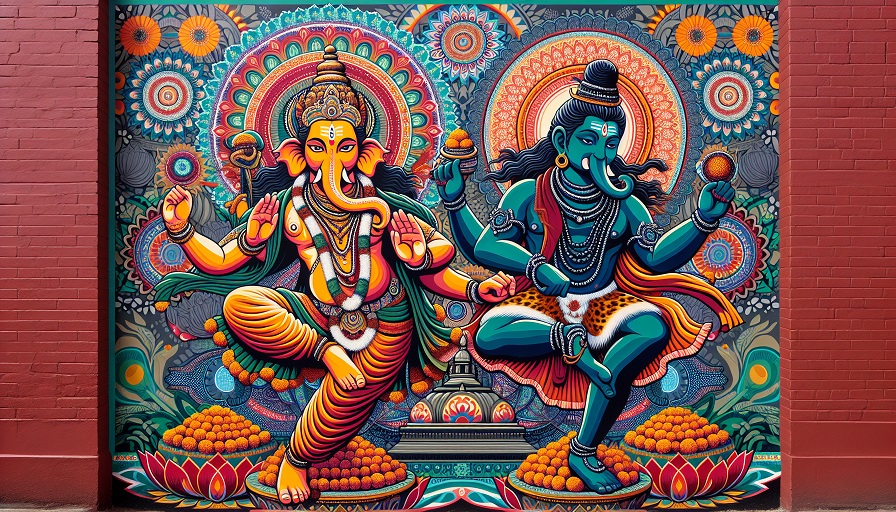
Nepal is one of the few places on earth where the question of whether someone is Hindu or Buddhist is regularly answered with a warm shrug and something along the lines of “both, depending on the day.” This is not religious confusion or casual indifference to doctrine. It is the natural expression of a culture where Hinduism and Buddhism have coexisted, intertwined, borrowed from each other, and occasionally merged so completely that separating them feels less like untangling threads and more like trying to un-bake a cake. The result is one of the most visually and spiritually rich artistic traditions anywhere in the world, one in which a single temple courtyard might contain a seated Buddha alongside a dancing Shiva, a Tara statue beside a Ganesh shrine, and devotees of both traditions offering flowers at the same altar without the slightest sense of contradiction.
For anyone drawn to Nepali art and the handcrafted statues that emerge from the workshops of the Kathmandu Valley, understanding the Hindu deities in that tradition is every bit as important as understanding the Buddhist ones. These figures are not decorative borrowings from a neighboring culture. They are living presences in Nepali devotional life, invoked daily in homes, honored at crossroads shrines, celebrated in festivals that fill the streets with color and music, and rendered in copper, bronze, and stone by artisans whose families have been making these sacred objects for generations.
Ganesh: The One You Always Approach First
If you spend any time in Nepal, you quickly notice that Ganesh shrines are everywhere. At the entrance to temples, at road junctions, outside homes and businesses, tucked into niches in ancient walls, the elephant-headed deity is a constant, cheerful, and endlessly various presence. There is a reason he is always at the entrance rather than the center: Ganesh is traditionally invoked first, before any other deity, at the beginning of any undertaking, journey, ceremony, or prayer. To begin without acknowledging Ganesh is considered a bit like starting a long drive without checking whether you have fuel. Technically possible. Probably inadvisable.
The Mythology Behind the Elephant Head
How Ganesh acquired his elephant head is a story with several versions across Hindu traditions, of which the most widely known goes something like this. The goddess Parvati, wife of Shiva, created Ganesh from the clay or turmeric paste of her own body while Shiva was away, fashioning a son and posting him at the door of her bathing chamber with instructions to let no one enter. When Shiva returned, unrecognized by the child who had never met his father, and was firmly refused entry, the encounter escalated rapidly. In a moment of divine misunderstanding that has the quality of a very ancient and very cosmic misunderstanding, Shiva severed the child’s head. Parvati’s grief was immediate and absolute, and Shiva, understanding what he had done, sent his attendants to find the head of the first creature they encountered sleeping with its head pointing north. They returned with an elephant’s head, which Shiva attached to the child’s body and restored to life. The result, Ganesha, was declared the lord of beginnings and the remover of obstacles, positions of considerable responsibility that he has occupied with evident competence for several thousand years.
Reading the Symbols
Ganesh’s iconography is a treasury of meaning packed into one memorably round figure. His large elephant ears are said to winnow the truth from falsehood the way a winnowing basket separates grain from chaff, hearing everything and keeping only what is real. His single tusk, the other having been broken off in various mythological accounts, represents the capacity to retain the essential and let go of the incomplete. His large belly holds the entire universe, containing all experience without being overwhelmed by any of it. He typically holds a modaka, a sweet rice dumpling, representing the sweetness of spiritual attainment that is the reward of sincere practice. His vehicle, the mouse, represents the ego: small, swift, capable of gnawing through almost anything, and best kept under the guidance of something wiser and larger than itself.
Ganesh in Buddhist Nepal
What makes Ganesh’s presence in Nepali art particularly interesting is that the Buddhist tradition of the Kathmandu Valley, Newar Buddhism, absorbed him completely. In this tradition he appears as Vighnaraja, the lord of obstacles, and is venerated at the entrances to Buddhist temples and courtyards with the same logic applied in the Hindu tradition: begin with Ganesh. This cross-traditional adoption speaks to something about Ganesh that transcends doctrinal boundaries. He addresses a universal human concern, the anxiety of beginnings, the worry that something will go wrong before you even get started, with a generous, pot-bellied reassurance that has proven hard to resist across two millennia and two major religious traditions.
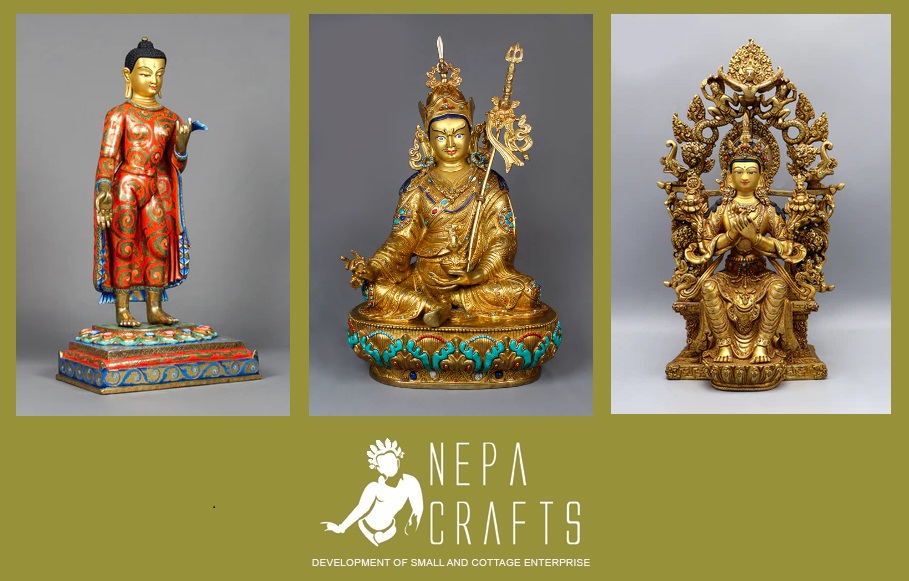
Shiva: The Destroyer Who Creates
If Ganesh is the deity of the threshold, Shiva is the deity of the whole wild territory beyond it. He is simultaneously the destroyer of the universe and the source of its renewal, the supreme ascetic who sits motionless in meditation for eons and the passionate husband of Parvati, the cosmic dancer whose movement sustains existence and whose stillness would end it. He is terrifying and tender, remote and intimate, the one who wears a crescent moon in his matted hair and carries the Ganges River in his locks and has a third eye that, if opened, incinerates whatever it looks at. In short, Shiva is one of the most complex, contradictory, and endlessly fascinating figures in the entire Hindu pantheon, and Nepali artists have been exploring that complexity in stone and metal for well over a thousand years.
The Linga and the Nataraja
Shiva is most commonly encountered in Nepali temples in two primary forms. The first is the linga, a cylindrical form representing his creative energy, typically set within a yoni, a disc-shaped base representing the feminine creative principle. The combination of linga and yoni together represents the union of masculine and feminine cosmic forces as the generative ground of all existence. This form, which strikes some Western visitors as surprising to find in a religious context, is in the Hindu understanding profoundly abstract: it is not a depiction of sexuality so much as an image of the creative dynamic at the root of all manifestation.
The second great form is Nataraja, Shiva as the lord of the cosmic dance. In this image, one of the most recognizable and beloved in all of Indian and Nepali art, Shiva dances within a ring of fire, one leg raised, arms extended holding a small drum representing the sound of creation and a flame representing destruction, one hand raised in the gesture of protection and one foot pressing down on the dwarf figure of Apasmara, representing ignorance and heedlessness. The entire cosmos, in this image, is a dance, a rhythmic alternation of creation and dissolution sustained by Shiva’s movement, and whatever is ignorant and heedless gets stood on while the dance continues.
Shiva as Pashupatinath
In Nepal, Shiva’s most significant form is Pashupatinath, the lord of all animals, whose great temple complex in Kathmandu is one of the most sacred Hindu sites in the world and a UNESCO World Heritage site. Pashupatinath represents Shiva in his benevolent, protective aspect, as the shepherd of souls rather than the cosmic destroyer. The temple complex, situated on the banks of the Bagmati River and surrounded by smaller shrines, cremation ghats, and the constant presence of sadhus, wandering ascetics who are themselves living images of Shiva, is a place where the full scope of Hindu religious life, birth, death, prayer, ash, marigolds, and river water, is compressed into a few hectares of extraordinary intensity.
Vishnu: The Preserver and His Many Avatars
Nepal’s religious landscape would be incomplete without Vishnu, the preserver deity of the Hindu trinity, whose function is to maintain the cosmic order and who descends to earth in a series of avatars whenever that order is seriously threatened. His most beloved avatars, Rama and Krishna, are among the most widely worshipped figures in all of Hinduism, and both appear regularly in Nepali art, temple programs, and festival traditions.
Vishnu in the Kathmandu Valley
The Kathmandu Valley holds one of the most extraordinary Vishnu images in the world, the reclining Vishnu of the Budhanilkantha temple, a fifth-century stone sculpture of the sleeping deity resting on a bed of serpents in a still reflecting pool. This image, Vishnu in his cosmic sleep between the dissolution and recreation of the universe, is of such sacred significance that the King of Nepal was traditionally prohibited from viewing it, based on an ancient prophecy about the consequences of that encounter. Whether or not such prohibitions still carry practical weight, the sculpture itself is breathtaking, one of those objects that seems to generate a quality of stillness in the air around it simply by existing.
Durga and the Goddess Tradition
No survey of Hindu deities in Nepali art would be complete without the goddess, who in Nepal’s Tantric Hindu traditions holds a position of supreme importance. Durga, the warrior goddess who rides a lion and carries weapons in her many hands, is perhaps the most dramatically depicted of the goddess forms. Her great festival, Dashain, is the most important festival in the Nepali calendar, a fifteen-day celebration involving elaborate rituals, family gatherings, animal sacrifices, and the blessing of everything from vehicles to weapons with the goddess’s protective power.
The Living Goddess: Kumari
Nepal’s goddess tradition takes one of its most distinctive forms in the institution of the Kumari, the living goddess, a young girl selected from the Newar Buddhist Shakya caste through an elaborate process of testing and ceremony and installed as a living embodiment of the goddess Taleju, a form of Durga. The Kumari lives in a dedicated palace in Kathmandu’s Durbar Square, rarely walking on the ground, appearing at important festivals carried on a golden palanquin, and receiving the reverence of both Hindu and Buddhist worshippers. When she reaches puberty and sheds her first blood, the divine presence is understood to depart, and she returns to ordinary life while a new Kumari is selected. Few religious institutions anywhere in the world bring together goddess theology, childhood, ritual life, and cultural identity quite so vividly as Nepal’s living goddess tradition.
Where Hindu and Buddhist Art Meet in the Same Object
One of the most genuinely fascinating aspects of Nepali sacred art is the number of objects and images that sit comfortably in both traditions simultaneously. Ganesh in a Buddhist temple. Tara venerated at a Hindu goddess shrine. The Newari pantheon of deities that blends Hindu and Buddhist figures so thoroughly that scholars still debate the classification of individual icons. The artisans of Patan do not find this perplexing. They have been making sacred objects for both traditions, sometimes in the same family workshop on the same day, for as long as anyone can remember. Their craft is the living embodiment of a cultural synthesis that most societies never achieve and that Nepal, for all its challenges, has maintained for centuries.
To bring a Nepali Hindu deity statue into your home is to bring a piece of that synthesis with you: a tradition where the elephant-headed god of beginnings stands guard at the same threshold as the compassionate bodhisattva, where destruction and preservation are understood as partners in the same cosmic dance, and where the sacred has never been confined to a single lane. That kind of spaciousness, cultural and spiritual both, is something the world could use considerably more of.