
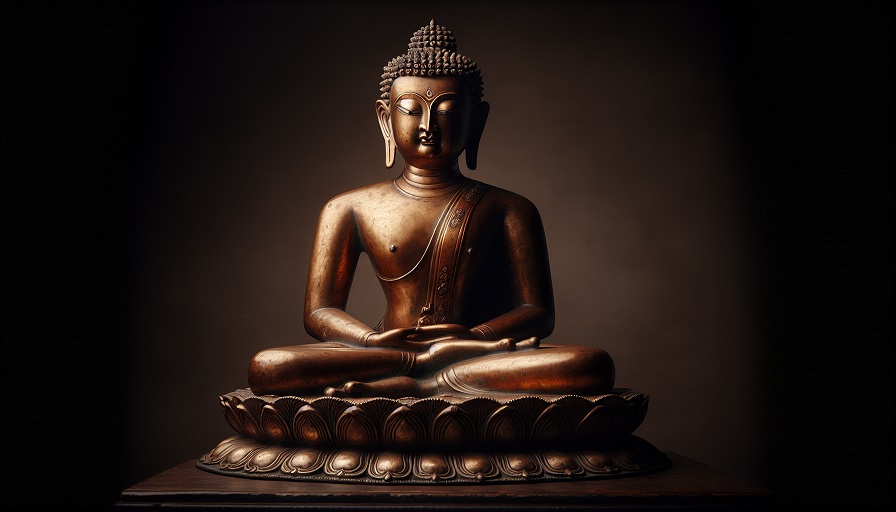
It appears on the walls of yoga studios from Mumbai to Minneapolis. It is tattooed on wrists and shoulders, printed on tote bags, etched into jewelry, and carved into the facades of temples that have stood for a thousand years. It is probably the most widely recognized symbol in all of Asian spiritual culture, and almost certainly the most frequently misunderstood. The syllable Om, written in its Sanskrit form as a character that resembles a stylized numeral three with a curved tail and a dot above, is ubiquitous to the point where many people who encounter it daily have only the haziest sense of what it actually means or why it has occupied such a central position across so many traditions for so long.
The honest answer to the question of what Om means is that it means something considerably more layered, more philosophically precise, and more experientially interesting than a general symbol of peace or spiritual good vibes, which is roughly the understanding that much of its contemporary Western popularity rests on. That popular understanding is not wrong, exactly, in the way that saying the ocean is wet is not wrong. It is simply operating at a level of abstraction that misses the actual depth of the thing. Om is one of the most carefully examined, rigorously debated, and experientially tested concepts in the entire history of religious thought, and it has been that for at least three thousand years.
Contents
The Ancient Roots: Where Om Comes From
Om appears in written form for the first time in the Vedas, the oldest scriptures of the Hindu tradition, which are estimated by most scholars to have been composed somewhere between 1500 and 500 BCE, though the oral tradition they represent is almost certainly older. In the Rig Veda, the oldest of the four Vedic collections, Om appears as a syllable of affirmation and invocation, similar in function to the Hebrew Amen or the Arabic Amin, a word of assent and blessing that precedes and follows sacred utterance. This early usage already carries the sense of Om as something more than a word with a specific referent: it is a sound that marks a transition between ordinary speech and sacred speech, a sonic threshold.
The Upanishads: Where Om Gets Serious
It is in the Upanishads, the philosophical texts composed roughly between 800 and 200 BCE that form the culmination of Vedic thought, that Om receives the systematic philosophical treatment that established its central importance for all subsequent Hindu philosophy. The Mandukya Upanishad, one of the shortest of the major Upanishads at just twelve verses, is devoted entirely to the meaning of Om and is considered by many scholars and practitioners to be one of the most concentrated philosophical documents in human history. The great eighth-century philosopher Adi Shankaracharya, who systematized Advaita Vedanta, the non-dualist school of Hindu philosophy, wrote that the Mandukya Upanishad alone is sufficient for liberation, which gives some sense of the esteem in which this tiny text is held.
The Mandukya’s central claim is that Om encompasses all of existence. Its opening verse states that Om is everything: all that was, all that is, and all that will be, as well as everything that transcends time itself. This is not metaphorical hyperbole. It is a metaphysical proposition that the Upanishad then proceeds to unpack with considerable precision through its analysis of the syllable’s components.
The Four Elements of Om
The Mandukya Upanishad analyzes Om as consisting of four elements, corresponding to four states of consciousness that together constitute the totality of experience. Understanding these four elements is the key to understanding why Om was considered not merely a sacred sound but a complete map of mind and reality.
A: The Waking State
The first element, the sound A, represents the waking state of consciousness, the ordinary everyday awareness in which we perceive the external world through the senses, engage with other people, make decisions, and navigate the demands of daily life. This is the most immediately familiar state, the one in which most of us spend most of our time, and it is associated with outward-directed awareness and the experience of a world that appears to be separate from and external to the observer.
U: The Dream State
The second element, the sound U, represents the dream state, the inner world of imagery, narrative, and experience that arises during sleep. The dream state is understood in Vedantic philosophy as a demonstration of the mind’s creative capacity: in the dream, the mind generates an entire world, populated with apparently solid objects and apparently real other beings, all from its own resources. This capacity of mind to create reality from within is considered philosophically significant because it suggests that what we take for granted as the solidity of the waking world may be less categorically different from the dream world than common sense assumes.
M: The Deep Sleep State
The third element, the sound M, represents the state of deep dreamless sleep, in which the ordinary distinction between subject and object, between self and world, dissolves into a unified, undifferentiated awareness. This state is understood not as a mere absence of consciousness but as a positive condition: the blissful absorption of the individual awareness back into its source, the ground state of mind before it differentiates into the experience of a subject perceiving an object. Most people pass through this state nightly without being aware of it, which is understood as a limitation rather than a feature: the practice of meditation is partly aimed at making the deep sleep state accessible in waking life.
The Silence: Turiya
The fourth element of Om is not a sound at all. It is the silence that follows the resonance of the syllable, the space into which the three sounds dissolve and from which they emerge. This silence represents Turiya, the fourth state of consciousness, which cannot be described as waking, dreaming, or deep sleep because it is the ground of all three rather than a state that alternates with them. Turiya is the witnessing awareness that is present during all three states, the pure consciousness that is never absent even when the ordinary contents of consciousness change completely. In Advaita Vedanta, Turiya is identical to Brahman, the ultimate reality, and the recognition of Turiya as one’s own deepest nature is the recognition that the individual self and the universal consciousness are not ultimately separate. That recognition, in this tradition, is liberation.
The full Om, understood in this way, is a sonic journey through the complete spectrum of consciousness and a return to its source. Chanting it is not merely making a religious noise. It is, according to the tradition, a map of mind being followed by mind itself.
Om in the Buddhist Tradition
Buddhism’s relationship with Om is somewhat different from Hinduism’s, reflecting the different philosophical and historical contexts of the two traditions, but no less significant. Om appears most prominently in Tibetan and Mahayana Buddhist contexts, where it functions as the opening syllable of many of the most important mantras in the tradition.
Om Mani Padme Hum
The most widely recited mantra in Tibetan Buddhism, Om Mani Padme Hum, the six-syllable mantra of Avalokiteshvara, the bodhisattva of compassion, begins with Om. The mantra is inscribed on prayer wheels, carved into mani stones along Himalayan pilgrimage routes, and recited by millions of practitioners daily. Each of its six syllables is said to purify one of the six realms of existence in Buddhist cosmology, and the mantra as a whole is considered to contain the complete teaching of the Buddha in condensed sonic form. Om in this context carries something of the same all-encompassing quality it has in the Hindu tradition: it is the syllable of totality that frames and contains what follows.
Om in Vajrayana Mantra
In Vajrayana Buddhist practice, Om appears at the beginning of an enormous range of deity mantras, including the Medicine Buddha mantra, the mantras of Manjushri, Green Tara, and many others we have encountered throughout this series. In this context Om is understood as the body of the deity, the sonic embodiment of the deity’s physical presence, while the syllables that follow represent the deity’s speech and mind. Chanting a mantra that begins with Om is understood as an invocation of the complete being of the awakened deity, starting with the physical, visible, manifest dimension of that being’s presence.
The Sound Itself: What Happens When You Chant Om
Beyond the philosophical and doctrinal dimensions, Om is also a profoundly physical experience, and the instruction to chant it, which appears in virtually every tradition that uses it, is an invitation to discover that experience directly rather than to simply understand it conceptually.
The Physiology of Om
When Om is chanted correctly, the three constituent sounds produce vibration in specific regions of the body. The A sound resonates in the lower abdomen and chest. The U sound moves the vibration upward into the throat and soft palate. The M sound closes the lips and concentrates vibration in the skull, particularly in the bones of the face and the cranium, producing a buzzing resonance that many practitioners describe as immediately calming and centering. Researchers studying mantra chanting have documented measurable effects including reduction in heart rate, decrease in cortisol levels, and activation of the vagus nerve, the primary nerve of the parasympathetic nervous system. The ancient instruction to chant Om was not arbitrary. It was experientially discovered and refined over millennia of dedicated practice.
Om as Visual Symbol
The written form of Om in the Devanagari script, the script used for Sanskrit and Hindi, is itself a subject of symbolic interpretation. The main body of the character represents the three sounds A, U, and M in their unified form. The curved line below the main body represents Maya, the creative illusion or apparent reality through which the absolute presents itself as a world of multiplicity. The dot, called the bindu, represents Turiya, the fourth state, the point of pure consciousness from which all manifestation arises and into which it eventually returns. The entire symbol is, in other words, a visual map of the same metaphysical territory that the sound maps acoustically: the complete spectrum of existence, held within a single character.
This is why an Om symbol carved into a Nepali singing bowl, engraved on a statue’s base, or woven into the border of a Thangka painting is not merely decorative. It is a complete philosophical statement condensed into a visual form, the tradition’s most concentrated way of saying: this object participates in the total reality that Om points toward. In the workshops of Patan, where artisans engrave Om onto sacred objects with the same care they bring to every other element of their craft, that understanding is not abstract. It is built into the work with the same attention as the hammer marks on the metal and the pigment in the paint.