
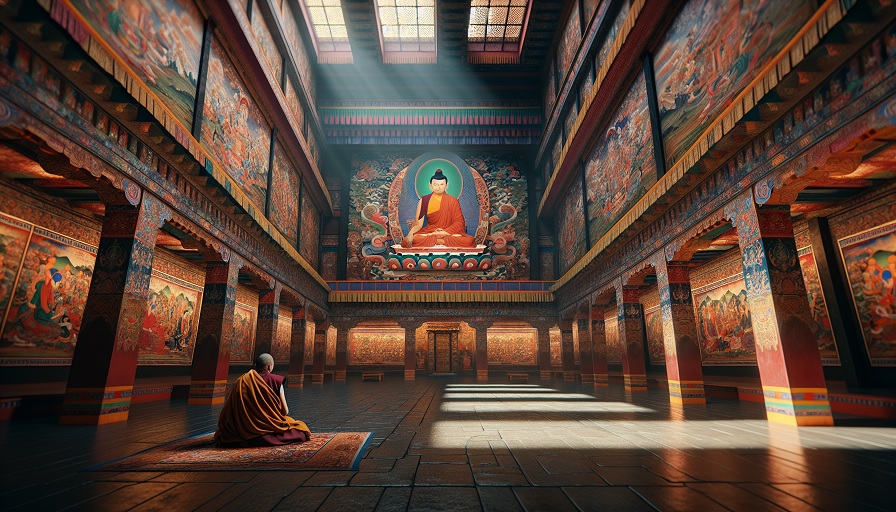
Most of us think of meditation as something that happens with the eyes closed. Settle into a comfortable seat, let the gaze soften or shut entirely, follow the breath, and gradually quiet the noise of the thinking mind. That is a perfectly valid approach, and it has helped millions of people. But Tibetan Buddhist meditation has, for more than a thousand years, taken a very different route into the same territory. It keeps the eyes wide open, and it puts a painting directly in front of them.
Thangka paintings were never purely decorative objects or simply visual summaries of Buddhist doctrine. They were, from their earliest origins, functional instruments of meditation practice. A Thangka hanging in a monastery cell or a private shrine room is more akin to a musical instrument than a picture on a wall. It exists to be used, not merely admired. Understanding how that use actually works reveals something surprising: that looking at a painting with the right kind of attention can become one of the most rigorous and transformative practices a meditator undertakes.
Contents
The Foundation: Why Images Matter in Tibetan Practice
To appreciate why Thangkas play such a central role in Tibetan Buddhist meditation, it helps to understand the general philosophy behind using imagery in the first place. In many contemplative traditions, images are considered a distraction, something to set aside on the path to formless awareness. Tibetan Vajrayana Buddhism takes nearly the opposite view.
Working With the Mind’s Own Nature
Vajrayana teaching holds that the mind is naturally creative and imaginative, constantly generating images, stories, and inner experiences whether we invite it to or not. Rather than fighting that tendency, Vajrayana practice harnesses it. If the mind is going to generate imagery anyway, why not train it to generate sacred imagery, imagery that embodies wisdom, compassion, and the qualities of an awakened being? The Thangka is the external reference point that supports and seeds that inner work. It is, in a sense, the practice’s training wheels and its advanced manual at the same time.
The Deity as a Mirror
Central to Vajrayana meditation is the concept of deity yoga, the practice of visualizing oneself as, or in the presence of, a fully enlightened being. This is not wishful thinking or performance. The underlying logic is that repeatedly dwelling in the felt sense of awakened qualities, compassion, wisdom, power, clarity, actually cultivates those qualities within the practitioner. The deity figure is a mirror held up to the practitioner’s own deepest nature. The Thangka gives that mirror a face, a posture, a color, and a set of symbolic attributes that the meditating mind can work with concretely.
Concentration Practice: The Thangka as Anchor
Before the more advanced forms of visualization practice begin, a student typically spends considerable time in simpler concentration work using a Thangka as the object of attention.
Trataka: The Steady Gaze
One foundational technique involves simply fixing the gaze on a specific element of the painting, often the face of the central deity, and holding it there with relaxed but steady attention. This is related to the Indian practice of trataka, or steady gazing, which has been used across contemplative traditions as a method for training one-pointed concentration. The mind wanders, as minds do, and the practitioner gently returns attention to the chosen point. Over time, with regular practice, the ability to sustain focused attention grows noticeably. The Thangka is a perfect object for this work because it rewards sustained attention. The longer and more steadily you look, the more you see, which gives the concentrating mind a natural incentive to stay.
Memorizing the Image
A more demanding stage involves studying the Thangka so thoroughly that the meditator can reproduce the entire image in the mind’s eye with the physical eyes closed. Every color, every gesture, every ornament, every background element is internalized until the inner image is as vivid and stable as the outer one. This process can take months or years for a complex composition. A seasoned practitioner might be able to hold a detailed multi-figure Thangka in interior vision with a clarity that would surprise most people, maintaining that inner image with the same steady attention they first developed through open-eyed gazing.
Visualization Practice: Building the Inner Palace
Once a degree of concentration is established and the outer image has been internalized, the meditator moves into what Tibetan teachers call generation stage practice, the active construction of a visualized sacred world in the mind.
The Mandala as Blueprint
For practitioners working with mandala Thangkas, the painting serves as a literal architectural blueprint for an inner journey. The meditator visualizes themselves approaching and entering the mandala palace through its eastern gate, moving through successive rings of symbolic meaning, encountering guardian figures at each threshold, and finally arriving at the center where the primary deity resides. This is not a passive experience of watching a mental movie. It is an active, effortful construction of a complete inner world, maintained with precision and populated with detail drawn directly from the Thangka’s iconographic program.
The Five Senses in Visualization
Advanced visualization practice in the Tibetan tradition does not limit itself to visual imagery alone. A meditator working with a deity figure from a Thangka might simultaneously hold the image of the figure, hear the deity’s associated mantra as an interior sound, sense the fragrance of offering incense, and feel the quality of compassion or wisdom that the deity embodies as a physical sensation in the body. The Thangka initiates this multi-sensory inner world by anchoring its visual layer with extraordinary specificity. Everything else unfolds from that anchor.
Specific Thangkas for Specific Practices
Different Thangka subjects are used as supports for different types of meditation practice, each one cultivating a particular quality or insight.
Medicine Buddha Thangkas
Thangkas depicting the Medicine Buddha, shown in deep lapis blue holding a bowl of healing nectar and a myrobalan plant, are used in practices aimed at healing, both physical and mental. Meditators visualize healing light radiating from the figure, entering their own body and mind, and extending outward to all beings who suffer. These practices are found in Tibetan medical tradition as well as in purely contemplative contexts, and their therapeutic dimension is taken seriously by practitioners and, increasingly, by researchers studying the mind-body connection.
Green Tara Thangkas
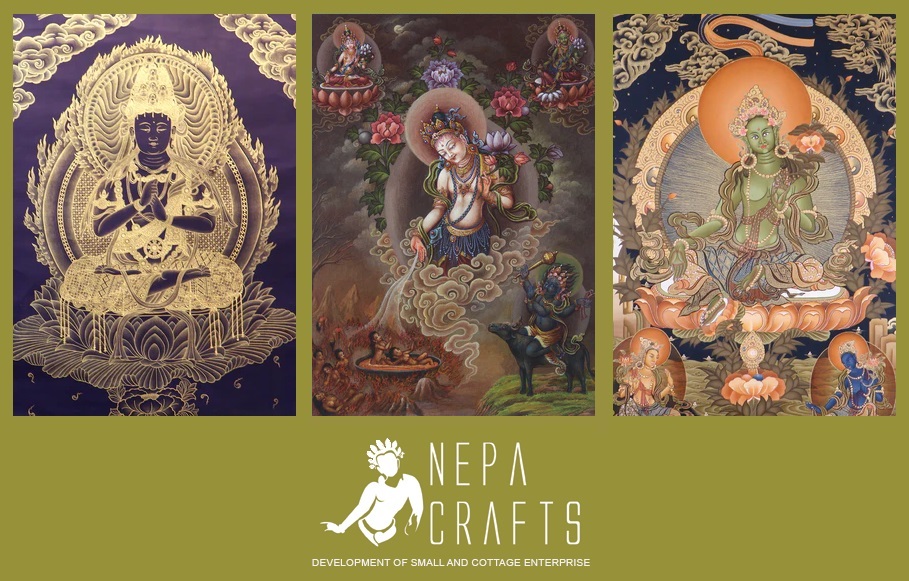
Green Tara, shown seated with one foot slightly extended as though ready to spring into action, is the deity of swift compassion and fearlessness. Her Thangka is used in practices that cultivate courage, the ability to act without hesitation in the face of difficulty. Practitioners working with fear, grief, or a felt sense of being frozen or overwhelmed often find Tara practice particularly alive. There is something about the combination of her serene face and her ready posture that communicates exactly what it is trying to cultivate: calm and capable at the same time.
Mandala Offering Thangkas
Some Thangkas depict the entire cosmological universe as an offering, the cosmic Mount Meru at the center, surrounded by four continents, sun and moon, and all the treasures of existence. These are used in mandala offering practice, a form of meditation in which the practitioner repeatedly offers the entire universe, mentally constructed with the help of the Thangka image, to the awakened beings. The psychological effect of regularly practicing giving away everything, including one’s sense of a fixed, bounded self, is said to loosen the grip of possessiveness and the anxiety that comes with it.
Thangka Practice Outside the Monastery
You do not need to be a monk or a formally initiated practitioner to benefit from working with a Thangka as a contemplative object. Many people find that simply sitting quietly before a well-made Thangka, without any formal technique, produces a natural settling of the mind. The precision and intentionality embedded in the image seem to communicate themselves to the viewer, inviting a quality of attention that ordinary decorative art rarely calls forth.
For those drawn to meditation who have not found a technique that resonates, working with a Thangka as a simple concentration object, returning attention gently to the image whenever the mind drifts, is a practice with a thousand-year track record. No special initiation is required for that. Just a painting, a cushion, and a willingness to look slowly.
The Image That Looks Back
There is a phrase sometimes used by Tibetan teachers when describing the relationship between a practitioner and their practice deity: “You look at the deity, and the deity looks at you.” It sounds poetic, but it points at something experiential. When genuine concentration develops in front of a Thangka, the painting stops feeling like a passive object and begins to feel like a presence. The figures seem to lean slightly forward. The eyes seem to actually see you.
Whether one interprets that experience as projection, as the awakening of a genuine sacred presence, or as something in between likely says as much about the interpreter as it does about the Thangka. But the experience itself is remarkably consistent across cultures and centuries of practitioners. It is, at minimum, a signal that the practice is working, that the boundary between observer and observed has become productively blurry. And that, in the Tibetan view, is exactly where the interesting work begins.