
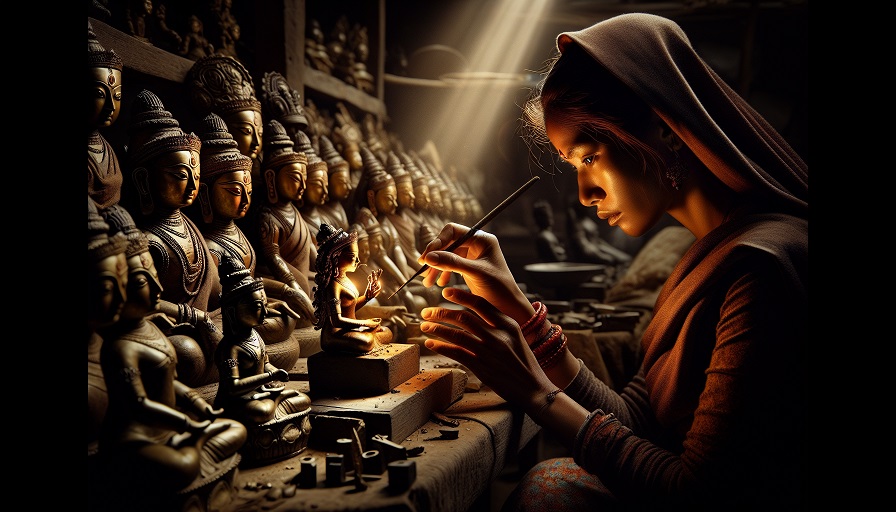
Ask a knowledgeable collector where to find the world’s finest handmade Buddhist statues and the answer will almost certainly include one word: Patan. This ancient city, also known by its Newari name Lalitpur, meaning “city of beauty,” sits in the Kathmandu Valley just a few kilometers south of Nepal’s capital. It is one of the oldest continuously inhabited cities in the Himalayan world, and for more than a thousand years it has been the undisputed center of Himalayan metal craft, the place where copper, bronze, and gold become sacred art in the hands of families who have done nothing else for generations.
Patan is not primarily a tourist attraction with a craft tradition attached to it. It is a craft tradition that happens to also be a city, one organized around the workshops, guild structures, and hereditary artisan families whose work has supplied Buddhist and Hindu temples, monasteries, and private collections across Asia and eventually the world.
Contents
A City Built Around Its Craftspeople
Patan’s urban structure reflects its craft identity with unusual directness. The neighborhoods of the old city were historically organized by caste and trade: metalworkers in one quarter, weavers in another, priests in another. The Shakya and Bajracharya communities, two Newar Buddhist castes with the deepest roots in metalworking and ritual craft, have occupied the same lanes for centuries. Walk through Patan’s backstreets today and the sound that accompanies you is the rhythmic tap of hammers on metal, the same sound that has marked time in these lanes since the Licchavi period, roughly the fourth to ninth centuries CE, when Patan’s craft traditions first achieved the sophistication that distinguished them across the region.
The city’s UNESCO World Heritage-listed Durbar Square, a remarkable concentration of temples, palaces, and courtyards at Patan’s historic center, is ringed by workshops whose wooden facades conceal interiors where master craftspeople work in conditions that would look familiar to their medieval predecessors. The tools have changed somewhat. The essential process has not.
The Lost-Wax Technique: An Ancient Mastery
The primary technique used by Patan’s statue makers is lost-wax casting, known in Sanskrit as the cire perdue process, and its mastery by Patan’s Newar artisans is the foundation of everything that makes their work exceptional. The process begins with a detailed wax sculpture of the deity to be cast. This wax model is coated in layers of clay mixed with other materials to create a mold, which is then fired. The heat melts the wax, which runs out through channels left for the purpose, leaving a precise hollow cavity in the shape of the original sculpture. Molten metal, typically a bronze alloy, is poured into the cavity. Once cooled, the clay mold is broken away to reveal the raw casting, which is then cleaned, chased with fine tools, and finished by hand.
What distinguishes Patan’s execution of this universal technique from similar work produced elsewhere is the quality of every stage. The wax model is sculpted with iconographic precision, following the canonical proportion systems, called thig-tse, that determine the correct measurements of every sacred figure. The finishing work, the chasing and engraving of surface detail that brings a statue’s face, robes, and ornaments to life, is where the generational expertise of Patan’s artisan families expresses itself most clearly. This is work that cannot be learned quickly or mechanized without losing what makes it meaningful.
Gold, Silver, and the Art of Gilding
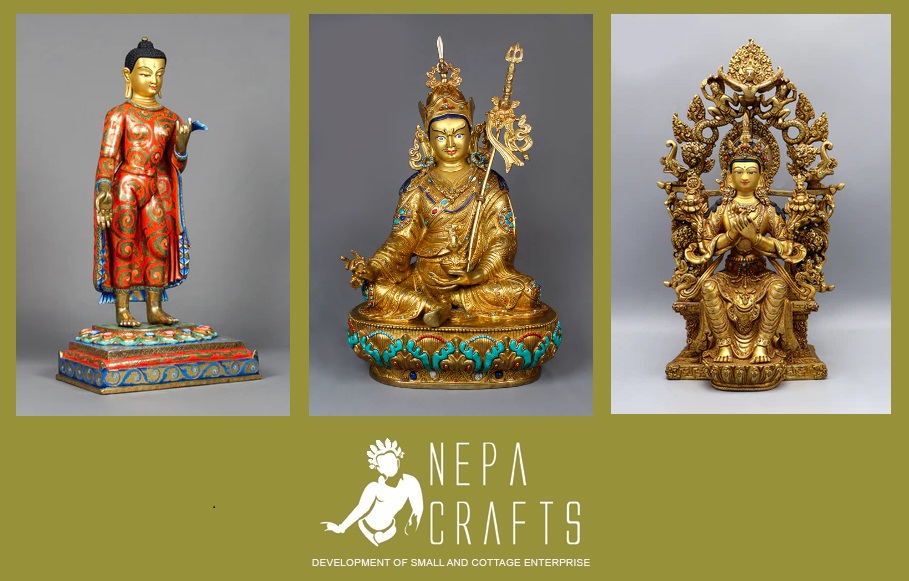
Many of Patan’s finest statues are gilded, covered in a thin layer of gold applied through either fire gilding or mercury gilding, processes that require both chemical knowledge and physical skill developed over years of practice. Fire gilding, the traditional method, involves applying an amalgam of gold and mercury to the statue’s surface, then heating it until the mercury vaporizes, leaving the gold fused to the metal beneath. The result is a surface of extraordinary warmth and depth, with a luminosity that differs noticeably from the flat brightness of electroplated gold. Some of Patan’s finest pieces are also inlaid with semi-precious stones including turquoise, coral, and lapis lazuli, each set by hand into settings created specifically for the individual stone.
Statues finished to this standard are not mass-produced in any meaningful sense. A single large, fully gilded, stone-inlaid figure of a Bodhisattva or Dhyani Buddha may represent months of concentrated work by one of Patan’s master craftspeople and several assistants. The price reflects this. So does the quality, which is immediately apparent to anyone who places a Patan-made statue alongside a factory-produced imitation.
The Newar Buddhist Identity Behind the Work
The artisans of Patan are not making sacred objects as a cultural performance for outside appreciation. Most of the families involved in statue production are themselves practitioners of Newar Buddhism, one of the oldest and most distinctive Buddhist traditions in the world, with roots in the Kathmandu Valley stretching back well over a millennium. For these families, the making of a Buddha statue or a Tara figure is an act of devotion as much as an act of craft. Many maintain active personal practices with the very figures they produce, reciting mantras during work and understanding the creation of a sacred image as an accumulation of spiritual merit.
This integration of devotion and skill is precisely what gives Patan’s statues their particular quality of presence, a quality that buyers often describe without quite being able to name it. It is the accumulated effect of generations of attention, intention, and mastery concentrated in a single object.
Patan Today
The 2015 earthquake that struck Nepal caused significant damage to historic structures in Patan, including several of the temples in Durbar Square. The rebuilding process has been slow and the losses in some cases irreplaceable. Yet the craft tradition itself proved more resilient than the stone. The workshop families of Patan continued working through the recovery period, their skills undamaged, their knowledge intact, their commitment to the tradition as steady as it has been for a thousand years.
A statue that comes from one of Patan’s traditional workshops carries all of that history with it. Not as a label or a provenance certificate, but as something embedded in the object itself, in the hammer marks on the metal, in the carved lines of a deity’s face, and in the hands that will have moved across its surface hundreds of times before it is considered complete.