
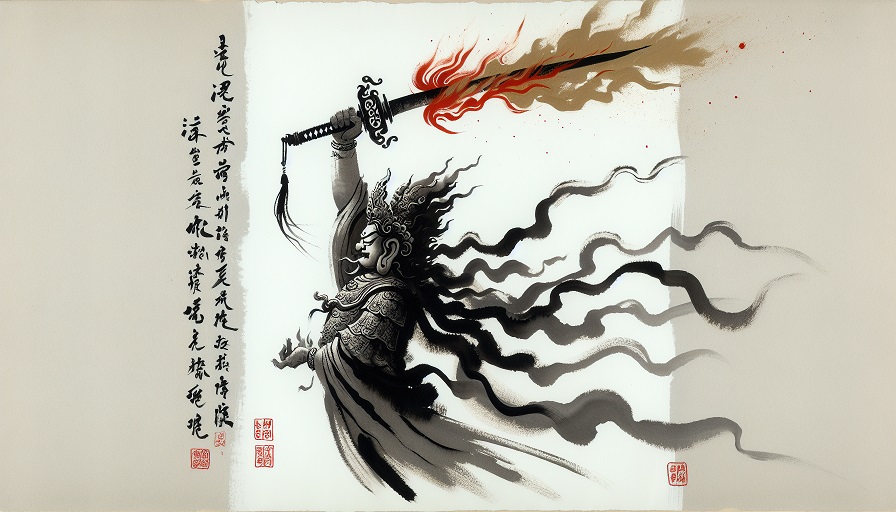
Of all the questions a newcomer might ask when first encountering Tibetan Buddhist art, few are more natural than this one: why is that serene, bejeweled figure raising a flaming sword above his head? The combination feels jarring, even contradictory. Serene and sword-wielding. Gentle and armed. It looks, at first glance, like a warrior who wandered into the wrong painting. But once you understand who Manjushri is and what that sword actually represents, the image becomes not just coherent but quietly brilliant, one of the most concentrated expressions of what Buddhist wisdom actually means and why its acquisition takes genuine courage.
Manjushri is the bodhisattva of wisdom, one of the most ancient and widely venerated figures in the entire Mahayana Buddhist tradition. His name, from the Sanskrit, is typically translated as “gentle glory” or “sweet splendor,” and those soft syllables stand in deliberate and instructive contrast to the fierce attribute he is best known for. He appears in Buddhist texts dating back nearly two thousand years, and across that span of time he has served as the patron of scholars and students, the guardian of philosophical inquiry, the deity invoked at the beginning of debates and the start of studies. He is, in the most practical and active sense, the figure Buddhism associates with the kind of intelligence that cuts through confusion rather than simply accumulating information.
Contents
The Iconography of Wisdom
A well-made Manjushri statue or Thangka painting communicates his essential character with considerable precision, and each element of his appearance is worth examining carefully. He is typically depicted as a young prince in the full bloom of youth, adorned with jeweled ornaments and a crown, skin golden yellow or sometimes white, his expression combining serenity with a quality of alert, engaged intelligence. He does not look like someone who has retired from the world into passive contemplation. He looks like someone who is paying very close attention.
The Flaming Sword of Prajna
In his right hand, raised high above his head, Manjushri holds the sword of prajna, of discriminating wisdom. It is important to be clear about what this sword is and is not. It is emphatically not a weapon of violence, aggression, or dominance. It is a symbol drawn from a long tradition of using the blade as a metaphor for the quality of mind that cuts through complexity to essential truth. The sharpness of a sword that can part tangled knots with a single stroke captures something genuine about the experience of real understanding: when true insight arises, confusion does not gradually fade. It is severed. It is gone. The flame on the blade emphasizes this quality further, adding the connotation of purification, of burning away what obscures rather than simply setting it aside. Ignorance, in this image, is not an opponent to be defeated in argument. It is a knot to be cut, a fog to be burned through.
The Prajnaparamita on a Lotus
In his left hand, Manjushri holds the stem of a lotus flower, and resting on the flower’s open bloom is a text: the Prajnaparamita Sutra, the Perfection of Wisdom scripture. The Prajnaparamita literature is among the most philosophically challenging and revered body of texts in all of Buddhism. Its most condensed form, the Heart Sutra, is only a page long and yet contains teachings on emptiness and the nature of reality that practitioners spend lifetimes unpacking. By holding this text on a lotus, Manjushri is depicted as the embodiment and living source of that wisdom tradition, the being from whom these teachings most directly flow and the figure who can most directly transmit their meaning to a receptive student.
Youth as a Symbol
The choice to depict Manjushri as a young prince rather than as an elder sage is deliberate and somewhat counterintuitive in a tradition that associates age with accumulated wisdom. The youth of Manjushri’s form represents not inexperience but the quality of wisdom itself when it is fully alive: fresh, immediate, not overlaid with the accumulated habits and fixed positions that years of intellectual activity can sometimes produce. The Sanskrit name for this aspect of Manjushri is Manjughosha, “sweet voice,” and one of his forms is called Manjushri Kumarabhuta, “Manjushri in the form of a youth.” His wisdom is not the heavy, defended knowing of someone who has spent decades building an intellectual edifice they are now invested in protecting. It is the bright, cutting clarity of a mind that has not yet decided what it already knows.
Emptiness and the Sword: The Deeper Teaching
To fully appreciate what Manjushri’s sword is cutting, it helps to understand something about what Buddhist wisdom, prajna, is actually directed toward. The central insight that Mahayana Buddhism considers the apex of understanding is the doctrine of shunyata, emptiness. This is not a nihilistic claim that nothing exists or that nothing matters. It is the more precise and ultimately more liberating recognition that nothing exists in the fixed, independent, self-sufficient way that our habitual thinking assumes.
The Knot of the Self
What Manjushri’s sword is cutting, at its most fundamental level, is the deeply ingrained belief in a permanent, independent self, a solid “I” that exists as a fixed entity at the center of experience. Buddhist analysis, both philosophical and meditative, suggests that this belief, which runs far deeper than any conscious opinion we might hold about it, is the root from which all forms of suffering grow. We suffer because we are protecting something that, on careful examination, turns out not to be there in the solid form we assumed. When that belief is genuinely cut through, not intellectually argued away but actually severed at the experiential level, what remains is not a terrifying void but something more like open sky, spacious and unimpeded.
This is why the sword in Manjushri’s hand is raised and aflame. What it cuts is not small. It is the most fundamental misunderstanding a sentient being carries, the misunderstanding that makes all other confusions possible. And it requires something genuinely sharp to cut it.
Manjushri in Practice: How His Energy Is Invoked
For practitioners in the Tibetan tradition, Manjushri is not simply an interesting iconographic figure to be studied and admired. He is actively invoked in practices aimed at sharpening intelligence, deepening understanding, and cutting through the mental fog that makes clear perception difficult.
The Mantra of Clear Intelligence
Manjushri’s principal mantra, Om A Ra Pa Tsa Na Dhih, is one of the most widely recited mantras in Tibetan Buddhist practice. The final syllable, Dhih, is considered Manjushri’s seed syllable, his most concentrated sonic essence, and it is sometimes recited rapidly in long sequences as a specific practice for clearing mental obscurations and sharpening the capacity for study and insight. Students preparing for examinations, practitioners beginning a period of intensive philosophical study, and meditators working through conceptual tangles in their practice have recited this syllable in multiples of hundreds and thousands for generations. Tibetan monasteries traditionally begin their philosophical debate sessions with recitation of Manjushri’s mantra, an acknowledgment that the sharpest human intellect, without the blessing of wisdom, is still just cleverness.
Manjushri as Debate Patron
The monastic philosophical debate tradition of Tibet is one of the most rigorous intellectual systems ever developed, a form of dialectical training in which monks and nuns argue positions on points of Buddhist philosophy with a formalized structure of question, answer, and challenge that can continue for hours. Participants slap their hands together sharply as they make logical points, a gesture that is both emphasis and punctuation. The entire enterprise is conducted under Manjushri’s patronage, and beginning a debate session with his invocation is understood not merely as ritual courtesy but as a genuine request for the kind of precision and clarity that good philosophical inquiry requires and that ordinary conceptual mind, left to its own devices, tends to slide away from.
Manjushri Across Buddhist Cultures
Like Maitreya and Avalokiteshvara, Manjushri has traveled widely across the Buddhist world and taken on distinct cultural colorings at each stop. In China he is Wenshu, one of the four great bodhisattvas of Chinese Buddhism, and is associated with Mount Wutai in Shanxi province, one of the four sacred Buddhist mountains of China, where he is said to manifest and where a tradition of pilgrimage stretching back over a thousand years continues to this day. In Japan he is Monju, the patron of students and learning, whose image is found in Zen temples alongside teaching halls. In Nepal and Tibet his presence is felt not only in religious practice but in cultural mythology: the Kathmandu Valley itself is said in Newar Buddhist legend to have been drained of its primordial lake by Manjushri, who cut through the surrounding hills with his sword to release the waters and create habitable land. The valley’s civilization, in other words, began with an act of Manjushri’s discriminating wisdom.
Manjushri and Nagarjuna
The most celebrated human recipient of Manjushri’s direct transmission in the Buddhist philosophical tradition is Nagarjuna, the second-century Indian philosopher whose Mulamadhyamakakarika, the Fundamental Verses on the Middle Way, is considered the foundational text of Madhyamaka philosophy and one of the most important philosophical works ever composed in any tradition. Nagarjuna is said to have received his deepest insights directly from Manjushri, and his systematic exposition of emptiness, using logical analysis to demonstrate the unfindability of any independently existing phenomenon, is understood by Tibetan scholars as the conceptual articulation of the insight Manjushri’s sword embodies. Put another way, Nagarjuna’s two-thousand-year-old philosophical masterwork is, in some sense, what happens when Manjushri’s blade lands true.
The Statue That Teaches by Standing There
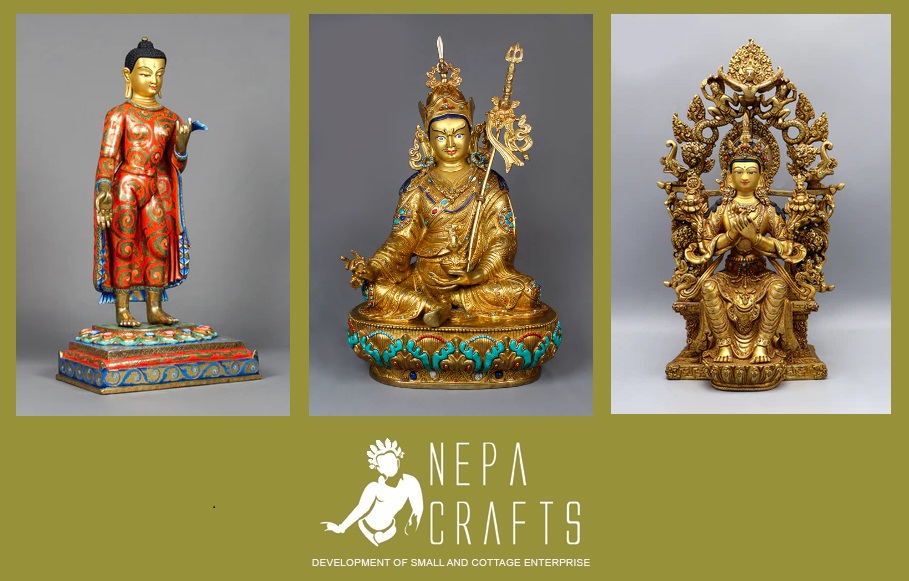
A well-crafted Manjushri statue occupies a room differently from most other Buddhist figures. Where a Medicine Buddha statue radiates a quality of healing stillness and a Tara carries an air of poised readiness, Manjushri brings something that feels more active, more searching. It is the quality of a question held with complete commitment, the kind of questioning that does not rest until it has found something real to rest on.
Artisans in Patan who craft Manjushri statues are working with a particularly demanding subject. The sword must be rendered with enough precision to feel genuinely sharp rather than merely decorative. The face must carry that distinctive combination of serenity and keen alertness. The youth of the figure must communicate freshness rather than inexperience. Getting all of that right in bronze or copper requires exactly the quality that Manjushri himself embodies: a fine-tuned sensitivity to the difference between what is almost right and what is actually right, and the patience and skill to close that gap.
In the end, that is what Manjushri’s sword is pointing at in every shrine room and meditation space it occupies: not just the cutting of ancient philosophical knots but the everyday gap between confusion and clarity, between the mind that is circling an idea and the mind that has actually landed on something true. That gap is not as wide as it sometimes feels. But you do need a sharp blade to cross it.