
Every great tradition has its version of the hope that things will, eventually, be better than they are now. Christianity has its Second Coming. Judaism has its messianic age. Hinduism has Kalki, the tenth avatar of Vishnu, who arrives at the end of the current age to restore order and righteousness. Buddhism has Maitreya. And while the specifics differ considerably from their counterparts in other traditions, the underlying human longing that these figures address is recognizable across all of them: the wish that wisdom, justice, and compassion will one day prevail, that the arc of things bends somewhere meaningful, and that the suffering of the present moment is not the final word on the human story.
Maitreya is the Buddha of the future, the next fully enlightened teacher who will arise in our world after the teachings of Shakyamuni Buddha have been completely forgotten. His name derives from the Sanskrit maitri, meaning loving-kindness or benevolence, the same root from which the Pali word metta comes, the loving-kindness that is the subject of one of Buddhism’s most widely practiced meditations. He is, in other words, not merely the next great teacher but specifically the Buddha of love, and that detail is not incidental. It is a statement about what quality of awakened mind will be most needed when he arrives.
Contents
Where Maitreya Is Now
Unlike the historical Shakyamuni Buddha, who walked dusty roads in northern India and whose life can be placed within a reasonable historical framework, Maitreya currently resides in Tushita, one of the heavenly realms of Buddhist cosmology. Tushita, whose name means “the joyful” or “the contented,” is described in Buddhist texts as a realm of extraordinary beauty and favorable conditions, a place where beings of great merit are reborn and where the future Buddhas await their time to descend to earth.
A Realm of Preparation
The idea of Maitreya waiting in Tushita is not a picture of passive celestial lounging. In the Tibetan understanding, Maitreya is actively teaching in Tushita right now, and practitioners who accumulate sufficient merit and maintain the aspiration to meet him there are said to be reborn in his presence after death, receiving his teachings directly while awaiting the circumstances of his earthly descent. Several Tibetan teachers have described their meditation retreats as including visions of Maitreya in Tushita, and the lineage of teachings attributed to him, transmitted through the fifth-century master Asanga, forms a cornerstone of Mahayana philosophical study to this day.
Asanga’s encounter with Maitreya is itself one of the most compelling stories in Buddhist intellectual history. After twelve years of intensive meditation retreat aimed at achieving a vision of Maitreya, a practice most of us would find discouraging after about twelve weeks, Asanga emerged from his cave having apparently failed. On the road, he encountered a wounded dog covered in maggots. Moved by compassion, he bent to remove the maggots, unwilling to harm them but equally unwilling to leave the dog suffering. At that moment of pure selfless action, Maitreya appeared before him. The teachings Asanga subsequently received and recorded, known as the Five Treatises of Maitreya, became foundational texts of Mahayana Buddhism. The story suggests that Maitreya was not absent during those twelve years. Asanga simply was not yet ready to see him.
When Will Maitreya Arrive?
This is the question most newcomers to the subject ask first, and the honest answer requires some adjustment of expectations. Buddhist cosmological time operates on a scale that makes geological time look like a long weekend. The traditional teaching holds that Maitreya will appear in our world when the human lifespan, which is currently understood to be in a period of gradual decline, has fallen to around ten years, then slowly increases again over immense spans of time, eventually reaching eighty thousand years. When the lifespan reaches that extraordinary length and conditions are optimally favorable for the reception of Dharma teachings, Maitreya will descend from Tushita and achieve full Buddhahood under a great tree, just as Shakyamuni did under the Bodhi tree.
A Timeline That Reframes Urgency
Different Buddhist schools give different numerical estimates for when this will occur. Some texts speak of millions of years, others of figures so large they strain the imagination entirely. Rather than finding this discouraging, Tibetan teachers tend to use the vast timeline to make a particular point: the relative rarity and preciousness of encountering the Dharma in the present moment. If Maitreya’s arrival is millions of years away, and the window of time during which Shakyamuni’s teachings remain available is finite, then the opportunity of the present moment to practice and awaken carries an urgency that the sheer inconceivability of future time only sharpens. You have now. Use it well.
How Maitreya Is Depicted in Art
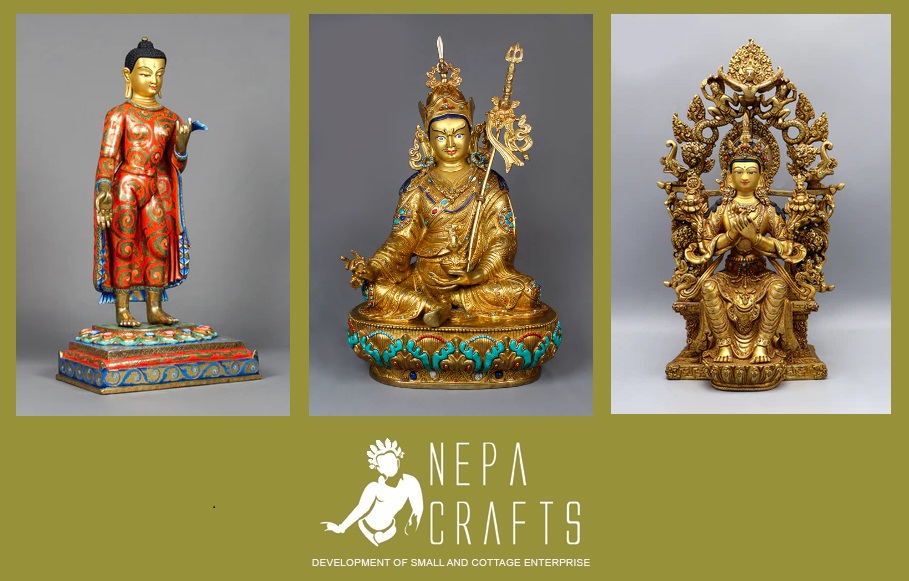
One of the most immediately recognizable features of Maitreya in Buddhist statuary and Thangka painting is his posture, and it is distinctly different from the seated meditation posture associated with most Buddha figures. Maitreya is typically shown seated on a throne with both feet flat on the ground, or with his legs pendant, hanging down as though he is about to stand. This posture is called the European seat or bhadrasana in Sanskrit, and it communicates something specific: Maitreya is seated in readiness, not in the deep inward absorption of a figure resting in enlightened equipoise, but in the posture of one who is about to rise and enter the world.
Crown and Stupa
Unlike the historical Shakyamuni, who is typically shown in the simple robes of a monk with the topknot of the ushnisha visible on his bare head, Maitreya is depicted as a bodhisattva rather than a fully realized Buddha, adorned with jewels, silks, and a crown. In his crown, or sometimes resting on a lotus beside him, is a small stupa, a reliquary mound representing the Buddhist teaching itself and the presence of the Buddha. This stupa in the crown is Maitreya’s primary identifying attribute and the detail that distinguishes him from other jeweled and crowned bodhisattva figures when no other inscription or context is available. In his hands he typically holds the stems of lotus flowers, upon which rest the vase of the nectar of immortality and the Wheel of Dharma, the wheel he will set turning again when he arrives.
The Great Standing Statues
Some of the most monumental Buddhist sculptures ever created depict Maitreya standing upright, arms at his sides or raised in blessing, on a scale that dwarfs the human figures gathered at his feet. The enormous Maitreya statues of Ladakh in northern India, some carved directly into cliff faces during the eighth and tenth centuries, and the famous standing Maitreya at the Tashilhunpo Monastery in Tibet, are among the most awe-inspiring works of religious art in the Himalayan world. The sheer scale of these works communicates something that iconographic detail alone cannot: the magnitude of what Maitreya’s arrival will mean for all beings.
Maitreya and the Teaching of Loving-Kindness
Because Maitreya’s name is rooted in maitri, loving-kindness, his figure carries a particular resonance for practitioners of metta meditation, the systematic cultivation of goodwill toward all beings without exception. The traditional metta practice begins with cultivating warmth toward oneself, then toward a benefactor, then toward a neutral person, then toward a difficult person, and finally extends outward to encompass all beings in every direction without limit. It is a practice that tends to feel easy in the early stages and increasingly demanding as it encounters the people and situations where genuine goodwill is hardest to maintain.
Love as Cosmic Principle
What Maitreya as a figure suggests is that loving-kindness is not simply a meditation technique or a personal virtue to be cultivated in quiet moments on a cushion. It is the quality of an enlightened mind at the level of full Buddhahood, the specific form that awakened awareness takes when it meets the world of beings. The fact that the next Buddha is specifically the Buddha of love, rather than the Buddha of power or knowledge or discipline, says something about where this tradition understands the arc of awakening to be heading. Not toward a distant cold perfection but toward the warmth at the center of things, a warmth large enough to hold every being without exception and without remainder.
Maitreya Across Asian Cultures
Few Buddhist figures have traveled as widely or transformed as dramatically across different cultural contexts as Maitreya. In China, the future Buddha became associated with Budai, the fat, laughing monk figure sometimes called the Laughing Buddha in the West, whose round belly and broad grin became the universally recognized face of contentment and good fortune. While this identification is not universally accepted in scholarly or religious circles, it reflects something genuine about how Maitreya’s quality of benevolent abundance translated into Chinese cultural sensibility.
In Japan he is Miroku, one of the most ancient and beloved Buddhist figures in the tradition, depicted in a famous seventh-century wooden sculpture at the Koryu-ji temple in Kyoto with one leg crossed over the other and a hand raised to a thoughtfully tilted cheek, his expression so gentle and inward that the sculpture has moved generations of visitors to tears. In Korea he is Mireuk, deeply woven into shamanic and folk religious traditions alongside his Buddhist identity. The figure of the Future Buddha, it seems, adapts with particular ease to new cultural containers, perhaps because the longing he represents is itself so universally human.
What His Arrival Ultimately Means
Strip away the cosmological timelines, the heavenly realms, and the elaborate iconographic programs, and what Maitreya points toward is something quite simple. He is the reminder that love, in its fullest and most unconditioned form, is not a private feeling or a personal achievement but the natural expression of a mind that has seen clearly all the way to the bottom of things. His arrival in some inconceivably distant future is less a prediction than a direction of travel, an orientation of aspiration that shapes how a practitioner moves through the present.
You practice loving-kindness now not because Maitreya is coming soon, but because the cultivation of that warmth, extended with increasing fearlessness to an ever-wider circle of beings, is itself the path toward whatever Maitreya represents. The future Buddha is not waiting passively in Tushita for the calendar to catch up. According to the tradition, he is teaching right now, and the lesson, if Asanga’s story is anything to go by, has less to do with grand celestial visions than with a wounded dog on a dusty road, and the choice of what to do when you encounter something that is suffering and you have the capacity to help.