
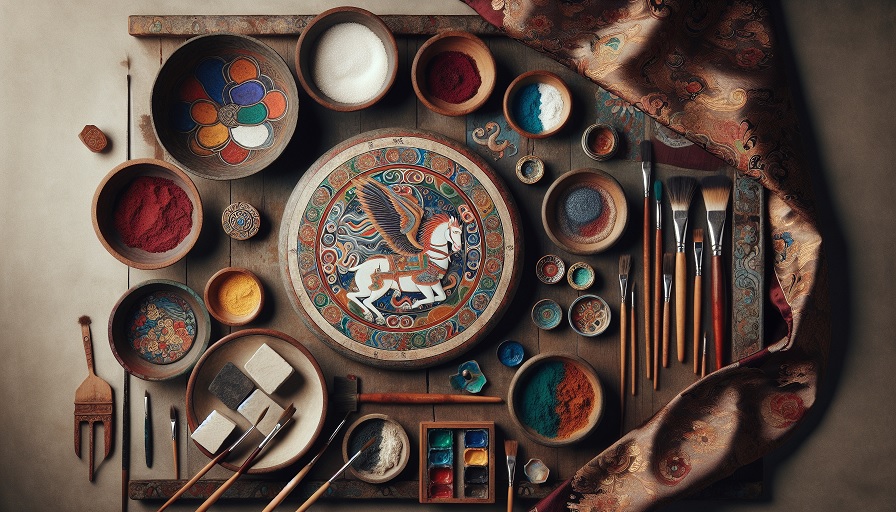
In the narrow lanes of Bhaktapur and Patan, two of Nepal’s ancient cities tucked into the Kathmandu Valley, you can still find workshops where the air smells of mineral pigment and hide glue, where artists sit cross-legged on low cushions with brushes so fine they contain only a few hairs, and where a single painting may take months to complete. These are Thangka studios, and what happens inside them is one of the most remarkable intersections of art, craft, spirituality, and cultural continuity anywhere on earth.
Most people, when they learn how a Thangka is actually made, have the same reaction: a long pause, followed by something like, “They do all of that by hand?” Yes. All of it. From the moment raw cotton cloth is stretched across a frame to the final whisper of gold detail work, every stage of creating a Thangka is a deliberate, skilled, and deeply intentional process. Here is how it unfolds.
Contents
Before the Brush Is Lifted: Preparation of the Artist
In traditional Thangka practice, the preparation of the artist is considered just as important as the preparation of the materials. A painter approaching a sacred commission is expected to be in the right mental and moral state before beginning. This means prayer, purification rituals, and sometimes fasting or meditation. The underlying idea is that the quality of the artist’s mind during the work will be absorbed into the painting itself, affecting its spiritual potency.
The Lineage of Learning
A Thangka painter does not simply pick up a brush and improvise. The tradition is transmitted through apprenticeship, often within families where the craft has been practiced for generations. Young artists typically spend years learning proportion systems, copying established compositions, and studying iconographic texts before they are trusted to work on an original commission. In some Nepalese families, the trade has passed from parent to child for five or six generations without interruption. That is not just a craft tradition. That is a living archive.
Preparing the Canvas
The surface of a Thangka is not simply a piece of fabric pinned to a wall. It is a carefully engineered ground, built up in stages to create exactly the right texture for fine detail work.
Stretching and Sizing
The process begins with a piece of plain cotton or linen cloth, cut to the desired size and laced onto a wooden stretcher frame with cord. Once taut, the cloth is coated with a sizing mixture, traditionally made from chalk or gypsum mixed with animal-hide glue and sometimes a small amount of water. This mixture fills the weave of the fabric and creates a smooth, slightly absorbent ground.
Polishing the Surface
Once the sizing has dried, the real work of surface preparation begins. The coated canvas is polished repeatedly with a smooth stone, often a river-rounded piece of quartz or agate, using firm circular pressure. This step is done multiple times, sometimes with additional thin coats of sizing between polishings. The goal is a surface as smooth and uniform as fine paper, one that will allow a single hair brush to glide without catching. Run your fingertip across a properly prepared Thangka canvas and it feels almost like porcelain. That quality does not happen by accident. It happens because someone spent hours with a stone.
Transferring the Composition
With the canvas ready, the artist must lay out the composition. This is where the iconographic grid systems, called thig-tse, come into play. These are precise proportional frameworks, passed down in manuals, that specify the correct measurements for every type of deity figure: how many finger-widths from the crown of the head to the chin, how wide the shoulders should be relative to the total height, where the navel falls, and so on. Sacred figures are not guessed at. They are measured.
Sketching with Charcoal
Using a length of charcoal string snapped against the canvas to create guidelines, and then a fine charcoal pencil to draw the figures freehand within those guides, the artist builds the complete composition in light, removable lines. At this stage the painting looks like a ghostly blueprint, all flowing outlines with no color. Corrections are easy here, simply brush away the charcoal and redraw. Once the sketch is approved, the outlines are reinforced with a thin ink line that will survive the painting process.
Grinding and Mixing Pigments
Traditional Thangka pigments come from natural mineral and organic sources, and preparing them is a craft within a craft. Raw mineral chunks of lapis lazuli, malachite, cinnabar, and orpiment are ground by hand on a stone palette with a muller, a process that can take hours for a single color. The ground pigment is then mixed with a binding agent, traditionally a dilute solution of animal-hide glue, ox bile (which helps the paint flow and adhere), and sometimes a little water. The resulting paint has a particular quality that synthetic pigments simply do not replicate: a depth and luminosity that comes from light interacting with actual mineral particles rather than dye molecules.
The Gold Preparation
Gold deserves its own mention. In Thangka painting, real gold is used, typically in two forms. Gold leaf, extremely thin sheets of beaten gold, is applied in certain areas for broad gilded surfaces. Gold paint is made by grinding gold dust or flake with a binding agent to create a fluid that can be applied with a brush. Before applying gold paint, the artist often burnishes the dried surface with an agate stone to create a mirror-like shine. The effect, especially under warm light, is the soft inner glow that makes a well-made Thangka look lit from within.
The Painting Process
With pigments prepared and the sketch in place, the painting itself begins in a specific order that every Thangka artist follows. Backgrounds are laid in first, typically the sky and landscape elements. Then the large flat areas of color on the main figures are blocked in. This is called the “first color pass,” and it establishes the overall color relationships of the composition.
Shading and Modeling
Once the flat colors are dry, the artist begins the painstaking work of shading and modeling, building up the three-dimensional appearance of figures through careful gradations of lighter and darker tones. This is done with extraordinarily fine brushwork, layering thin glazes of color to suggest the roundness of limbs, the drape of fabric, and the softness of a face. A single figure might receive a dozen or more successive layers of shading before the artist is satisfied.
The Finest Work: Detail and Outline
The final painting stages involve the most demanding brushwork of all. Faces, which carry the spiritual expression of the deity and are considered the most sacred part of any figure, are often painted last and sometimes by the most senior artist in the studio. Eyes, in particular, are treated with special reverence. There is a traditional practice in some schools of painting the eyes of a new Thangka in a small ceremony, the moment when the figure is said to truly “come alive.” Fine gold line work, intricate decorative patterns on robes and thrones, and the delicate rendering of flowers and offering objects all belong to this final stage.
Mounting: The Brocade Frame
When the painting is complete, it is removed from the stretcher frame and mounted onto a fabric surround of silk or woven brocade. The traditional color combinations for the border, inner lining, and backing carry their own symbolic meanings, typically working with red, yellow, and sometimes blue or gold. Wooden dowels are attached at the top and bottom so the finished piece can be hung and rolled. A panel of sheer silk is sometimes attached as a veil over the face of the painting, which is drawn aside when viewing. The whole mounted assembly is what most people mean when they say “a Thangka.”
Consecration: The Final Step
For a Thangka made for religious use, the physical completion of the painting is not the final step. The finished work is brought to a qualified lama, a Buddhist teacher, who performs a consecration ceremony. Prayers are recited over the painting, mantras are inscribed on the back of the canvas in ink, and sacred substances are sometimes sealed inside a small compartment at the base. This ritual is what formally transforms a very fine painting into a sacred object, one that practitioners believe carries genuine spiritual blessing.
It is worth sitting with that for a moment. From the artist’s morning prayers before the first brushstroke to the lama’s final blessing over a completed work, the making of a Thangka is treated as a single continuous sacred act. The months of skilled labor in between are not just production. They are practice. And that, more than any technique or material, is what makes a genuine Thangka something genuinely rare in the world.