
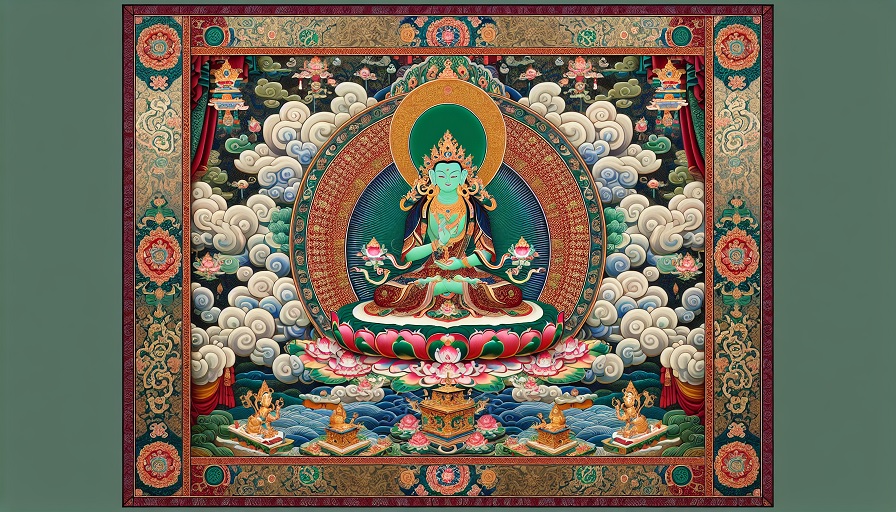
Something interesting is happening in Western interior design, and it has very little to do with trends. Himalayan art objects, Buddha statues, Thangka paintings, singing bowls, prayer flags, and handwoven textiles from Nepal and Tibet, are appearing with increasing frequency in homes that have no particular connection to Buddhism or to Asia. They appear in meditation rooms and living rooms, in minimalist Scandinavian-style apartments and eclectic bohemian spaces, in the offices of therapists and the studios of artists. They keep showing up because, it seems, they keep doing something useful wherever they land.
Understanding why Himalayan art travels so well into Western contexts requires thinking about what these objects actually are, what they carry, and how the qualities that made them meaningful in their cultures of origin translate, sometimes with surprising directness, into the needs of contemporary Western life.
Contents
The Qualities That Cross Borders
The art objects of the Himalayan tradition were not designed for aesthetic contemplation in the Western sense. They were made to do things: to anchor meditation practice, to embody and radiate specific qualities of awakened mind, to create sacred space, to mark transitions, to invoke specific energies and intentions. These are not, it turns out, culturally specific needs. They are human needs, and a Western living room is just as capable of needing an anchor for attention, a reminder of what matters, or a quality of sacred stillness in a designated corner, as a Tibetan shrine room was.
The objects also carry an aesthetic authority that comes from their origins in a tradition of rigorous craft. A well-made Buddha statue from Patan has been shaped by proportion systems refined over centuries, by iconographic programs carrying layers of meaning, and by the physical attention of an artisan bringing both technical skill and devotional intention to the work. That accumulated quality of care is visible, even to eyes that cannot read the symbolic program. People respond to it without necessarily knowing why.
Buddha Statues: Beyond Religious Symbol
The Buddha statue is probably the most widely distributed Himalayan art object in Western homes, and its presence there is often described in non-religious terms: it brings calm to a space, it creates a focal point, it provides something to return the eye to when the room’s ordinary demands feel overwhelming. These descriptions are more accurate than they might initially seem. A Buddha in the earth-touching mudra, seated in unshakeable equanimity, does communicate something specific to the nervous system that sees it regularly. That communication happens below the level of belief. You do not need to be Buddhist for a quality of stillness to be recognizable as stillness, or for an image of complete settledness to encourage some of that quality in the observer.
The question of placement matters more than most people initially realize. A Buddha statue set on the floor or used as a doorstop is, by the standards of its tradition, disrespectful. Placed at or above eye level, given some clear space around it, treated as the significant object it is, it functions entirely differently, both aesthetically and in the subtler ways that careful placement of meaningful objects affects the quality of a space. The tradition’s guidance on altar placement, covered in the earlier article on Buddhist home altars in this series, applies even in secular contexts: elevation and clear space signal significance, and significance is what creates the quality of focal presence that draws people to these objects in the first place.
Thangka Paintings as Wall Art
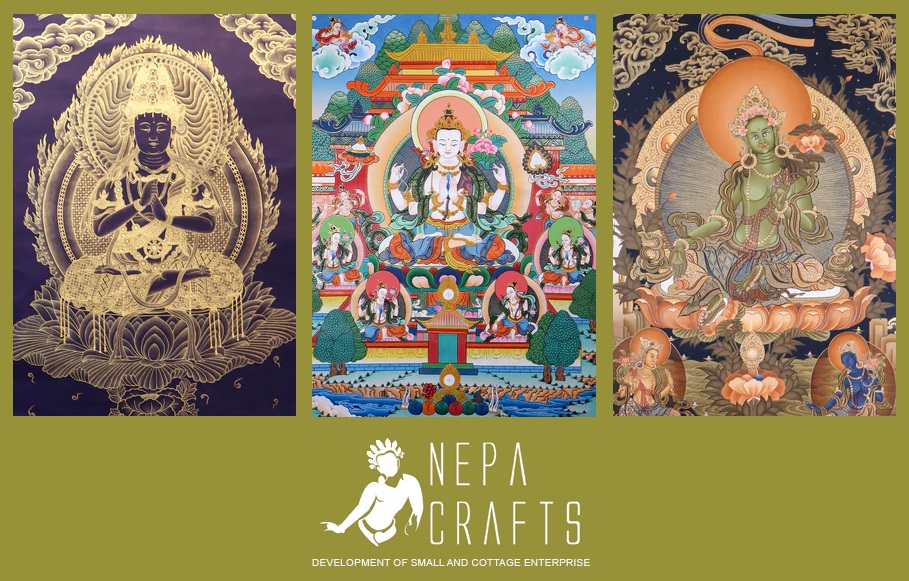
A Thangka painting brings something to a wall that conventional Western art rarely offers: visual complexity that rewards sustained attention rather than yielding its content immediately. The symbolic density of a Thangka, its multiple figures, its precise color program, its layered iconographic meaning, means that looking at it carefully over months and years is a genuinely different experience from looking at it casually. The painting opens slowly, revealing more the longer it is known.
In a Western home, a Thangka works best when given enough wall space to breathe and enough light to reveal its colors without the bleaching effect of direct sunlight. It does not need to be placed on a formal altar. Above a reading chair, at the end of a hallway, or as the focal point of a meditation corner, it brings a quality of visual intention to the space that reproductions and prints cannot match. The silk brocade border and the wooden hanging rod are part of the object’s aesthetic logic, not accessories to be removed for a cleaner look.
Singing Bowls: Sound as Interior Design
The singing bowl may be the Himalayan object that requires the least cultural translation for Western audiences, because its primary mode of communication is acoustic rather than symbolic. You do not need to understand Tibetan Buddhism to feel what a well-made singing bowl does to the air in a room and to the quality of attention of the people in it. This directness of effect is precisely why singing bowls have found homes in yoga studios, therapy offices, sound healing practices, and ordinary living rooms where someone simply discovered that striking one at the end of a difficult day produced a reliable shift in the quality of the next thirty minutes.
A singing bowl displayed on a cushion on a coffee table or a side table is not merely decorative. It is available, which matters. An object that invites interaction, that can be picked up and used whenever the day calls for it, integrates into the rhythm of daily life in a way that purely decorative objects do not. The bowl becomes part of the household’s practical toolkit for managing the texture of ordinary days.
Textiles, Prayer Flags, and Everyday Objects
Beyond the major art categories, Himalayan craft objects in smaller scales, pashmina shawls, hand-knitted wool textiles, hand-felted cushion covers, Lokta paper journals, hemp bags, find homes in Western living spaces with particular ease because their cultural specificity is worn lightly. A pashmina draped over a reading chair carries the quality of its making without requiring its owner to know anything about Nepalese textile traditions. A Lokta paper journal on a desk carries the warmth and texture of handmade craft without any symbolic freight that might feel unfamiliar.
Prayer flags strung across a garden or balcony are perhaps the most visually dynamic of all the Himalayan objects that travel well. Their five colors move in the wind, their printed prayers and mandalas visible on close inspection, their overall effect joyful and culturally distinctive in a way that brightens any outdoor space. The tradition behind them is meaningful and worth knowing. The visual pleasure they provide is available regardless.
Bringing It Home With Awareness
Appreciating Himalayan art in a Western home is entirely appropriate. These objects were made by living communities whose craft traditions deserve global appreciation, whose economic wellbeing is supported by thoughtful purchase, and whose cultural contributions to human artistic life are significant enough to warrant genuine engagement rather than superficial decoration. The one useful principle is the same one that applies to any meaningful object: know what you have, treat it accordingly, and let the knowing deepen over time. Himalayan art, brought home with that quality of attention, tends to earn its place repeatedly and quietly, doing what it was always made to do in whatever space it finds itself.