
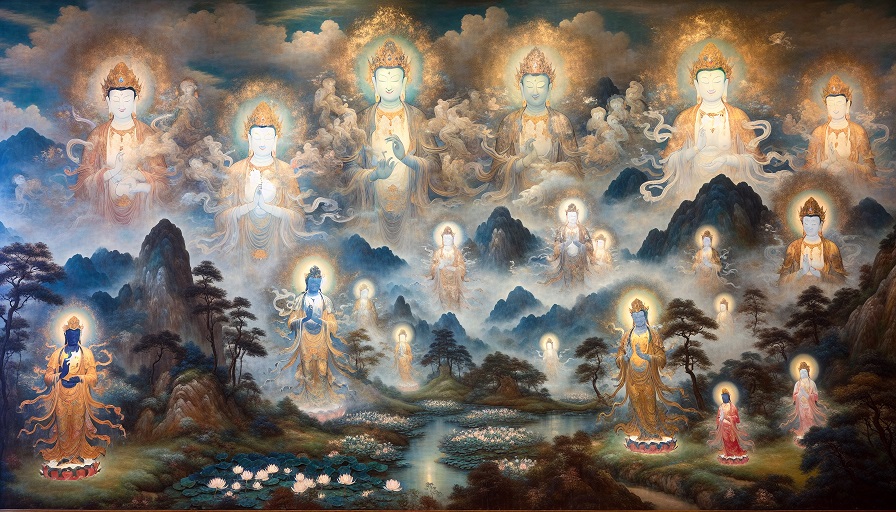
There is a particular kind of person most of us have encountered at some point in our lives. They show up during the difficult moments, sometimes as a stranger, sometimes as someone we have known for years, and they bring with them an unusual quality of presence, a calm attentiveness, an ability to see exactly what is needed and offer precisely that, without drama or self-congratulation. They do not make their help about themselves. They simply show up, do what needs doing, and leave you feeling that the world might be more spacious and less frightening than you had recently been thinking. If you had to name a quality that distinguished them, you might call it something like wisdom in the service of love, or love made intelligent by experience. In Buddhist teaching, you might call them a bodhisattva.
The word bodhisattva comes from two Sanskrit roots: bodhi, meaning awakening or enlightenment, and sattva, meaning being or essence. A bodhisattva is, at its most literal, an awakening being, one who is on the path toward full Buddhahood and whose defining commitment is to achieve that awakening not as a private accomplishment but as a gift to all sentient life. It is a concept that sits at the heart of Mahayana Buddhism, the broad tradition that spread across Tibet, China, Japan, Korea, and Vietnam, and it has produced some of the most extraordinary figures in the history of world religion.
Contents
The Vow That Changes Everything
What makes a bodhisattva a bodhisattva is not primarily a level of spiritual attainment. It is a vow, specifically the bodhisattva vow, which in various formulations across different traditions amounts to something like this: I commit to achieving enlightenment for the benefit of all sentient beings, however numerous, and I will not rest in personal liberation while a single being remains lost in suffering. In some versions of the vow, the bodhisattva commits to remaining in the cycle of birth and death as long as it takes, however many lifetimes that requires, until every being has been led to freedom.
The Audacity of the Vow
It is worth pausing on just how remarkable this commitment is. The number of sentient beings, from insects to humans to beings in realms we cannot perceive, is considered by Buddhist cosmology to be effectively infinite. Vowing to remain engaged with the world until all of them are free is, by any measure, an open-ended commitment of staggering proportions. Tibetan teachers sometimes respond to the student who says this sounds impossible with a gentle smile and the observation that the impossibility is the point. The vow is not a contract with achievable deliverables. It is an orientation of the heart, a direction of travel that reshapes everything it touches, including the person who makes it.
Two Types of Bodhisattva
Buddhist teaching distinguishes between two main categories. Ordinary bodhisattvas are practitioners who have taken the bodhisattva vow and are working toward awakening within that aspiration. They are human beings like you and me, somewhere on the path, shaped by the vow but not yet fully realized. Great bodhisattvas, sometimes called mahasattvas, are beings who have advanced so far along the path that they possess extraordinary powers of perception, compassion, and skillful action, who are capable of manifesting in multiple forms simultaneously, and who actively respond to the needs and prayers of suffering beings. It is these great bodhisattvas who populate the Thangka paintings and the altars of Tibetan Buddhist shrine rooms, and who are the subjects of some of the finest statuary produced in Nepal.
Avalokiteshvara: The Hearer of Cries
Of all the bodhisattvas in the Mahayana pantheon, Avalokiteshvara is arguably the most universally beloved. His name is typically translated as “the one who perceives the sounds of the world” or “the lord who looks upon suffering with compassion,” and his defining quality is an attentiveness to suffering so complete that he is said to hear every cry for help in every realm of existence, simultaneously and without distortion.
A Thousand Arms for a Thousand Needs
One of Avalokiteshvara’s most striking forms has eleven heads and a thousand arms, each hand holding a different implement of help. The story behind this form is itself instructive. Avalokiteshvara, gazing upon the immensity of suffering in the universe, made a vow to liberate all beings. When he looked again and saw that, despite his efforts, beings were still suffering in vast numbers, he was so overwhelmed that his head split into ten pieces. His teacher, Amitabha Buddha, reassembled the pieces into eleven heads so that Avalokiteshvara could perceive suffering from every direction at once, and gave him a thousand arms so he could respond to every need simultaneously. It is a myth that takes suffering seriously and responds with more compassion rather than less, which is itself rather the point.
In Tibet, Avalokiteshvara is known as Chenrezig, and the Dalai Lamas are considered his human manifestations. In China, the same bodhisattva is known as Guanyin and takes a predominantly female form, one of the most interesting cross-cultural transformations in all of Buddhist history. The mantra Om Mani Padme Hum, arguably the most widely recited mantra on earth, is the mantra of Avalokiteshvara, and its six syllables are said to contain the entirety of his teaching.
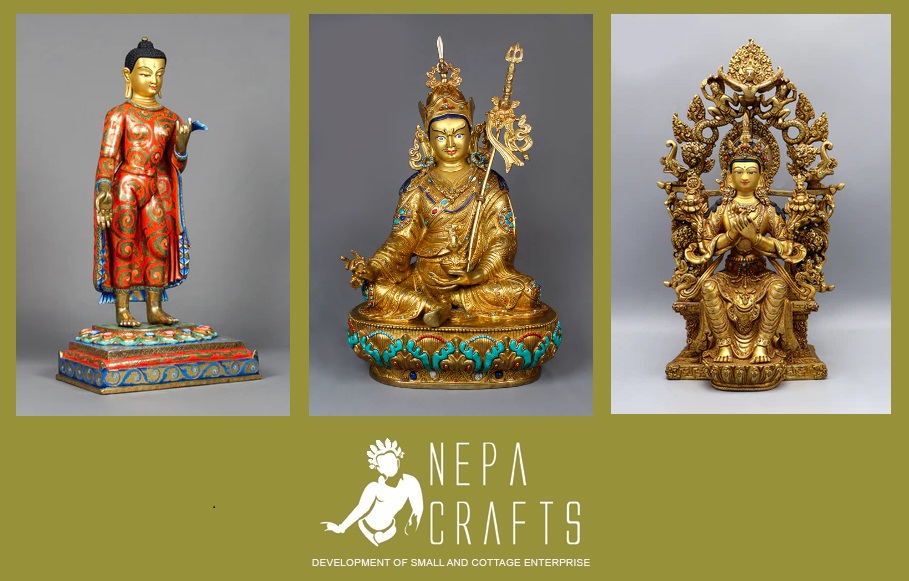
Manjushri: The Sword of Wisdom
Where Avalokiteshvara embodies the compassion aspect of awakening, Manjushri embodies its inseparable companion: wisdom. His name means “gentle glory” or “sweet splendor,” though there is nothing particularly gentle about his most prominent attribute. Manjushri carries a flaming sword in his right hand, raised above his head, and in his left hand he holds a lotus upon which rests the Prajnaparamita, the perfection of wisdom text, a scripture regarded as among the most profound in all of Buddhism.
Cutting Through Confusion
The sword is not a weapon of violence. It is the sword of prajna, discriminating wisdom, that cuts through the root of confusion and ignorance the way a sharp blade parts tangled knots. Manjushri is the patron bodhisattva of scholars, students, and all those whose practice involves the cultivation of understanding. He is invoked at the beginning of philosophical debates, called upon by students facing difficult examinations, and venerated by practitioners who want their meditation to be infused with clear seeing rather than merely pleasant feeling. His color is golden yellow, associated with Ratnasambhava and the south. His mantra, Om A Ra Pa Tsa Na Dhih, is used in practices specifically aimed at sharpening intelligence and cutting through mental fog.
Ksitigarbha: The Earth Womb
Ksitigarbha is perhaps the least familiar of the great bodhisattvas to Western audiences, but in East Asia, particularly in China and Japan where he is known as Jizo, he is among the most deeply beloved. His name means “earth womb” or “earth treasury,” and his vow is specifically directed toward beings in the most extreme conditions of suffering, including the hell realms of Buddhist cosmology.
The Bodhisattva of the Forgotten
Ksitigarbha is typically depicted as a monk, simply dressed compared to the jeweled bodhisattvas, carrying a staff with six rings that jangles as he walks to warn small creatures to move out of his path, and a wish-fulfilling jewel that illuminates the darkness. His vow is stark and unambiguous: he will remain engaged with the most suffering beings, those in the darkest places, until all hell realms are empty. In Japan, small Jizo statues are placed at roadsides and in cemeteries as guardians of travelers, children, and those who died before their time. Parents who have lost infants often leave offerings at Jizo shrines with a tenderness that is among the most moving sights in all of religious Japan.
Samantabhadra and Maitreya: The Breadth of the Tradition
The bodhisattva tradition is wide enough to hold figures as varied as Samantabhadra, the bodhisattva of noble action and the ten great vows of practice, whose name means “universally good” and who is associated with the practical application of awakening in daily life, and Maitreya, the future Buddha, who currently resides in a heavenly realm and will descend to earth as the next historical Buddha when the teachings of Shakyamuni have been fully forgotten. Maitreya’s image, often depicted standing or seated on a throne with legs pendant rather than crossed, facing outward as though about to descend, carries a quality of benevolent anticipation that artists have been capturing in bronze and copper for fifteen centuries.
Bodhisattvas in Bronze: The Art of Compassion Made Solid
The bodhisattva figures produced by Nepalese artisans in the workshops of Patan are among the most technically and spiritually accomplished works in the entire Buddhist artistic tradition. The particular challenge of rendering a bodhisattva in metal, as opposed to paint, is that the three-dimensionality of sculpture demands that the figure communicate its essential quality from every angle. A well-made Avalokiteshvara in bronze should feel attentive whether you are looking at it straight on, from the side, or even from behind. The quality of the gaze, the tilt of the head, the poise of the hands, all must cohere into a single unified expression of compassionate presence.
The artisans who achieve this are working with a skill that is simultaneously technical, aesthetic, and devotional. Many of them maintain a personal practice with the figure they are crafting, reciting its mantra as they work, understanding the creation of the statue not merely as production but as offering. This is why a statue made in this tradition can feel different from a purely decorative object, even to someone who does not know the tradition’s history. The attentiveness has been built in, layer by layer, over weeks or months of careful and consecrated work.
The Bodhisattva Ideal and the Rest of Us
Buddhism is, among other things, a tradition with a keen eye for how ideals can either inspire or intimidate depending on how they are presented. The bodhisattva ideal, taken in its most literal form, could feel crushing: who among us is ready to vow to stay in the cycle of existence for countless eons for the sake of all beings? But Tibetan teachers are generally careful to present the bodhisattva aspiration as a direction rather than an immediate destination. The question is not whether you are already a bodhisattva. The question is whether you are willing to orient yourself in that direction, to let the aspiration of unbounded compassion be the compass by which you navigate, even knowing that the journey is long and the destination further than you can currently see.
The great bodhisattvas depicted in statues and Thangkas are, in this reading, not distant and unreachable models of impossible virtue. They are images of where the human capacity for compassion is ultimately headed, given enough time, enough practice, and enough willingness to keep showing up for the world even when it breaks your heart. Which, come to think of it, sounds quite a lot like that person we all know who seems to appear exactly when they are needed, and who leaves the room a little cleaner, a little lighter, than they found it.