

It is a question that gets asked, in one form or another, about a lot of plants that find their way into the modern wellness conversation. Is this something genuinely old, with roots in healing traditions that predate pharmaceutical medicine by centuries? Or is it a contemporary marketing construction, assembled around a fruit that happens to be unfamiliar enough to seem exotic and nutritious enough to justify the “super” prefix? For soursop graviola, the honest answer is that it’s both, and the relationship between those two identities is more interesting than either label captures on its own.
The question is worth asking carefully because the answer shapes how you understand what soursop is, what it can do, and why the current enthusiasm surrounding it is something more durable than a seasonal wellness trend. Ancient remedies and modern superfoods are not opposites. In the case of soursop, they are two chapters of the same story, connected by a plant that was doing something genuinely useful long before anyone developed the vocabulary to describe it in biochemical terms.
Contents
The Ancient Part: A Plant With a Documented Healing History
Soursop graviola’s history as a healing plant is not a reconstruction invented to give a modern supplement product an air of authenticity. It is a real and extensively documented tradition that spans multiple continents and hundreds of years of consistent, purposeful use by communities who had every reason to be empirical about what worked and what didn’t.
The Annona muricata tree originated in the tropical Americas, and its healing applications were well established among indigenous Caribbean and South American communities long before European contact. When Spanish and Portuguese colonizers arrived in the Americas, they encountered soursop already embedded in local healing practices and were thorough enough in their documentation to leave historical records that confirm the plant’s traditional applications. Those early records describe uses that align remarkably well with what contemporary research is now characterizing at a mechanistic level: soursop preparations for fever, for digestive complaints, for skin conditions, for restlessness and poor sleep, and for a range of inflammatory concerns.
How the Tradition Spread and Deepened
From the Americas, soursop traveled with the movement of people and trade across the Atlantic. It took root in West African communities, where it was absorbed into independent healing traditions and applied in ways that overlapped significantly with its American uses despite the cultural distance between the two traditions. It spread through Southeast Asia and Pacific island communities, each of which developed its own relationship with the plant while arriving at broadly similar conclusions about its properties. By the time the modern world began paying systematic scientific attention to soursop, there were centuries of accumulated observational data from diverse cultures pointing in consistent directions. That kind of cross-cultural convergence is not noise. It is a signal, and it is one of the strongest arguments for taking soursop’s traditional reputation seriously as evidence rather than folklore.
What Traditional Healers Were Actually Observing
Traditional medicine doesn’t come with clinical trial infrastructure, randomized controls, or blinded outcome measurements. What it comes with is something equally valuable in its own way: generations of careful observation by practitioners who had strong incentives to understand what their botanical preparations actually did, because their communities depended on the results. When Caribbean healers consistently reached for soursop leaf tea for sleeplessness and digestive complaints, they weren’t guessing. They were reporting accumulated experience about what produced reliable improvement in reliable symptoms. When West African traditional practitioners incorporated soursop leaves into preparations for inflammatory and infectious conditions, they were recording observations that had been tested across generations of use and refined by the outcomes. The biochemical explanations came later. The observations were always real.
The Modern Part: What Science Has Made of an Ancient Plant
The transition from ancient remedy to modern superfood began in earnest in the latter decades of the twentieth century, when researchers first turned serious laboratory attention toward Annona muricata and found that the plant’s traditional reputation had a great deal of biochemical substance behind it. What followed was one of the more productive botanical research programs of the past three decades, generating hundreds of peer-reviewed publications and establishing soursop as one of the more extensively studied tropical plants in the scientific literature.
The discovery of annonaceous acetogenins in soursop and related plants was a turning point. These unique bioactive compounds, found only in the Annonaceae plant family, demonstrated properties in laboratory studies that sparked sustained scientific curiosity and brought soursop to the attention of pharmacologists, oncology researchers, and nutritional scientists in ways that a fruit with a good flavor profile and decent vitamin C content never would have managed on its own. The acetogenin research opened a door, and what researchers found on the other side was a plant with a considerably more sophisticated pharmacological profile than its humble tropical origins suggested.
The Nutritional Science Dimension
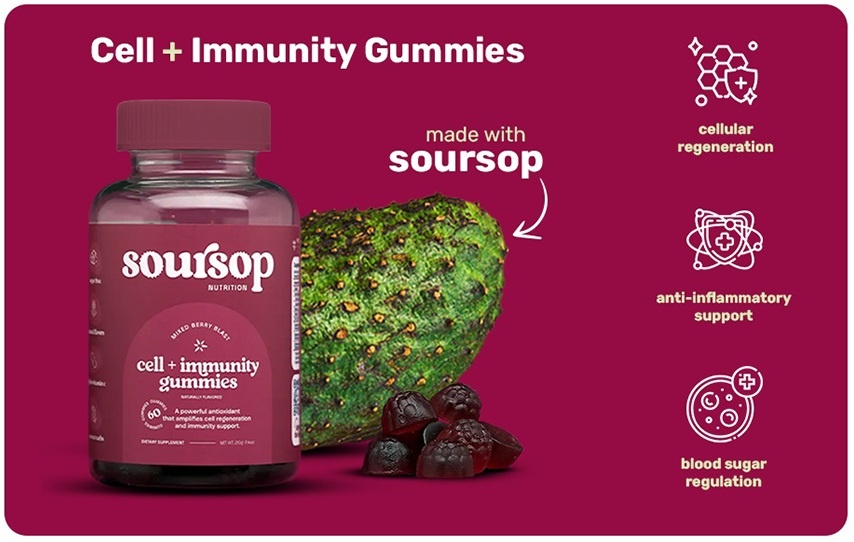
Alongside the pharmacological research, nutritional scientists have characterized soursop’s vitamin and mineral profile in detail, confirming meaningful concentrations of vitamin C, B vitamins including thiamine, riboflavin, and folate, potassium, magnesium, and phosphorus alongside the phenolic acids, flavonoids, and acetogenins that contribute its antioxidant and anti-inflammatory activity. The antioxidant capacity of soursop has been measured and confirmed across multiple independent studies, with leaf extract consistently demonstrating particularly high free radical scavenging activity. Anti-inflammatory mechanisms involving quercetin and luteolin have been characterized at the molecular level. Blood sugar-relevant enzyme inhibitory activity has been identified and measured. Antimicrobial properties have been confirmed against clinically relevant pathogens. Gastroprotective effects have been demonstrated in animal models. Neuroprotective potential has been raised by research examining soursop’s effects on oxidative stress in neural tissue.
Each of these findings, taken individually, might not be enough to justify the “superfood” designation. Taken together, across a plant whose different components address different body systems through different mechanisms from a single botanical source, the case for soursop as one of the more nutritionally and pharmacologically significant tropical plants is one that the scientific literature genuinely supports.
Why the Ancient and Modern Identities Need Each Other
Here is where the question posed by this article’s title becomes most interesting. Ancient remedy and modern superfood are not competing descriptions of soursop. They are mutually reinforcing ones, and understanding why matters for anyone trying to decide how seriously to take the current enthusiasm around the plant.
The traditional use history is what gives the modern research its most important context. Without it, a collection of in vitro studies and animal model findings would be an interesting but inconclusive set of preliminary observations that might or might not lead anywhere. With it, those findings become the scientific explanation for a set of outcomes that were observed and recorded by careful practitioners across centuries and continents. The research doesn’t validate the tradition from a position of superiority. It explains what the tradition was already reporting. That is a fundamentally different and considerably more compelling relationship between science and traditional knowledge than the one in which laboratory research “discovers” something that no one previously knew.
Conversely, the modern research is what gives the traditional use its credibility in a contemporary context. Most people making supplement decisions in 2025 are not prepared to rely on Caribbean folk medicine as their primary evidence base, however extensive and consistent that evidence base is. The growing body of published research on soursop’s mechanisms of action gives people who want scientific validation a foundation for taking the traditional reputation seriously. It translates centuries of observational evidence into the biochemical language that contemporary wellness culture finds persuasive. Both halves of soursop’s story need the other half to be fully convincing.
The Superfood Label: Does Soursop Actually Earn It?
“Superfood” is not a regulated term, which means it has been applied to everything from kale to chocolate to water with lemon in it, and the designation has suffered accordingly from overuse. Earning that label in any meaningful sense requires a plant to deliver an unusually dense and diverse range of beneficial properties from a single source in a way that genuinely distinguishes it from ordinary nutritious foods.
By that standard, soursop makes a credible claim. The combination of multi-class antioxidants, multi-mechanism anti-inflammatory compounds, immune-relevant vitamins and antimicrobial properties, digestive fiber and prebiotic activity, blood sugar-relevant enzyme inhibition, cardiovascular-supportive minerals, sleep and relaxation associations, and the unique acetogenins found only in this plant family is genuinely unusual in the botanical world. Very few plants deliver that range from a single source. Soursop does, which is why it keeps appearing at the center of serious wellness conversations rather than fading after an initial moment of attention. The superfood designation, when applied to soursop, is one of its more defensible uses.
What This Means for You
Understanding soursop as both an ancient remedy and a modern superfood changes how you engage with it as a supplement. It isn’t a trend to evaluate against its likely longevity. It isn’t a laboratory novelty whose research base might not hold up to further scrutiny. It’s a plant with a long, stable, cross-cultural track record of doing something genuinely useful, whose modern scientific investigation has been progressively confirming and explaining that track record for thirty years and counting. That combination of historical depth and contemporary scientific momentum is rare in the supplement world, and it’s the most honest answer to the question this article set out to address.
Ancient remedy and modern superfood aren’t alternative answers. They’re both true, and they’re true together in a way that makes soursop graviola one of the more compelling and durable botanical stories in the current wellness conversation. Whether your confidence comes from the traditional history, the modern research, or the recognition that both are pointing in the same direction, the conclusion they lead to is the same: soursop has earned its place, and it has been earning it for a very long time.
Frequently Asked Questions
These are the questions that arise most often when people start engaging with soursop’s dual identity as a traditional botanical and a contemporary wellness ingredient.
How Long Has Soursop Been Used as a Healing Plant?
Soursop has been used in healing traditions across the Caribbean, Central America, and South America since before European contact in the fifteenth century, and historical records from Spanish and Portuguese colonizers document its established traditional applications from that period onward. Following its spread through trade and migration, it became embedded in West African, Southeast Asian, and Pacific island healing traditions as well, giving it a multicultural use history spanning at least five centuries and very likely considerably longer.
Is “Superfood” Just a Marketing Term When Applied to Soursop?
While “superfood” is an unregulated term that has been applied loosely to many ordinary foods, soursop’s claim to the designation is more substantive than most. Its combination of multi-class antioxidants, multi-mechanism anti-inflammatory compounds, immune-relevant vitamins, digestive fiber, blood sugar-relevant enzyme inhibition, cardiovascular-supportive minerals, and the unique annonaceous acetogenins found only in its plant family delivers an unusually dense and diverse range of health-relevant properties from a single botanical source. That breadth is what the superfood designation is actually supposed to convey, and soursop earns it genuinely.
Does Traditional Use Make Soursop More Trustworthy as a Supplement?
Traditional use alone is not clinical proof, but when it is consistent across geographically separated cultures that arrived at similar applications independently, and when modern research is progressively providing mechanistic explanations for exactly what those traditions were observing, the convergence carries significant evidential weight. Soursop’s traditional reputation and its modern research profile are mutually reinforcing in a way that makes the overall case for the plant considerably stronger than either line of evidence would be on its own.
What Was Soursop Traditionally Used For?
Traditional applications of soursop across Caribbean, Latin American, West African, and Southeast Asian healing traditions have included preparations for digestive complaints, fever, skin conditions, restlessness and sleep difficulties, inflammatory conditions, and infectious illness. The leaves, fruit, bark, roots, and seeds have all featured in various traditional applications, with leaf preparations being among the most consistently documented across different cultural traditions.
How Does Soursop’s Research Profile Compare to Other Superfoods?
Soursop has a larger and more diverse published research base than many ingredients that carry the superfood designation. Hundreds of peer-reviewed studies have examined its antioxidant capacity, anti-inflammatory mechanisms, antimicrobial properties, blood sugar-relevant activity, neuroprotective potential, and the unique pharmacological profile of its acetogenin compounds. While human clinical trial evidence is still developing relative to some better-established botanicals like turmeric, the breadth of soursop’s research across multiple body systems and mechanisms is genuinely impressive for a tropical botanical that has only received sustained scientific attention over the past three decades.