

Every purchase is a vote, even if it does not feel like one. The objects we bring into our homes are the visible end point of economic chains that determine whether a Nepali metalworker earns a living wage or a poverty wage, whether a tradition of handmade craft survives into the next generation or slowly hollows out as its practitioners find more reliable income elsewhere, and whether the global market for “artisan” goods continues to be dominated by machine-made imitations or gradually shifts toward the genuine article. These are large consequences attached to ordinary decisions, and most of us make them without much information about what the chain behind the object actually looks like.
Fair trade and handmade craft, properly understood, are not feel-good marketing categories. They are a specific set of economic relationships and ethical commitments that, when genuine, produce measurably different outcomes for the communities involved. Understanding what those outcomes are and what genuine fair trade practice actually looks like is the beginning of buying well.
What Fair Trade Actually Means
The term fair trade has been applied so broadly that it risks losing precision, but its core commitments are clear enough. Fair trade practice means paying producers prices that cover the genuine cost of production, including fair wages for the labor involved. It means transparent supply chains in which the buyer knows who made the object and under what conditions. It means long-term trading relationships that provide stability rather than the volatile spot-market pricing that puts small producers at constant economic risk. And it means rejecting the practice of continuously pressing suppliers for lower prices, which in a handmade craft context is simply a mechanism for transferring poverty down the supply chain until it lands on the person who did the actual making.
For Nepali artisan goods specifically, fair trade relationships have been particularly important because the alternative, competing on price with mass-produced goods from larger industrial economies, is a race that handmade craft cannot win and should not enter. A copper singing bowl hand-hammered by a skilled artisan in Patan cannot and should not cost the same as a machine-pressed bowl manufactured in a factory. The difference in price is the difference between a living tradition and a dying one.
The Economics of Handmade
There is a persistent cultural assumption in consumer markets that a lower price is always better, a bargain always desirable, and that paying more for something is a mild failure of thrift. Applied to genuinely handmade craft objects, this assumption produces consequences its holders rarely intend. When a buyer insists on paying less than an object’s genuine value, the shortfall has to come from somewhere. In the craft context it almost always comes from the maker’s wages, from the quality of materials, or from both. The object that arrives in the mail at a surprisingly low price has almost certainly had someone’s livelihood squeezed to get it there.
Paying the genuine price for a handmade object is not charity. It is accuracy: an honest accounting of what the object actually cost to produce by a skilled person working with quality materials in a tradition that took generations to develop. A hand-gilded bronze Bodhisattva statue from a Patan master workshop that represents months of skilled labor should cost what months of skilled labor cost. The price of a genuinely handmade singing bowl should reflect the time a craftsperson spent hammering it into shape, tuning its tone, and finishing its surface. When it does not, someone is being underpaid, and the tradition that produced that skill is being eroded.
What Handmade Preserves That Manufacturing Cannot
The argument for buying handmade is not purely economic. It is also cultural and ecological, and in some cases spiritual in the most practical sense of that word. Handmade craft objects carry within them the irreplaceable knowledge of their makers: the specific understanding of how metal behaves under a particular hammer, how pigments from specific mineral sources interact with specific binding agents, how the fiber of a particular sheep’s wool responds to a particular dyeing process. This knowledge cannot be uploaded, transferred to a database, or preserved in a museum. It lives in hands and is transmitted through practice. When the practice stops, the knowledge is gone, and it is gone completely.
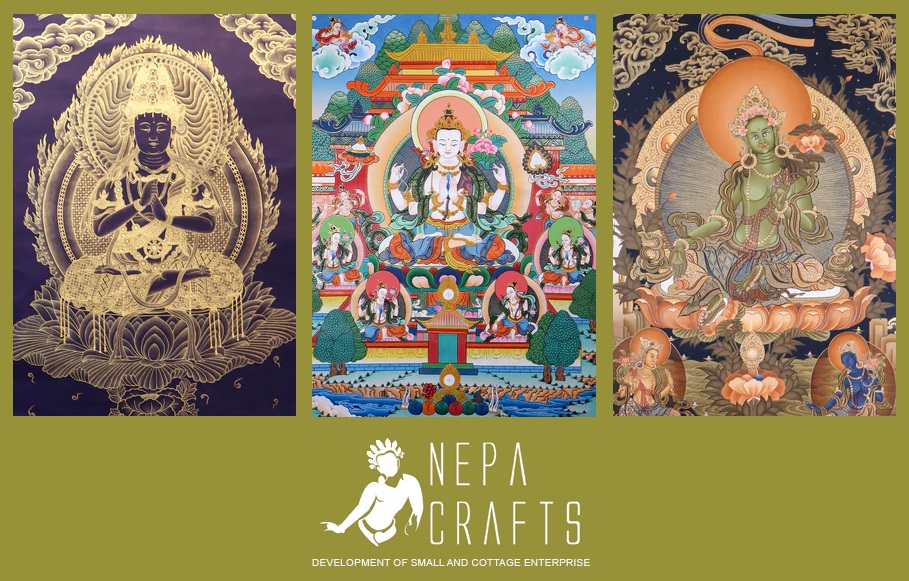
The felt-making cooperatives of Nepal, the Thangka painting lineages of Bhaktapur, the metalworking families of Patan, the Lokta paper producers of the mountain villages: each of these represents a thread of knowledge that has been kept alive across centuries by the simple act of continuing to practice and continuing to find buyers who valued the practice enough to sustain it economically. Global demand for genuine Nepali handcraft, translated into purchases at fair prices, is one of the primary mechanisms by which these threads remain unbroken.
Recognizing Genuine Artisan Production
The practical challenge for buyers is distinguishing genuine handmade artisan goods from machine-made imitations presented in artisan language. The global market has become expert at aesthetic mimicry: products can look handmade without being so, carry the story of a tradition without participating in it, and display the visual markers of craft without any of the underlying skill or community connection. A few reliable indicators help cut through this.
Transparency about production is the most important signal. Producers committed to genuine artisan practice can tell you specifically where their goods were made, by whom, under what conditions, and through what process. Vague references to “traditional methods” or “artisan-inspired” production are red flags. The specific detail that genuine producers provide, the name of the cooperative, the region of production, the technique used, the names of the materials and where they come from, is not marketing decoration. It is the evidence of a supply chain that has nothing to hide.
Organizations such as the World Fair Trade Organization and the Fair Trade Federation maintain membership standards and certification processes that provide an additional layer of verification. Producers who have sought and received fair trade certification have submitted to external scrutiny of their practices, which is worth something when evaluating claims.
The Ripple Effects of Buying Well
When a buyer chooses a genuine handmade object at a fair price from a producer with transparent practices, the effects extend well beyond the transaction. The artisan receives income that supports not only their own household but the broader community economy in which they participate. The craft knowledge they carry is given another generation’s worth of economic viability. The children who grow up watching a parent practice a skilled trade have a different relationship to that knowledge than they would if the parent had abandoned the craft for factory work because the craft could no longer sustain a family.
None of this requires the buyer to think of themselves as an activist or a development aid donor. It requires only the recognition that the object in your hand came from somewhere specific, was made by someone specific, and that the price you pay for it is part of a chain of consequences that reaches back to that person and forward to whether their children will learn what they know. That is not a burden. It is an invitation to participate, through an ordinary act of purchase, in something worth participating in.