There is a moment that many people who meditate regularly eventually arrive at, sometimes after years of practice, sometimes surprisingly early in the journey. It is the moment when sitting on a cushion in the corner of a bedroom, next to a laundry basket and a charging cable, starts to feel like it is working against you rather than for you. The practice is real, the intention is genuine, but the space keeps pulling the mind back toward the ordinary, the domestic, the endless list of things that need doing. Something in you begins to understand that a practice benefits from a home, and a home for a practice has a particular look and feel that is quite different from the rest of the house.
A Buddhist home altar is that home. It does not need to be elaborate. It does not require a dedicated room, a large budget, or the guidance of an ordained monk, though any of those things can help. What it requires is intention, a few carefully chosen objects, and a willingness to create a small area of your living space that is set apart from the flow of ordinary life and dedicated to something larger than the next item on the to-do list. What happens to a meditation practice once that space exists, even modestly, tends to surprise people. The cushion becomes easier to return to when something is waiting there to receive you.
Why a Physical Altar Matters
In a culture that increasingly locates spiritual practice in apps, podcasts, and digital guided meditations, the idea of arranging physical objects on a dedicated surface might seem almost quaint. But the altar tradition that runs through virtually every contemplative culture in human history, from the domestic shrines of ancient Rome to the home altars of Japanese Buddhism to the mesa of Andean curanderismo, has survived and persisted for reasons that are as practical as they are sacred.
The Psychology of Sacred Space
The human nervous system is exquisitely sensitive to environmental cues. The same body that tightens up in a hospital waiting room softens in a garden. The mind that cannot focus in a busy café often sharpens in a library. Physical environments shape psychological states with a reliability that modern neuroscience has now confirmed in considerable detail. A dedicated altar space works through exactly this mechanism. Over time, as you return to the same spot, see the same objects, light the same candle, and settle into the same posture, the space itself becomes a cue for the state you are trying to access. The nervous system learns that this particular corner means: slow down, turn inward, this is where that other quality of attention lives. Eventually the altar begins to do part of the work for you simply by existing.
Objects as Teachers
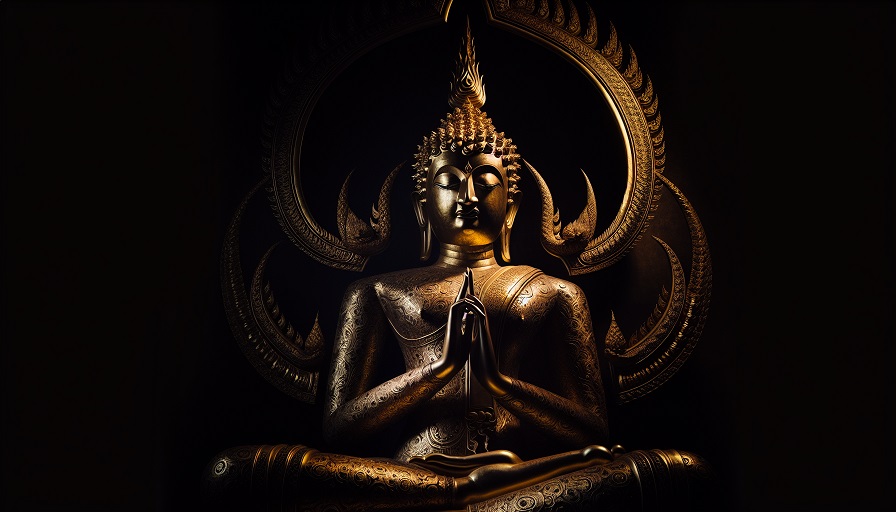
In Buddhist understanding, the objects placed on an altar are not decorations with spiritual overtones. They are teachers. A Buddha statue is not a representation of an external deity to whom prayers are directed. It is a three-dimensional embodiment of the qualities of awakened mind, seated in the visual field as a constant reminder of what practice is oriented toward and what is ultimately possible for a human being. A Thangka painting on the wall above the altar is a visual text encoding Buddhist wisdom that speaks to the meditating mind through imagery rather than language. A singing bowl beside the cushion marks the beginning and end of formal practice with a sound that draws the nervous system across a threshold. Each object is earning its place on that surface by doing something.
The Core Elements of a Buddhist Home Altar
There is no single mandatory configuration for a Buddhist home altar, and different traditions emphasize different elements. What follows is a framework drawn from the broad Tibetan Buddhist tradition, which has produced some of the most developed altar culture in all of Buddhism. You need not include every element immediately. Start with what speaks to you and let the altar grow organically over time.
A Central Image or Statue
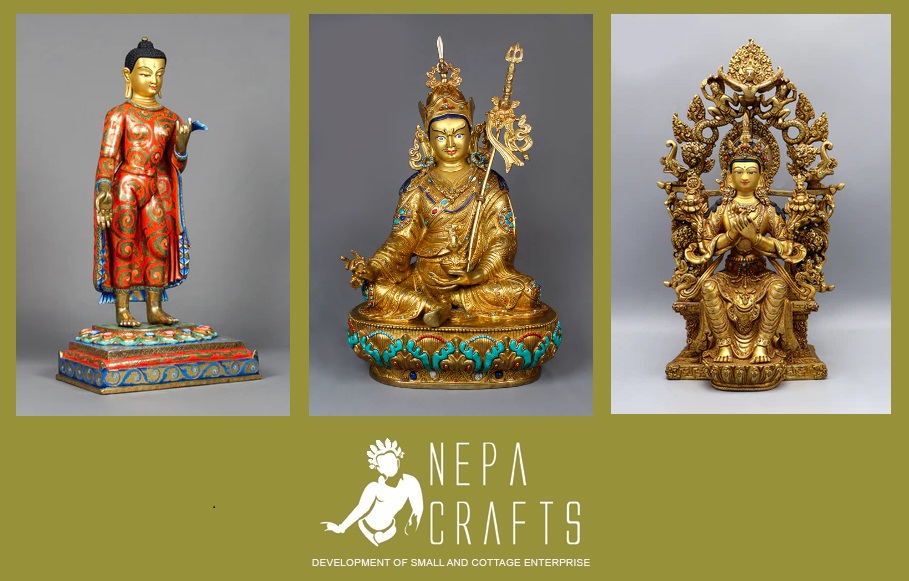
The heart of any Buddhist altar is a representation of an awakened being. For most practitioners this means a Buddha statue, most commonly Shakyamuni Buddha in the earth-touching posture that commemorates his enlightenment, though Medicine Buddha, Amitabha, or the bodhisattvas Green Tara and Avalokiteshvara are also widely chosen as central figures depending on one’s practice tradition and personal connection. The statue should be placed at the highest point of the altar surface, reflecting the tradition’s understanding that awakened beings are honored above the level of ordinary objects. Size matters less than quality and intention. A small but finely crafted statue from a workshop whose artisans understand what they are making carries more presence than a large but carelessly produced one.
For practitioners drawn to the rich visual teaching tradition of Tibetan Buddhism, a Thangka painting mounted above or behind the altar serves as the central visual anchor of the space. A Thangka of Shakyamuni Buddha, or of the particular bodhisattva or deity whose practice you are engaged with, transforms the altar wall into an extension of the altar surface itself, creating a vertical dimension that gives the space a quality of depth and height that a flat altar surface alone cannot provide.
The Seven Traditional Offerings
Tibetan Buddhist altars traditionally include seven offering bowls arranged in a row, each containing a specific substance that represents one of the seven traditional offerings made to the awakened beings. Reading from left to right, these are: water for drinking, water for washing the feet, flowers, incense, light, perfume, and food. In practice, many home altars simplify this to a smaller number of offerings whose meaning and upkeep the practitioner can maintain genuinely rather than performing perfunctorily. A single offering bowl of fresh water changed daily, a candle or butter lamp for light, a stick of incense, and a small plate with a piece of fruit or a biscuit is a perfectly complete and sincere offering arrangement. The principle underlying the offering practice is generosity: the deliberate cultivation of the open-handed quality of mind that gives without expectation of return.
Candles and Butter Lamps
Light is one of the oldest and most universal offerings in human religious practice, and its presence on a Buddhist altar is both symbolically rich and practically useful. In the Tibetan tradition, butter lamps, small vessels of clarified butter or vegetable oil with cotton wicks, are the traditional source of altar light. Their warm, steady flame is associated with the dispelling of ignorance, the illumination that wisdom brings to a mind previously moving in the dark. For those who prefer practicality over tradition, a simple candle serves the same symbolic function with considerably less maintenance. Whatever the source, the act of lighting the altar lamp as you begin a practice session is a small but meaningful ritual that marks the transition from ordinary to sacred time with a physical gesture.
Incense
The offering of fragrance through incense is one of the five traditional sensory offerings in Buddhist altar practice, and it addresses the space in a way that visual objects cannot. Incense changes the air. It creates a sensory environment that is distinct from everyday domestic air, and that distinction is itself part of what the altar is doing: creating a space that is different enough from the rest of the house that the mind receives a clear signal that something different is happening here. Tibetan incense, made from Himalayan herbs, resins, and medicinal plants according to traditional formulas, has a particular character, earthy, complex, and slightly medicinal, that differs markedly from the sweeter incense of Japanese or Indian traditions. Many practitioners find that the specific scent of a particular incense, encountered first in a meaningful practice context, becomes a powerful state-change cue in its own right: smell the incense, begin to settle.
A Mala for Practice
A mala, the Buddhist string of prayer beads used for counting mantra repetitions, belongs on the altar both as a practice tool and as an object that accumulates the energy of the practice over time. A mala that has been used daily for months or years to count hundreds of thousands of mantra repetitions carries a quality that is sometimes described as being saturated with practice. Keeping it on the altar rather than in a drawer preserves that quality and makes it available each time you sit. When the mala is lifted and the counting begins, the accumulated practice of every previous session is in a sense present in the beads, and that continuity of intention has a settling effect that is difficult to account for purely in material terms.
A Singing Bowl
For many practitioners, a singing bowl on or beside the altar is the instrument that officially opens and closes each session. The bowl is struck at the beginning of formal practice, its tone marking the boundary between ordinary time and practice time, and struck again at the close, with the dedication of merit that follows. Between those two sounds, the session has its container, its defined edges. This bounded quality, the sense of entering a practice space and exiting it deliberately rather than drifting in and out of meditation, significantly deepens the quality of attention that the session can develop. A bowl engraved with a Dhyani Buddha image or a mantra adds the further dimension, discussed in the previous article in this series, of aligning the session’s sound environment with a specific quality of awakened awareness.
Caring for the Altar
An altar that is set up once and then left to gather dust is not functioning as an altar. It is functioning as a shelf with spiritual ambitions. The daily care of an altar, changing the water offerings, refreshing the flowers, relighting the lamp, cleaning the surfaces, is itself a practice. In Zen tradition it is sometimes called samu, work practice, the understanding that physical care of a sacred space is as much a part of practice as sitting in meditation. There is something in the act of tending to an altar that cultivates a quality of attention and respect that carries over into the formal practice that follows. You arrive at the cushion already a little more settled than you were when you walked in the door, because the act of caring for the space has already begun the inward turn.
Starting Small and Growing Naturally
The finest altar in the world, appointed with magnificent statuary and rare Thangka paintings and gleaming singing bowls, is worth less than a modest corner of a bookshelf with a single small statue and a candle if the modest corner is actually used every day and the magnificent altar is visited occasionally when the mood strikes. The altar serves the practice, not the other way around. Begin with what you have, with what genuinely moves you, with what you can sustain. Let the altar reflect where you actually are in your practice rather than where you think you should be.
What you will likely find, over time, is that the altar grows with the practice, that objects arrive when they are needed, and that the space takes on a quality that is both entirely your own creation and somehow larger than what you put into it. That is the altar doing what a good altar does: reflecting back the accumulated intention of everyone who has ever sat in front of it, which, in the end, is just you, returning again and again to the same spot, because something there is worth returning to.