
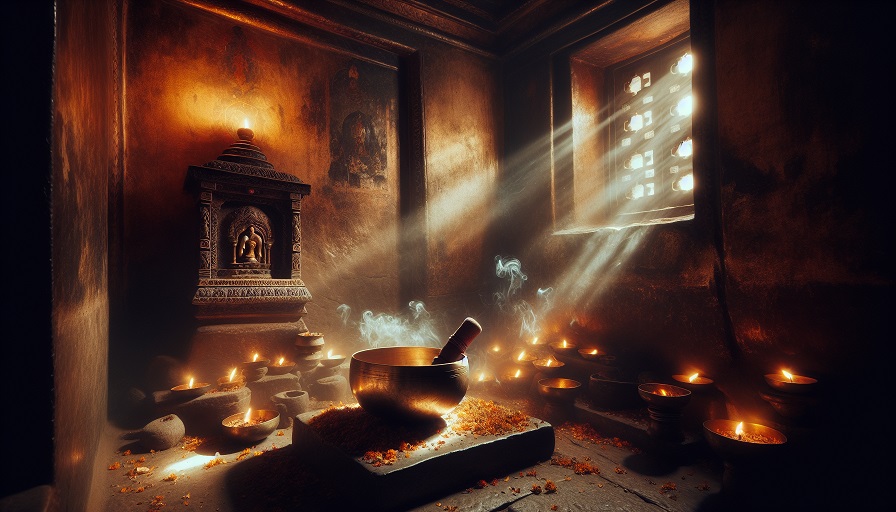
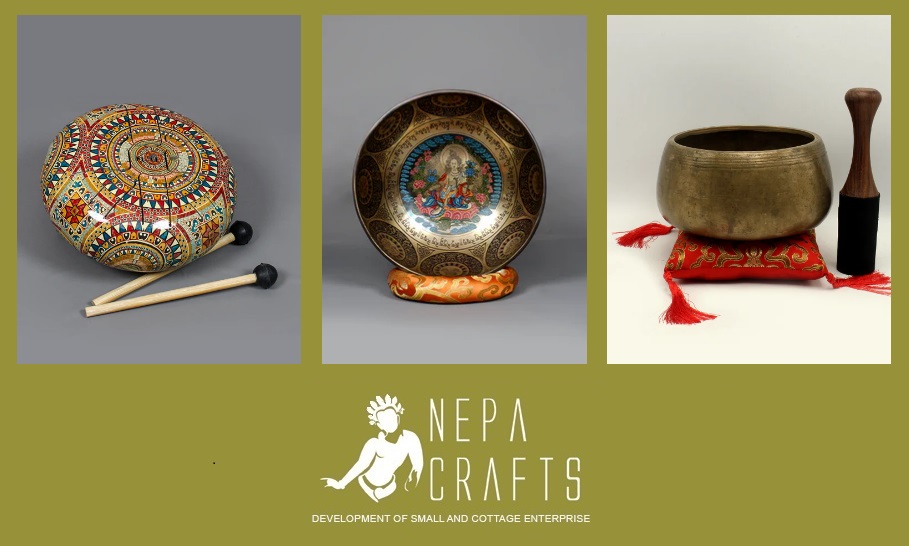
If you have spent any time browsing Himalayan singing bowls, you have probably noticed that many of them are not plain. Etched, engraved, or relief-cast into their outer surfaces are figures, mandalas, Sanskrit syllables, and sacred symbols drawn from the Buddhist iconographic tradition. Among the most common of these decorative and devotional programs are the Five Dhyani Buddhas, the five primordial meditation Buddhas whose system of wisdoms, colors, and correspondences we explored in an earlier article in this series. Finding one of these figures on the surface of a singing bowl is not merely a design choice. It is a statement of intention about what the bowl is for and what it carries beyond its acoustic properties.
A singing bowl engraved with a specific Dhyani Buddha is understood in the Tibetan tradition as an instrument consecrated to the wisdom and compassionate activity of that Buddha. When the bowl is played, its sound is understood to carry the quality and blessing of that figure into the space, functioning simultaneously as a musical instrument and as a ritual object whose vibration is identified with a specific aspect of enlightened awareness. Whether you approach this understanding literally or as a meaningful symbolic framework, it adds a dimension to the practice of sound healing that a plain bowl does not offer. It gives the sound a direction, a flavor, an intention that shapes the experience of both the player and the listener.
Before Choosing a Bowl: Understanding the System
A brief orientation to the Five Dhyani Buddhas as a system will make the individual descriptions that follow considerably more meaningful. We covered this system in detail in the earlier article on the Five Dhyani Buddhas, so here the essentials will serve as a useful reminder and a foundation for understanding the bowl-specific applications.
Each of the five Buddhas presides over one of the four cardinal directions plus the center. Each is associated with a specific color, a specific wisdom, a specific human mental poison that their wisdom transforms, and a specific element. Together they form a complete mandala of enlightened awareness, a map of the totality of awakened mind organized into five distinct but interrelated qualities. When all five bowls of a set are played together, the combined sound is understood to evoke the complete mandala, the fullness of Buddhahood expressed as harmonized acoustic resonance. That is a genuinely extraordinary thing to have in a room, and it explains why sets of five Dhyani Buddha bowls are considered among the most significant objects a serious practitioner can own.
Vairocana: The Bowl of the Center
Vairocana occupies the center of the mandala, and a singing bowl bearing his image carries the quality of the most foundational of the five wisdoms: the Wisdom of the Dharmadhatu, the all-encompassing awareness that perceives the fundamental nature of reality itself. His color is white, the color that contains all other colors within it, and his element is space, the ground in which all other elements arise and dissolve.
When to Choose a Vairocana Bowl
A Vairocana singing bowl is particularly well suited to practices and sessions oriented toward foundational clarity, the opening of awareness rather than the cultivation of any specific quality within awareness. If you are new to meditation practice and looking for a bowl that supports the most basic and comprehensive orientation, one that simply invites the mind to settle into its natural open state, Vairocana is a strong choice. His bowl is also well suited to beginning a meditation session or a group sound healing event, because his quality of all-encompassing space creates a container within which the other Buddhas’ wisdoms can more easily arise. In the human psychological dimension, a Vairocana bowl is particularly relevant when confusion, disorientation, or a felt sense of having lost one’s bearings is the presenting condition. His wisdom transforms ignorance, and a bowl resonating with that intention is working directly with the root of confusion.
Akshobhya: The Bowl of the East
Akshobhya, the unshakeable one, presides over the east, and a singing bowl bearing his image carries the Mirror-Like Wisdom: the quality of awareness that reflects whatever arises with complete clarity and without distortion, judgment, or preference. His color is deep blue, the blue of a still mountain lake or a cloudless sky at altitude, and his element is water in its quality of perfect reflective stillness.
When to Choose an Akshobhya Bowl
An Akshobhya bowl is particularly valuable for practices and sessions oriented toward clarity of perception, the ability to see situations, relationships, and one’s own mind with accuracy and without the distortions that emotional reactivity introduces. Sound healing sessions aimed at working with anger, reactivity, or the aftermath of conflict find a natural resonance with Akshobhya’s transformative quality: his wisdom transforms anger into mirror-like clarity, making his bowl an appropriate instrument for situations where agitation and reactivity are the conditions most needing to be addressed. The deep blue of his association also connects him with the Medicine Buddha, making an Akshobhya bowl a thoughtful choice for healing sessions in which clarity about one’s condition is as important as relief from its symptoms. His tone, ideally, carries the quality of deep stillness: not the stillness of absence but of a perfectly undisturbed surface on which reality can clearly reflect.
Ratnasambhava: The Bowl of the South
Ratnasambhava, the jewel-born one, presides over the south, and a bowl bearing his image carries the Wisdom of Equality: the recognition that all beings and all phenomena share the same fundamental nature, that the apparent differences of form, status, beauty, and capacity overlay a basic equality of Buddha-nature. His color is a warm golden yellow, associated with the earth element and the quality of abundance and generosity.
When to Choose a Ratnasambhava Bowl
A Ratnasambhava bowl is especially well suited to sound healing sessions and meditation practices oriented toward the cultivation of generosity, the releasing of comparative and competitive mental habits, and the opening of the heart toward beings who are different from oneself. His wisdom transforms pride, the tendency to rank and compare and place oneself above or below others in a hierarchy of worth, into the recognition of equality. This makes his bowl a particularly resonant choice for work with self-criticism and harsh self-judgment, situations in which the practitioner is applying a standard of evaluation to themselves that Ratnasambhava’s wisdom would recognize as a distortion. His warm golden tone, associated with the south’s abundance, also makes his bowl well suited to practices of offering and generosity, the cultivation of the open hand that characterizes genuine spiritual maturity.
Amitabha: The Bowl of the West
Amitabha, of boundless light, is the most widely known and devotionally significant of the five Buddhas across Asia, presiding over the west and carrying the Discriminating Wisdom: the capacity to perceive each individual thing with full clarity and appreciation, seeing the unique qualities of every particular phenomenon without losing sight of the whole. His color is a deep, warm red, and his element is fire in its quality of warmth, illumination, and passionate engagement with what is real and present.
When to Choose an Amitabha Bowl
An Amitabha bowl is one of the most versatile of the five for general use in sound healing and meditation contexts, partly because of the breadth and depth of his devotional tradition and partly because the quality his wisdom addresses, the transformation of attachment into discriminating appreciation, speaks to one of the most universal human conditions. We are all, to some degree, caught between the wish to hold onto pleasant experience and the inability to do so indefinitely. Amitabha’s bowl is a particularly appropriate tool for grief work, for practices oriented toward acceptance of impermanence, and for the cultivation of genuine presence, the ability to receive experience fully in its uniqueness without the grasping that turns appreciation into attachment. His bowl is also well suited to compassion meditation and loving-kindness practice, given his deep association with the Pure Land tradition and the aspiration for all beings to find ease and happiness. His deep red tone carries warmth rather than urgency, making it enveloping and comforting in a way that other bowls’ qualities do not always provide.
Amoghasiddhi: The Bowl of the North
Amoghasiddhi, the unfailing accomplisher, presides over the north and carries the All-Accomplishing Wisdom: the quality of awareness that acts spontaneously, skillfully, and without hesitation in the service of all beings, not through calculation but through a responsiveness so finely tuned it has become natural. His color is a rich, vital green, his element is wind, and his gesture is the raised palm of fearlessness, the hand that gently and completely says: there is nothing here to be afraid of.
When to Choose an Amoghasiddhi Bowl
An Amoghasiddhi bowl is particularly suited to practices oriented toward overcoming hesitation, fear, and the envy or restless dissatisfaction that measures one’s life against the lives of others and consistently finds it wanting. His wisdom transforms jealousy and envy into the all-accomplishing activity that works tirelessly for the benefit of all without competitive anxiety, which makes his bowl a powerful tool for sound healing sessions working with fear, creative blocks, and the paralysis that excessive self-comparison can produce. His green color, associated with the wind and with swift, unimpeded movement, gives his tone a quality of freshness and forward momentum that differs distinctly from the more settled qualities of the other four. If Vairocana’s bowl creates the space and Akshobhya’s bowl clarifies what is within it, Amoghasiddhi’s bowl activates: it carries an implicit encouragement to move, to act, to trust the impulse toward beneficial action without waiting for perfect certainty that will never arrive.
Choosing One Bowl or All Five
The question of whether to acquire a single Dhyani Buddha bowl or a complete set of five depends on both practical and personal considerations. A single bowl chosen because its specific Buddha’s quality speaks directly to your current practice, your current life circumstance, or the particular needs of the people you work with, is a thoughtful and meaningful instrument. There is no hierarchy that makes owning five bowls more spiritually significant than owning one bowl that genuinely resonates with your intention.
That said, a complete set of five carries a quality that no individual bowl provides: the sound of the entire mandala. When all five are played together by a skilled practitioner, the combined tonal environment evokes not just one quality of enlightened awareness but its totality, the full spectrum of wisdom in harmonious resonance. For serious sound healing practitioners and meditation teachers who work with groups, a full set of Dhyani Buddha bowls represents one of the most complete and intentional acoustic tools available in the Himalayan tradition.
Whether you choose one bowl or five, the engraved figure on the outer surface is not simply a decoration. It is a reminder, placed where the playing hand will move across it during every session, of the specific quality of awareness the bowl is aligned with and the specific transformation it is working toward. In a tradition where every object on the altar has been chosen with care and every element of practice carries deliberate meaning, that reminder is part of the practice itself. The bowl is not just singing. It is saying something specific. The figure on its side is the signature of the voice.