
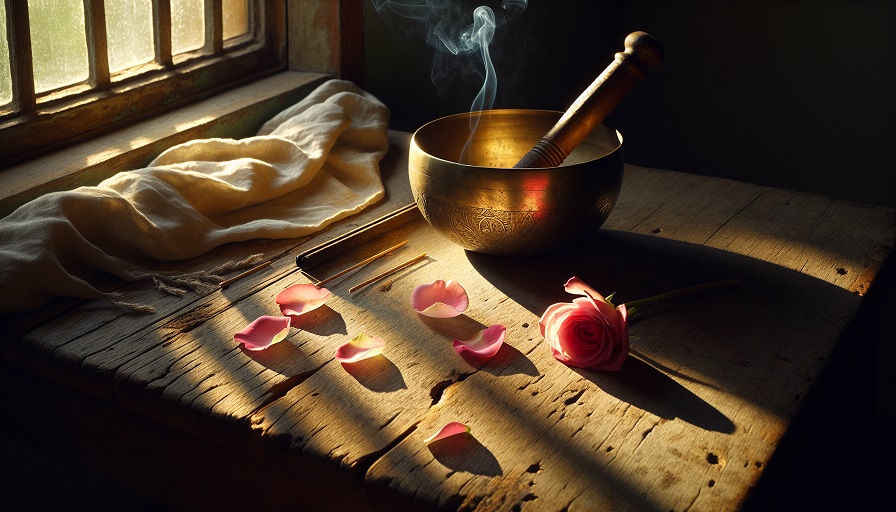
There is something almost paradoxical about an object this old arriving at this particular moment in history with such perfect timing. Himalayan singing bowls have been around for centuries, possibly millennia, yet they seem to speak directly to a set of concerns that feel distinctly contemporary: the need for stillness in an overstimulated world, the interest in practices that address the whole person rather than isolated symptoms, the hunger for objects that carry genuine cultural weight rather than manufactured meaning. They showed up in Western meditation centers and sound healing practices in the latter half of the twentieth century and have been gaining ground ever since, not as exotic novelties but as something that seems to answer a need people did not always know they had until they heard one ring.
But where do they actually come from? The question sounds simple and turns out to be considerably less so. The origins of singing bowls are wrapped in a combination of genuine antiquity, fragmentary historical record, oral tradition, and more than a little romantic embellishment that has accumulated during their journey into global awareness. Separating what is historically documented from what is tradition and what is modern mythology is itself an interesting exercise, one that leaves the bowls no less remarkable for the honest accounting.
The Mystery of the Early Record
The first thing to acknowledge about the history of Himalayan singing bowls is that the written record is surprisingly sparse for objects claimed to be so ancient. There is no reference to singing bowls in the early canonical texts of Tibetan Buddhism, no mention of them in the comprehensive catalogs of ritual implements that Tibetan monastic scholars compiled with considerable thoroughness over many centuries. This absence has led some scholars to question the most dramatic of the origin claims, specifically the assertion that singing bowls are three thousand or more years old and predate Buddhism entirely.
What the Silence Might Mean
The absence of textual documentation does not necessarily mean the bowls are recent inventions. It may mean something more interesting: that singing bowls belonged to a pre-literate, pre-Buddhist shamanic or folk tradition of the Himalayan region that was not systematically documented by the Buddhist scholars who later became the primary recorders of Tibetan cultural life. The Bon tradition, the indigenous spiritual tradition of Tibet that predates Buddhism’s arrival and was eventually partially absorbed into it, is one likely context for the bowls’ early use. Bon practitioners used sound, rhythm, and ritual objects in ways that have only partially survived in recorded form. The bowls may be an artifact of that largely oral, practice-based tradition.
Archaeological Evidence
What archaeological and material evidence does exist suggests that metal bowls of various types were being produced in the Himalayan and Central Asian regions from at least the early centuries of the Common Era, using bronze and brass alloys whose compositions varied by region and period. Some scholars have traced the metallurgical traditions behind singing bowl production to the broader Bronze Age cultures of Central Asia, which were producing sophisticated metal objects, including ritual vessels, well before Buddhism arrived in Tibet in the seventh century CE. The specific acoustic properties that make singing bowls sing rather than simply ring when played, those long, sustaining, multi-harmonic tones, are a product of particular bowl shapes, thicknesses, and alloy compositions that required considerable metallurgical knowledge and experimentation to achieve.
The Seven Metals Tradition
One of the most widely repeated claims about traditional Himalayan singing bowls is that the finest ones were made from an alloy of seven metals, each corresponding to one of the classical planets of ancient cosmology: gold for the Sun, silver for the Moon, mercury for Mercury, copper for Venus, iron for Mars, tin for Jupiter, and lead for Saturn. This tradition, which gives the bowls a cosmological dimension that aligns neatly with their use in spiritual practice, is cited frequently in popular accounts of singing bowl history.
What Metallurgical Analysis Reveals
Modern metallurgical analysis of antique singing bowls has produced results that are both clarifying and somewhat more nuanced than the seven-metals tradition suggests. Most antique bowls tested contain primarily bronze, an alloy of copper and tin, with the tin content varying between roughly ten and twenty-five percent depending on the period and region of production. Some bowls show traces of additional metals, including iron, silver, and occasionally gold, but typically at levels consistent with the natural impurity profile of the ores being smelted rather than deliberate multi-metal formulation. A smaller number of high-quality antique bowls do show compositions consistent with intentional multi-metal alloying, suggesting that the seven-metals tradition, while perhaps not universal, was practiced in at least some production contexts.
The honest conclusion is probably that the seven-metals tradition represents an ideal rather than a universal manufacturing standard, a statement about the sacred aspiration behind the finest bowls rather than a description of every bowl that was ever made in Nepal or Tibet. The aspiration itself is significant: these objects were understood as cosmological instruments, not merely acoustic ones.
Nepal, Tibet, and the Question of Origin
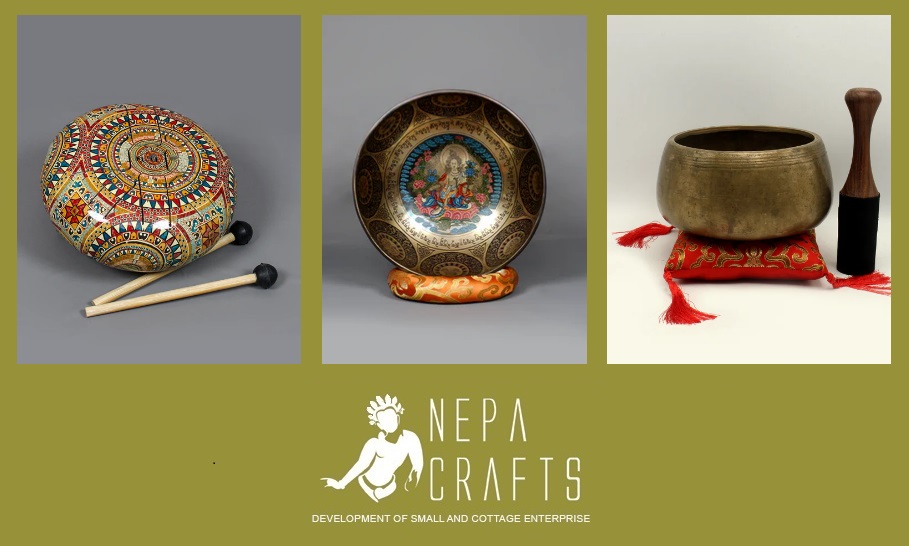
The bowls are routinely called Tibetan singing bowls in popular usage, but the most significant center of their historical production was almost certainly the Kathmandu Valley of Nepal, and specifically the metalworking communities of Patan and Bhaktapur where the Newar people developed bronze and copper casting traditions of extraordinary sophistication over many centuries. Tibetan traders and monasteries were among the primary customers for these Nepalese-made instruments, which is likely how the Tibetan association became so dominant in popular understanding.
The Newar Metalworking Heritage
The Newar people of the Kathmandu Valley were, and remain, among the most accomplished metalworkers in all of Asia. Their mastery of lost-wax casting, repoussé work, and alloy composition produced not only singing bowls but the extraordinarily refined sacred statuary that still fills the temples and monasteries of the Himalayan Buddhist world. The same families whose ancestors supplied singing bowls to Tibetan monasteries in the sixteenth and seventeenth centuries are, in many cases, still producing them today, using techniques that have been refined across generations of practice. This continuity of craft tradition is one of the things that distinguishes a genuinely Nepali-made singing bowl from the mass-produced imitations that have flooded global markets as the bowls’ popularity has grown.
Ritual Use in the Monastery and Beyond
Within the Tibetan Buddhist monastic tradition, bowls were used in several distinct ritual contexts. As offering bowls, they held water, grain, flowers, or other substances placed on the altar as symbolic gifts to the awakened beings. As sound instruments, they were struck or rimmed with a wooden or leather-wrapped mallet to produce the sustained tones used in meditation, ceremony, and the marking of ritual time. The deep, complex tone of a large singing bowl struck at the beginning of a meditation session carries that session across a threshold, marking the transition from ordinary time into sacred time with an unmistakable acoustic signal.
Sound as Sacred Technology
The use of sound as a sacred technology is not unique to the Himalayan tradition. Bells, gongs, drums, and singing vessels appear across virtually every contemplative tradition in human history, from the temple bells of Japan to the church bells of medieval Europe to the Tibetan damaru drum made of paired human skulls. What distinguishes the singing bowl within this company is its unusual acoustic profile: unlike a bell, which rings brightly and decays relatively quickly, a singing bowl sustains its tone and, when played with a circling mallet, generates an ongoing sound that can be maintained indefinitely. This sustained, evolving sound, which produces audible overtones and beating frequencies as the bowl’s vibration interacts with the room and the listener’s own body, is what makes the singing bowl particularly suited to meditative use.
From Monastery to the Modern World
The journey of singing bowls from Himalayan monasteries and trade routes into Western living rooms and sound healing studios is largely a story of the twentieth century, specifically of the cultural exchanges that followed the Tibetan diaspora after 1959, when the Chinese occupation of Tibet sent thousands of Tibetan monks, scholars, and practitioners into exile across India, Nepal, and eventually Europe and North America. These practitioners brought their ritual objects with them, and Westerners encountering singing bowls for the first time in the context of Buddhist teachings and meditation instruction found them immediately compelling.
By the 1970s and 1980s, singing bowls had entered the broader Western alternative culture, and by the 1990s the sound healing and wellness industries had embraced them enthusiastically. Today they are produced in Nepal in larger quantities than at any previous point in history, sold worldwide, and used in contexts ranging from traditional Buddhist ritual to hospital-based integrative medicine programs to yoga studios to the living rooms of people who simply find the sound deeply settling.
None of that, interestingly, contradicts their ancient origins. If anything, it confirms something that the Himalayan tradition understood from the beginning: that the right sound, produced by the right object at the right moment, has the capacity to do something that words, images, and ideas cannot quite manage on their own. It can stop the noise, even briefly, and let something quieter and older be heard.