
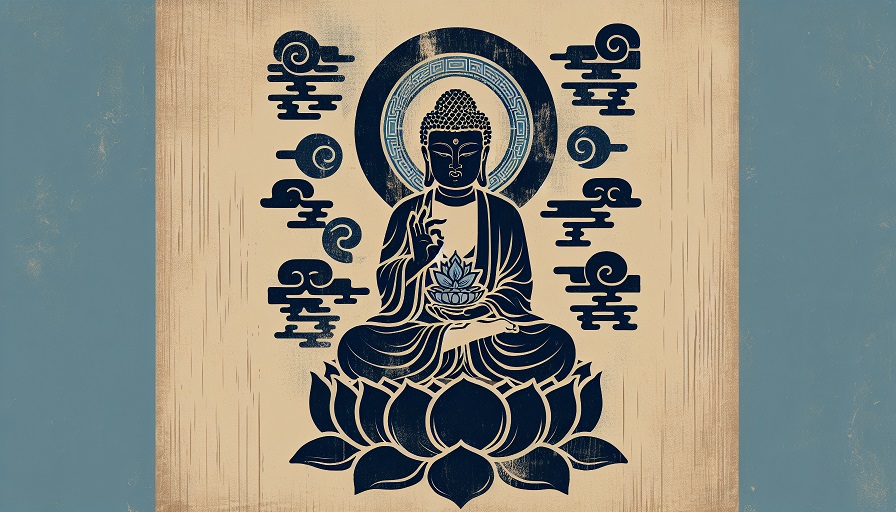
Picture the most vivid blue you have ever seen. Not the pale, washed-out blue of a winter sky, but something deeper and more saturated, the blue of lapis lazuli held up to strong light, the blue of a mountain lake at high altitude on a cloudless afternoon. Now imagine that color as the skin of a serene, seated figure, hands resting with a bowl of healing nectar in the left palm and a sprig of medicinal herb held delicately between the thumb and forefinger of the right. That is the Medicine Buddha, and even in a tradition populated by figures of great beauty and visual power, he stops you.
Known in Sanskrit as Bhaishajyaguru, a name that translates to “Master of Healing” or “Guru of Medicine,” the Medicine Buddha is one of the most beloved and actively practiced figures in all of Tibetan Buddhism. He is not a metaphor for healing or a poetic symbol of wellness. In the Tibetan tradition, he is a fully enlightened being whose compassionate vows specifically address the suffering of illness, whose practice has been passed down in an unbroken lineage for well over a thousand years, and whose deep blue image graces shrine rooms, hospitals, and meditation centers from Kathmandu to California.
The Twelve Vows of Bhaishajyaguru
What makes the Medicine Buddha doctrinally distinctive is the specific nature of his enlightenment vows. In Mahayana Buddhist teaching, a bodhisattva on the path to full Buddhahood makes vows, promises to all beings about how their enlightened activity will manifest. The bodhisattva who became Bhaishajyaguru made twelve vows of extraordinary specificity and ambition, and understanding them goes a long way toward explaining why his practice has resonated so deeply across cultures and centuries.
Vows That Address the Whole Person
The twelve vows cover remarkable territory. The first vow promises that his body will radiate light throughout the universe, dispelling darkness and enabling beings to accomplish whatever they wish. Later vows address the needs of the sick and the hungry, promise to clothe those who lack clothing, and commit to guiding beings away from harmful paths toward ethical ones. Several vows specifically address the liberation of those imprisoned or condemned, the healing of those with physical and mental illness, the provision of nourishment to the starving, and the transformation of beings with distorted views. One vow promises that any woman who suffers because of her female body can be reborn in male form if she wishes. Another promises the fulfillment of material needs so that beings can practice the Dharma without the distraction of desperate poverty.
Taken together, these vows present a vision of healing that is comprehensively holistic. Physical illness, mental suffering, social injustice, material deprivation, and spiritual confusion are all understood as forms of the same underlying wound, and the Medicine Buddha’s compassionate intention addresses all of them. This is not a narrow conception of medicine. It is medicine understood as the total removal of whatever prevents a being from flourishing.
Reading His Image: A Lesson in Symbols
Every element of the Medicine Buddha’s iconographic form has been precisely chosen to communicate something essential about his nature and activity. Once you know the visual vocabulary, looking at a Medicine Buddha statue or Thangka becomes a surprisingly direct encounter with the teaching itself.
The Blue Body
The Medicine Buddha’s deep lapis blue color is not simply an aesthetic choice, though it is certainly a striking one. Lapis lazuli was the most prized pigment in the ancient world, traded across vast distances from the mines of Afghanistan to Egypt, Greece, and Rome. In Tibetan Buddhist iconography, the deep blue of lapis is associated with Akshobhya, the unshakeable Buddha of the east whose wisdom is mirror-like clarity. That same quality of clear, undistorted reflection is central to what the Medicine Buddha represents. His blue body also evokes the sky and the deep ocean, both traditional symbols of vastness, spaciousness, and the quality of mind that is not disturbed by what arises within it. A mind like the deep blue sky does not become the clouds that pass through it. That quality of equanimity, the ability to hold suffering without being overwhelmed by it, is itself a form of medicine.
The Myrobalan Plant
In his right hand, the Medicine Buddha holds a sprig of the arura plant, known in Sanskrit as myrobalan and in Tibetan as arura. This small fruit-bearing plant holds a central place in Tibetan traditional medicine, where it is considered the king of medicinal plants and is said to treat conditions affecting every organ system in the body. Tibetan medical texts describe arura as being useful for everything from digestive disorders to nervous system complaints. In some texts it is said to be the only plant that treats all one hundred and four diseases recognized in the Tibetan medical canon. Holding it in his right hand, the Medicine Buddha is visually identified with the entire healing tradition of Tibetan medicine, which regards him as its ultimate source and inspiration.
The Begging Bowl of Nectar
The lapis-blue begging bowl held in the Medicine Buddha’s left hand contains amrita, the nectar of immortality or deathlessness. In Tibetan Buddhist iconography, amrita is a substance that cures illness, extends life, and ultimately removes the fear of death by providing a direct taste of the deathless nature of awareness itself. The bowl resting in his upturned left palm is offered openly to all beings without discrimination. There is no means test for the Medicine Buddha’s compassion. No one is too ill, too confused, too far gone, or too unworthy to receive what he is holding out.
His Posture and Throne
The Medicine Buddha sits in vajrasana, the full lotus posture of meditative stability, on a throne supported by lapis-blue lions. The lion is a classic symbol of fearlessness and sovereignty in Buddhist iconography, and the blue lions beneath his throne suggest that fearless clarity is the ground of his healing activity. He does not heal from a position of anxious concern but from one of absolute steadiness. The lotus he sits upon, as in all Buddhist iconography, represents purity and the capacity to bloom in clarity regardless of circumstances.
Tibetan Medicine and the Medicine Buddha
The relationship between the Medicine Buddha and the practice of Tibetan medicine is intimate and ancient. The foundational text of Tibetan medicine, the Gyushi or Four Tantras, is presented in the traditional account not as a human composition but as a teaching delivered by the Medicine Buddha himself in a pure realm, with an audience of enlightened physicians and gods. Whether one reads this literally or as a way of expressing the sacred status of medical knowledge, the effect has been profound: Tibetan physicians have traditionally understood their practice as a form of spiritual service, an expression of the Medicine Buddha’s compassionate vows made tangible through their hands and their knowledge.
A Living Medical Tradition
Tibetan medicine, known as Sowa Rigpa or the “science of healing,” is one of the oldest and most comprehensive traditional medical systems still in active practice. It draws on a sophisticated understanding of the humors, the elements, diet, behavioral medicine, herbal treatments, and external therapies. Practitioners diagnose through pulse reading, urine analysis, and detailed questioning about lifestyle and mental state, an approach that would not look out of place in an integrative medicine clinic today. The Medicine Buddha sits at the center of this tradition not as a distant patron but as its living source, invoked at the beginning of medical studies, present in hospital shrines, and called upon in healing rituals performed for patients whose conditions have proven resistant to other treatments.
Medicine Buddha Practice: What It Involves
For practitioners, working with the Medicine Buddha involves a combination of recitation, visualization, and meditation that follows the pattern established in earlier articles about Thangka and deity practice. The core practice typically begins with taking refuge and generating bodhicitta, the wish to achieve awakening for the benefit of all beings. The practitioner then visualizes the Medicine Buddha vividly, using the iconographic details as anchor points, and recites his mantra.
The Mantra
The Medicine Buddha’s mantra is one of the best-known healing mantras in the Tibetan tradition. Rendered in full as Tayata Om Bhaishajye Bhaishajye Maha Bhaishajye Bhaishajye Raja Samudgate Svaha, it is often translated as an invocation of the “great healer, king of healing.” The word bhaishajye appears repeatedly, functioning almost like the rhythm of breathing or a heartbeat in the mantra’s structure. Practitioners typically recite it in multiples of seven, twenty-one, or one hundred and eight repetitions, using a mala string of beads to count. The practice is considered beneficial both for the practitioner and, through visualization, for others who are ill or suffering.
Healing Practice for Others
One of the most moving dimensions of Medicine Buddha practice is that it is routinely performed not for oneself but for others. When someone in a Tibetan community falls seriously ill, relatives and friends will frequently undertake Medicine Buddha practice on their behalf, accumulating recitations and dedicating the merit to the patient’s recovery. Monasteries are commissioned to perform large-scale Medicine Buddha rituals for those facing serious illness or surgery. The sense of collective spiritual action in support of a suffering individual is both culturally distinctive and, for those on the receiving end of it, deeply comforting in a way that transcends doctrinal boundaries.
Why His Image Resonates Beyond Buddhism
It is worth noting how frequently Medicine Buddha statues and Thangkas find homes in spaces that are not specifically Buddhist. Yoga studios, integrative health clinics, hospice facilities, and the private spaces of people who would not describe themselves as practicing Buddhists have all welcomed his blue presence. There is something about the combination of deep, calm color, serene posture, and the universally recognizable gesture of a healing hand that crosses sectarian lines with unusual ease.
Perhaps what draws people is the quality that the Medicine Buddha’s image embodies so completely: the possibility of receiving care without judgment, without conditions, without the exhausting performance of being well enough or worthy enough or grateful enough to deserve help. His bowl is always full. His hand is always extended. The nectar is always being offered. That is a message that requires no translation and no initiation. It speaks, quietly and directly, to the part of every person that has ever been ill, frightened, or in need of something they could not provide for themselves.