
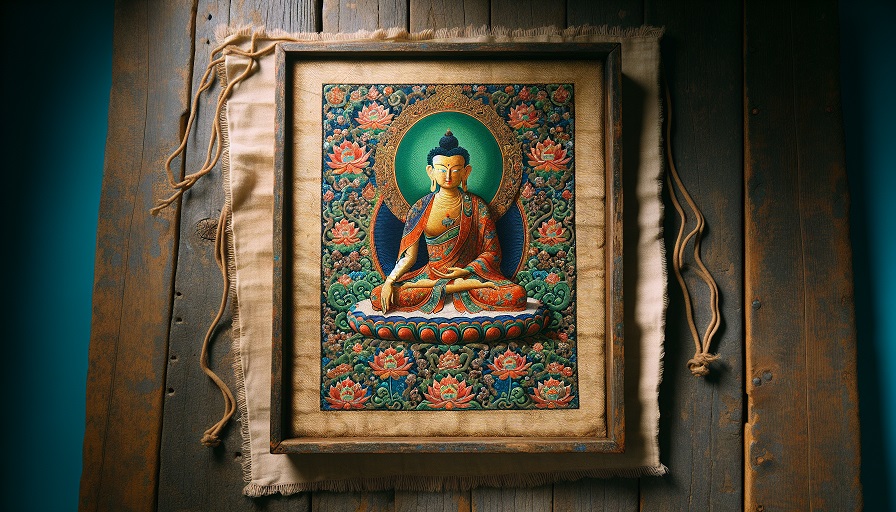
There is a particular kind of humbling that happens when you stand in front of a Tibetan Thangka and realize you are not just looking at a painting. You are looking at a text. Every figure, every color, every hand position, every flower, every cloud formation has been placed with deliberate intention, each one carrying a specific meaning passed down through centuries of Buddhist teaching and artistic tradition. It is a bit like discovering that what you thought was beautiful wallpaper is actually a detailed instruction manual for the universe.
Thangka art is, at its core, a visual form of the Dharma, the teachings of the Buddha. Before widespread literacy reached the Himalayan highlands, and even long after, these paintings served as teaching tools, meditation aids, and sacred maps. A skilled Thangka painter was not simply a craftsperson but a trained theologian who happened to work in lapis lazuli and gold. Understanding even a fraction of that symbolic language transforms the experience of looking at one of these works entirely.
The Architecture of a Thangka Composition
Before getting into individual symbols, it helps to understand how a Thangka is organized as a whole. The composition is never arbitrary. It follows established iconographic grids called thig-tse, proportional systems that determine precisely where every element should be placed, how large each figure should appear, and how the eye should move through the painting.
Size as Spiritual Hierarchy
In Western art, size is often used to create a sense of depth and perspective. In a Thangka, size means something different entirely. The larger a figure appears, the more spiritually significant it is. The central deity dominates the canvas not because it is standing closest to the viewer but because it is, within this symbolic world, the most important being present. Smaller surrounding figures, attendants, offering goddesses, and guardian deities occupy a supporting role both visually and spiritually.
The Three Zones
Many Thangkas are quietly divided into three horizontal registers. The upper portion typically depicts heavenly realms, other Buddhas, or the teachers in a lineage. The middle section holds the primary subject of the painting. The lower portion often shows offerings, protector deities, or earthly scenes. This vertical arrangement maps the cosmos in a single image, placing the viewer simultaneously in contact with heaven, the sacred, and the earth.
The Language of Color
Color in Thangka art is a sophisticated vocabulary, and one of its most immediately striking features. These are not decorative choices made because a particular shade looked pleasing on a Tuesday afternoon. Each major color carries doctrinal weight.
The Five Colors and the Five Buddhas
In Vajrayana Buddhism, the five primary colors each correspond to one of the Five Dhyani Buddhas, a direction on the compass, a specific wisdom, and even a particular human poison that that wisdom transforms. White represents the Buddha Vairocana and the wisdom of the Dharmadhatu, the all-encompassing truth. Yellow corresponds to Ratnasambhava in the south and the wisdom of equality. Red belongs to Amitabha in the west, the discriminating wisdom that sees all things clearly. Green is the color of Amoghasiddhi in the north, the all-accomplishing wisdom. Blue, often the deepest and most otherworldly tone in a Thangka, belongs to Akshobhya in the east, the mirror-like wisdom that reflects reality without distortion.
This means that when you look at a blue figure in a Thangka, you are not just seeing a color preference. You are seeing a theological statement about the nature of mind and perception.
Gold as the Sacred Ground
Gold occupies a special category beyond the five colors. It is used for highlighting, for halos, for ornaments, and sometimes for entire backgrounds in the most precious Thangkas. Gold represents the unconditioned, the luminous nature of enlightened awareness itself. A figure outlined in gold is being marked as radiant with inner light, not metaphorically, but as a literal statement about their spiritual nature.
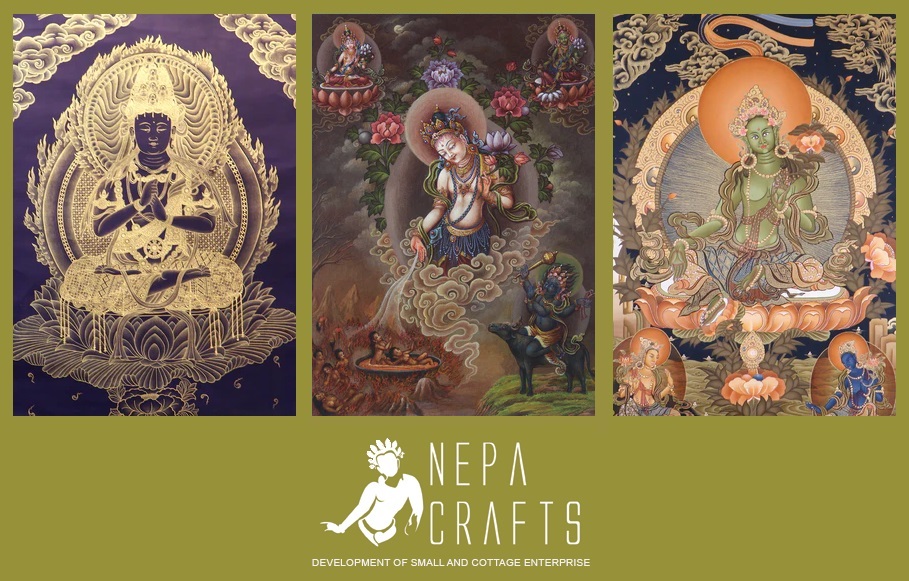
Mudras: The Eloquent Hands
If you spend any time looking at Thangkas, you will notice that the hands of every figure are always doing something specific. These hand positions are called mudras, and they function as a precise sign language, instantly communicating something essential about the figure depicted.
The Most Common Mudras
The earth-touching gesture, in which the right hand reaches down to touch the ground with fingers extended, recalls the pivotal moment when Shakyamuni Buddha called the earth itself to witness his enlightenment under the Bodhi tree. It is one of the most recognizable gestures in all of Buddhist art. The meditation mudra, both hands resting in the lap with palms upward, one atop the other, indicates deep contemplative absorption. The teaching mudra, with one or both hands held at chest height, thumb and forefinger touching to form a circle, signals that this figure is actively turning the Wheel of Dharma, sharing wisdom with the world. The gift-giving mudra, the hand extended outward with palm up and fingers pointing down, represents boundless generosity. It is the hand of a being who holds nothing back.
Symbolic Objects and Their Meanings
The objects held or displayed by figures in a Thangka are as carefully chosen as every other element. They are attributes, identifying markers that tell an informed viewer exactly which deity or bodhisattva they are looking at, and what that being represents.
The Lotus
The lotus flower is perhaps the most universal symbol in all of Buddhist art. It grows from mud, pushes through water, and blooms in the open air, untouched by the murk from which it came. This makes it a perfect image for the Buddha-nature present in every being: the capacity for awakening that exists even within the heaviest conditions of suffering and confusion. A figure seated on a lotus throne is being shown as one who has fully realized that nature.
The Sword, the Thunderbolt, and the Bell
The sword, particularly associated with Manjushri, the bodhisattva of wisdom, represents the cutting of ignorance. It is not a weapon of violence but a blade of discernment that severs the root of confusion. The vajra, or thunderbolt scepter, held in many Tantric deity depictions, represents indestructible reality, the diamond-like quality of enlightened mind. Its counterpart is the bell, which represents wisdom and emptiness. When a figure holds both vajra and bell, it is communicating the union of compassion and wisdom, the two wings of awakening.
The Wheel of Dharma
The eight-spoked wheel that appears throughout Buddhist art, including in Thangka compositions, represents the Buddha’s teachings themselves. The eight spokes correspond to the Eightfold Path. When a deity holds a Dharma wheel, it marks them as a great teacher, one whose purpose is to keep the wheel of truth turning in the world.
The Wheel of Life: A Thangka Unto Itself
One of the most complex and fascinating Thangka compositions is the Bhavachakra, the Wheel of Life. Held in the claws of Yama, the lord of death, this wheel is a complete diagram of cyclic existence. Its inner hub shows three animals chasing each other’s tails: a pig representing ignorance, a snake representing hatred, and a bird representing desire. These are the three poisons driving the entire wheel. The outer ring depicts the twelve links of dependent origination, the chain of cause and effect that perpetuates suffering. The six realms depicted in the spokes, from the realm of the gods down to the hell realms, represent the conditions that beings cycle through based on their actions and intentions.
It sounds heavy, but Tibetan teachers are quick to point out the small Buddha figure appearing in each of the six realms, pointing the way out. No situation is hopeless. That is the real message of the Wheel of Life.
Why Any of This Matters
You might wonder whether knowing all this changes the experience of looking at a Thangka, or whether it is just art-history trivia. The honest answer is that it changes everything. A Thangka without its symbolic layer is like listening to a symphony without hearing the melody. The colors, gestures, figures, and objects are not decorative additions to an underlying religious object. They are the teaching itself, encoded in pigment and gold for those willing to learn its alphabet.
Even a partial understanding of that language opens up a kind of conversation across centuries and cultures, a moment of genuine connection with the artists, scholars, and practitioners who built this tradition one careful brushstroke at a time.