
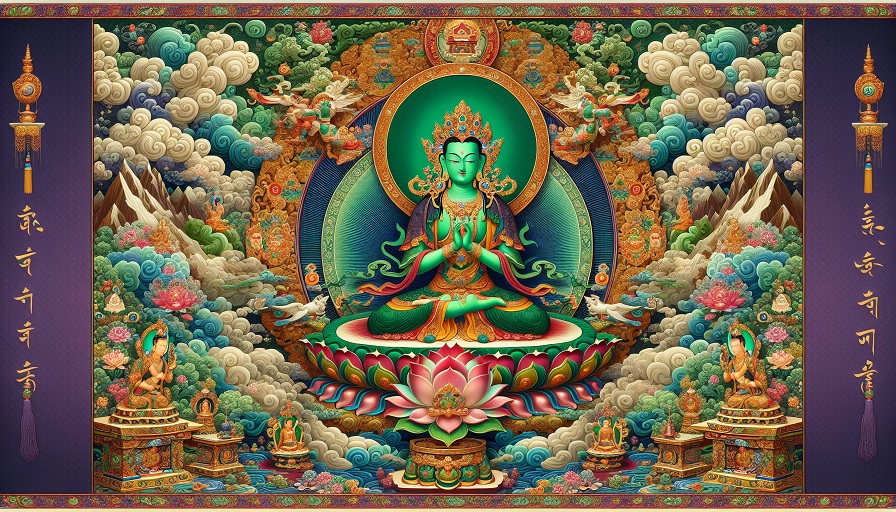
Imagine walking into a Tibetan monastery somewhere in the high Himalayas. Butter lamps flicker. The air smells of juniper incense. And hanging on nearly every wall, vivid and luminous against the stone, are paintings unlike anything you have seen in a Western art gallery. The figures are precise, almost jewel-like in their detail. The colors feel impossibly rich. And yet there is something about them that goes beyond decoration. These are Thangkas, and they are not just art. They are a language.
Whether you have encountered one in a museum, a meditation center, or a Himalayan craft shop, a Thangka has a way of stopping you in your tracks. The word itself (pronounced “tong-kah”) comes from the Tibetan, roughly meaning “recorded message” or “thing one unrolls.” That practical description, however, barely scratches the surface of what these works truly are.
A Thousand Years in the Making
Thangka painting as a distinct tradition is believed to have developed in Tibet around the 11th century, though it drew on artistic influences flowing in from India, Nepal, and China. Buddhist missionaries and traders carried both religious teachings and visual conventions across the Himalayas, and Tibetan artists synthesized these into something entirely their own.
Portable Temples
One of the most important things to understand about Thangkas is why they were made scroll-style in the first place. Tibet is a land of nomadic movement. Monks, traders, and pilgrims traveled enormous distances across harsh terrain. A heavy stone carving or a fixed wall mural could not come with you. A Thangka could. It rolled up neatly, traveled in a pack, and could be unrolled and hung in any tent, cave, or way-station to create an instant sacred space. Think of it as a portable temple that fit in a saddlebag.
Who Made Them?
Traditionally, Thangkas were painted almost exclusively by monks or highly trained lay artists working within a strict religious framework. Before picking up a brush, a painter was expected to pray, purify themselves, and approach the work as a spiritual practice rather than a creative project. The artist was not expressing personal feeling; they were, in a sense, channeling something beyond themselves. Even today, the finest Thangka painters in Nepal and Tibet follow meditative preparatory rituals before beginning a new work.
What Goes into a Thangka?
A Thangka is built from the canvas out, and every material choice carries meaning.
The Canvas and Ground
The base is typically cotton or linen cloth, stretched across a frame and coated with a mixture of chalk and animal-hide glue. Once dry, this surface is polished smooth with a stone to create the tight, even ground that allows fine detail work. Some very fine Thangkas are painted on silk.
Natural Pigments and Gold
Traditional Thangka pigments came from minerals and organic sources: lapis lazuli for deep blues, malachite for greens, cinnabar for reds, gold leaf and gold paint for the luminous highlights that seem to glow from within. These natural pigments are why antique Thangkas, even centuries old, still carry such astonishing vibrancy. Modern Thangkas often use mineral pigments mixed with a binding agent, maintaining the traditional palette while remaining more accessible to contemporary artists.
The Silk Brocade Border
A finished Thangka painting is typically mounted in a frame of silk or cotton brocade fabric, usually in a combination of red and yellow (colors associated with auspiciousness) or other traditional combinations. Wooden dowels are attached at the top and bottom so the piece can be hung and, when needed, rolled for storage. This mounting is not purely practical; it frames the sacred image the way an altar frames a candle.
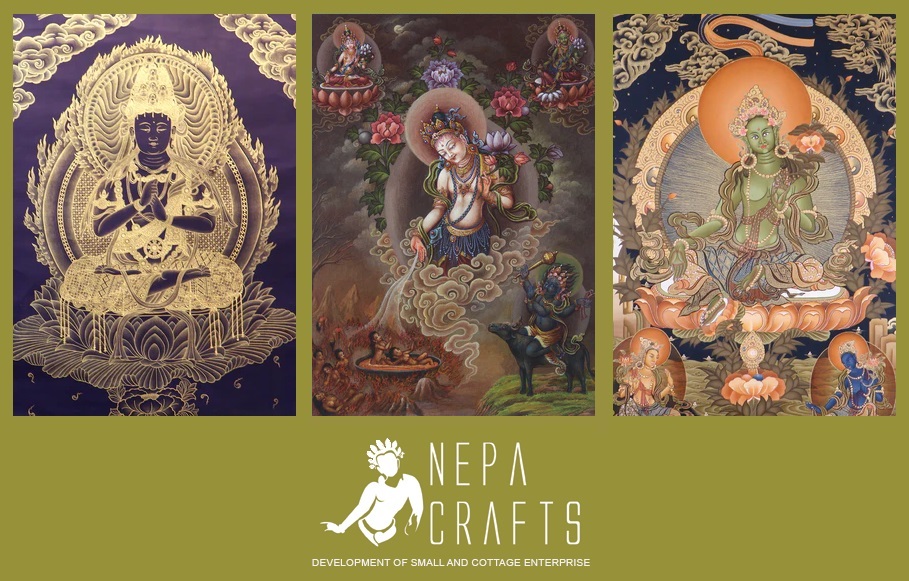
Reading a Thangka: Symbols and Figures
Standing before a Thangka for the first time, a newcomer might feel a little like someone handed a book in an alphabet they have never seen. The figures are striking, but what does it all mean?
The Central Deity
Nearly every Thangka is organized around a central figure, almost always a Buddha, Bodhisattva, or deity. The size of a figure on the canvas is directly related to its spiritual importance, not to any sense of visual perspective. The principal figure is always the largest. Surrounding figures, offerings, and landscapes exist to provide context, narrative, or symbolic support.
Hand Gestures and Attributes
In Tibetan Buddhist art, hand positions (called mudras) are a precise vocabulary. The hand held palm-outward with fingers pointing down is the gesture of generosity. Both hands in the lap, one resting on the other, represent meditation. A hand touching the earth recalls the moment the Buddha called the earth to witness his enlightenment. Each object held by a deity also carries meaning: a lotus for purity, a sword for the cutting of ignorance, a begging bowl for renunciation.
The Mandala Thangka
One particularly fascinating category is the mandala Thangka, in which the entire composition becomes a geometric cosmological map. A mandala represents the enlightened mind of a particular deity, arranged as a palace with four gates, concentric rings of symbolic meaning, and the deity enthroned at the center. These are used as aids in complex visualization meditations, and the precision required to paint one correctly is extraordinary.
Thangkas as Living Spiritual Objects
A Thangka is not considered fully complete simply when the paint dries. In traditional practice, a finished Thangka is brought to a lama (a qualified Buddhist teacher) for consecration. Prayers are recited, mantras are written on the back of the canvas, and the object is formally blessed. At this point, it transitions from a painting into a sacred object, believed to carry genuine spiritual potency.
This is why many Tibetan families treat their Thangkas with the same reverence they would extend to a shrine. They are not hung for decoration; they are hung for practice. A practitioner might spend time each day in front of a Thangka, using the image as a focal point for meditation or prayer.
Bringing a Thangka into Your Home
You do not need to be a Buddhist to find meaning or beauty in a Thangka. Many people are drawn to them for their extraordinary craftsmanship, their visual depth, or the feeling of calm that seems to radiate from a well-painted piece. That said, if you choose to bring one into your home, a little respect for its origins goes a long way. Displaying a Thangka thoughtfully, perhaps in a meditation space or a place where it can be properly seen rather than shoved between bookshelves, honors the tradition it comes from.
For those interested in the intersection of art, culture, and spirituality, a genuine handmade Thangka is one of the most remarkable objects the Himalayan world has produced. It is a window, a map, a teacher, and a work of art, all rolled up in one.